

MQL vs MQA: The Real Cost
of the Metric War
The independent analysis that ABM vendors (who want to kill MQLs) won’t give you
Why this report exists
I didn't set out to write a report on MQLs vs MQAs.
I'm a CRO (turned internal ‘founder’??) building a paid media optimization platform. Over the past few months, I've been having 3-4 conversations a week with demand gen leaders trying to understand who our platform is best suited for and what they actually care about.
A pattern kept showing up. Almost every enterprise marketer said some version of the same thing: *"We're trying to move from MQLs to MQAs."* They said it like MQLs were the disease and MQAs were the cure.
But the companies furthest along in their MQA journey didn't seem to have better answers about what was actually working. They had fancier dashboards and bigger platform contracts. When I asked which campaigns were creating pipeline, they didn’t know.
So I spent last week doing deep research: Forrester, Reddit threads, LinkedIn debates, practitioner blogs, vendor whitepapers, podcast transcripts, industry surveys to understand what's actually happening.
What I found surprised me. The MQL isn't dead. The MQA isn't the cure. The whole debate is more complicated and more vendor-influenced than the industry discourse would have you believe. And the right answer depends entirely on who you sell to, how they buy, and what your go-to-market motion demands.
This report is the result of that research. I'm sharing it because I think it'll be useful to anyone navigating the same question.
A note on independence: I don't sell an ABM platform. I don't sell marketing automation. I have no commercial interest in whether you run MQLs, MQAs, or both. That's exactly why I could write this honestly. This report just follows the evidence
Key findings at a glance
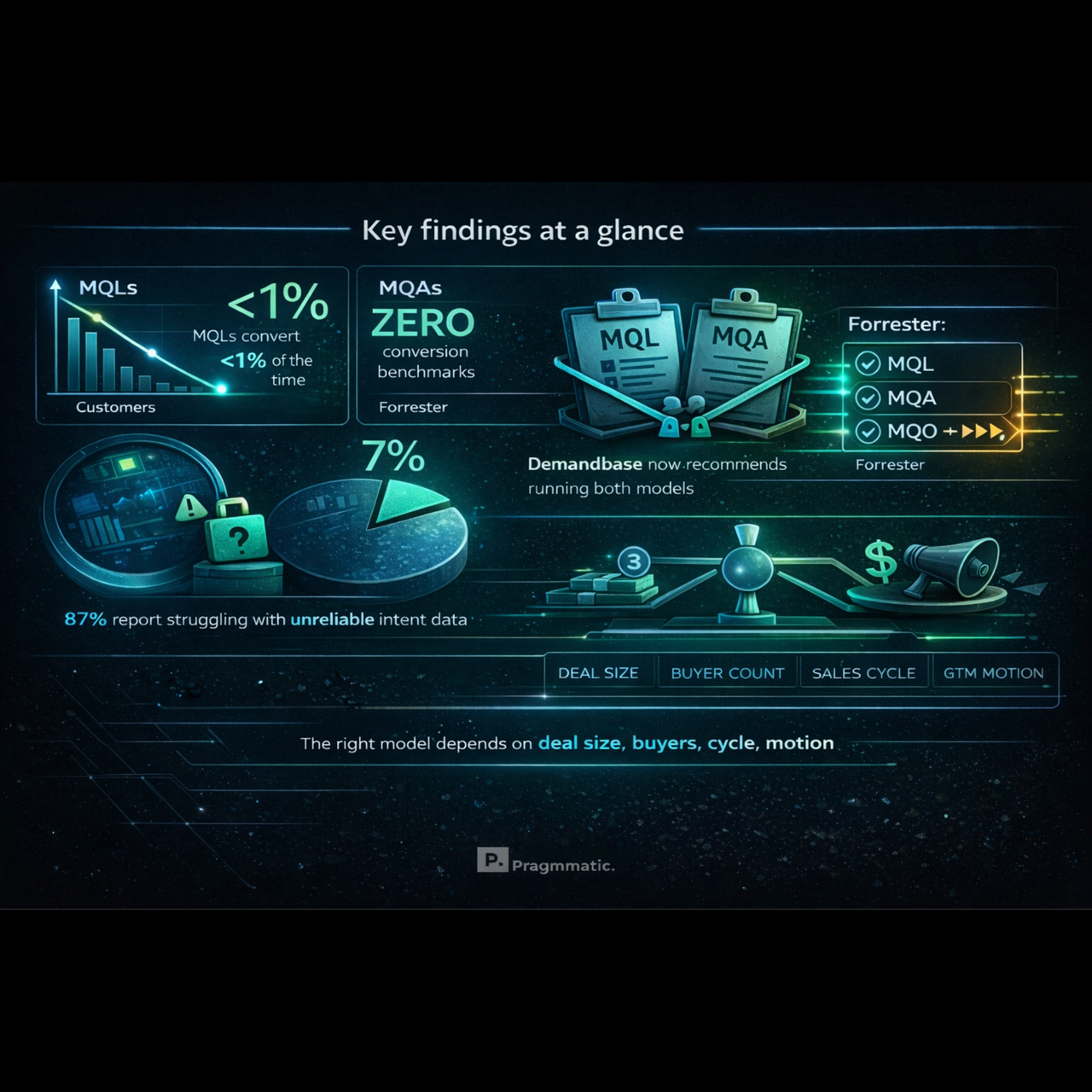
MQLs convert to customers less than 1% of the time, but MQAs have zero published conversion benchmarks to prove they're better.
87% of B2B teams report struggling with unreliable intent data, the foundation MQA scoring is built on
Only 7% of demand gen teams track MQAs as their primary success metric, despite the industry narrative
Demandbase, the company most associated with MQA, now recommends running both models simultaneously
Forrester says both MQL and MQA are insufficient and recommends a third model entirely (MQO)
The right model depends on four variables: deal size, buyer count, sales cycle length, and GTM motion
The "MQL is dead" narrative has been substantially amplified by vendors whose revenue depends on selling the replacement
Key findings at a glance
MQLs convert to customers less than 1% of the time, but MQAs have zero published conversion benchmarks to prove they're better.
87% of B2B teams report struggling with unreliable intent data, the foundation MQA scoring is built on
Only 7% of demand gen teams track MQAs as their primary success metric, despite the industry narrative
Demandbase, the company most associated with MQA, now recommends running both models simultaneously
Forrester says both MQL and MQA are insufficient and recommends a third model entirely (MQO)
The right model depends on four variables: deal size, buyer count, sales cycle length, and GTM motion
The "MQL is dead" narrative has been substantially amplified by vendors whose revenue depends on selling the replacement
About this report

Research & Report by Zeb Couch
Sources include: Forrester Revenue Process Alignment Series (Parts 1-4), 6sense Anti-MQL Manifesto, 6sense 2025 State of B2B Marketing Metrics, Demandbase MQA vs MQL blog, HockeyStack analysis of $100M+ B2B ad spend, Gartner CMO Spend Survey, MarketingProfs (Jon Miller predictions), Demand Loops Substack (Kaylee Edmondson), MarketingOps.com, RevenueTools, The B2B Stack, CaliberMind, LeanData buying group statistics, Corporate Visions B2B buying behavior data, and 50+ additional practitioner sources