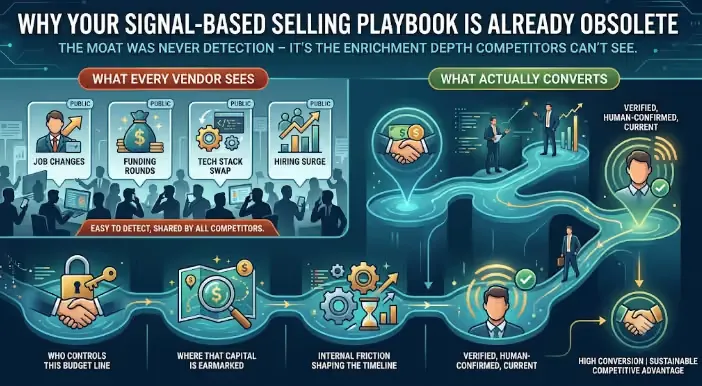
There’s a structural problem with competing for visibly in-market accounts: everyone can see them. When an account surges in a widely used research-based intent feed, every vendor subscribing to that feed gets the same alert in the same week. The “advantage” of intent data becomes a starting gun for a pile-on.
The durable advantage isn’t seeing in-market accounts faster. It’s seeing accounts before they’re obviously in-market — when the need is forming, the shortlist doesn’t exist, and the first credible vendor in the room gets to shape the evaluation.
Why early engagement wins disproportionately
B2B buyers do most of their journey before talking to sales, and the vendors who influence the early, problem-definition phase enjoy compounding advantages: they frame the requirements, they become the benchmark other vendors are compared against, and they build champion relationships before procurement formalizes anything.
Arriving at the shortlist stage means competing on a playing field someone else leveled.
The signals that precede research
Companies telegraph future purchases before anyone starts comparison-shopping. The signals live outside content consumption:
- Hiring: the executive who will own the purchase gets hired before the purchase happens. A new VP of Finance precedes the finance-software evaluation.
- Funding: a fresh raise creates budget and a mandate to build — with predictable purchasing patterns by category.
- News and events: expansions, launches, and strategic shifts create needs months before those needs become search queries.
- Technographic change: new adoptions create integration needs; aging stacks create replacement cycles.
- Adjacent demand: an account buying around your category — the batteries to your charger — is forming a need for you, even if it has never researched you.
Individually, each is a hint. Corroborated, they’re a forecast.
How predictive intent operationalizes this
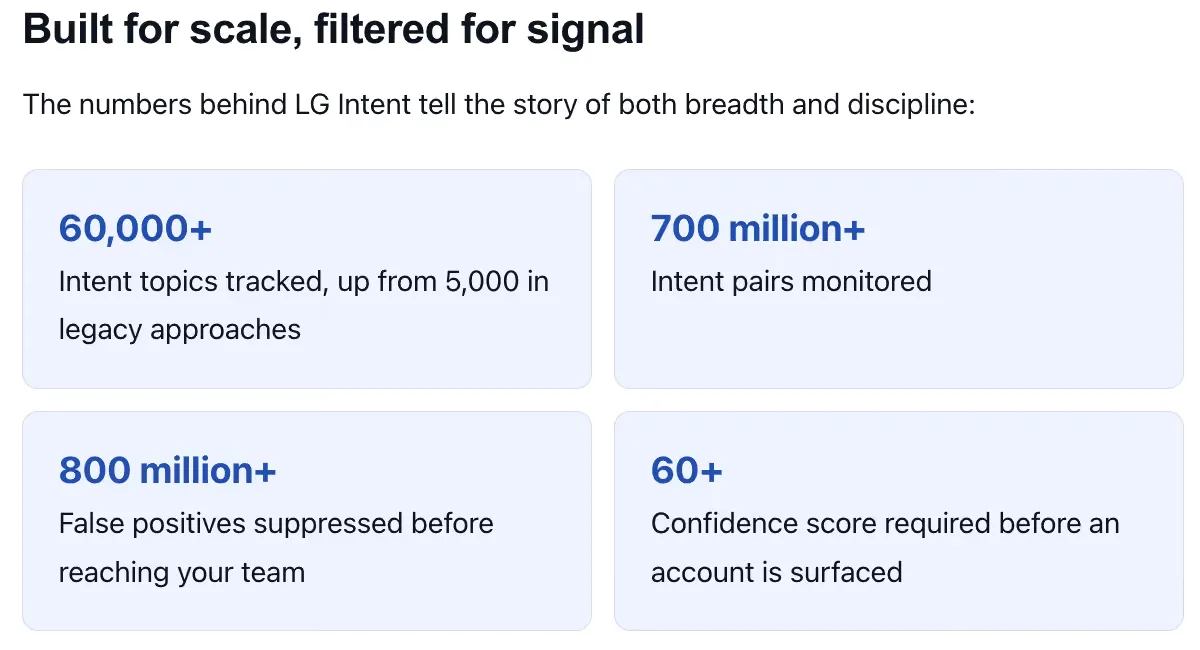
LG Intent, LeadGenius’s predictive intent solution, was built to catch exactly this earlier stage. It combines research activity across 60,000+ topics with the predictive signal families above, scores each account with boosters and detractors, and suppresses false positives so only accounts clearing a 60+ confidence threshold reach your team.
The coverage difference is dramatic. In one internal analysis of a single topic, a research-based feed surfaced 31 companies while the predictive feed surfaced 574 — with limited overlap. Those hundreds of additional accounts are the early-stage market: companies showing credible signs of emerging need that a research-only feed can’t see yet. That’s your whitespace, and for accounts currently buying from competitors, it’s your window to steal share before renewal conversations begin.
Running an earlier-stage motion
Early-stage accounts need a different play than in-market ones. Skip the demo pitch. Lead with the signal’s context — the hire, the raise, the expansion — and offer point-of-view content that helps them define the problem. Use lighter-touch nurture and targeted air cover to build familiarity, and let LG Intent’s weekly refresh tell you when the account’s behavior shifts toward active evaluation. When it does, you’re not introducing yourself. You’re continuing a conversation.
Capture demand and create it
None of this replaces demand capture — accounts researching now still deserve immediate attention. The point is sequencing: teams that engage the emerging market while competitors fight over the visible one build pipeline that compounds quarter after quarter.