If you already use a traditional intent provider, or you're evaluating options, the honest answer is that this usually isn't a rip-and-replace decision. Traditional publisher-network intent and predictive intent are built differently, see different things, and often work best together. Here's a straight comparison so you can decide what your motion needs.
The core difference in one paragraph
Traditional intent providers are strongest at surfacing accounts that are actively researching now, based on content consumption across large B2B publisher networks. LG Intent from LeadGenius expands that view by combining research activity with predictive signals, hiring, funding, news, technographics, and contextual topics, that indicate a company is entering a buying cycle, and by applying AI suppression so only verified, logical signals reach your team.
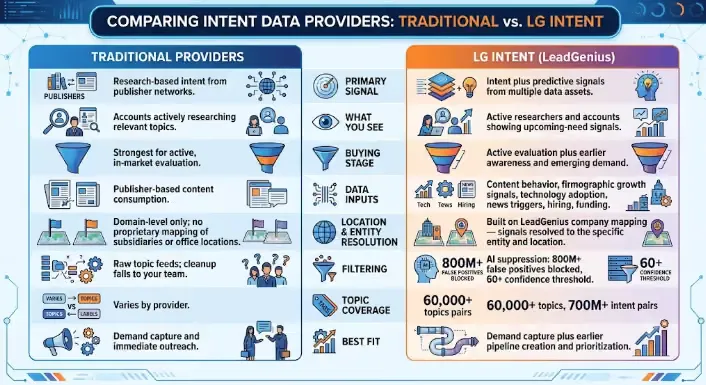
Side by side
| Category | Traditional providers | LG Intent |
|---|---|---|
| Primary signal | Research-based intent from publisher networks | Intent plus predictive signals from multiple data assets |
| What you see | Accounts actively researching relevant topics | Active researchers and accounts showing upcoming-need signals |
| Buying stage | Strongest for active, in-market evaluation | Active evaluation plus earlier awareness and emerging demand |
| Data inputs | Publisher-based content consumption | Content behavior, firmographic growth signals, technology adoption, news triggers, hiring, funding |
| Location & entity resolution | Domain-level only; no proprietary mapping of subsidiaries or office locations | Built on LeadGenius company mapping — signals resolved to the specific entity and location |
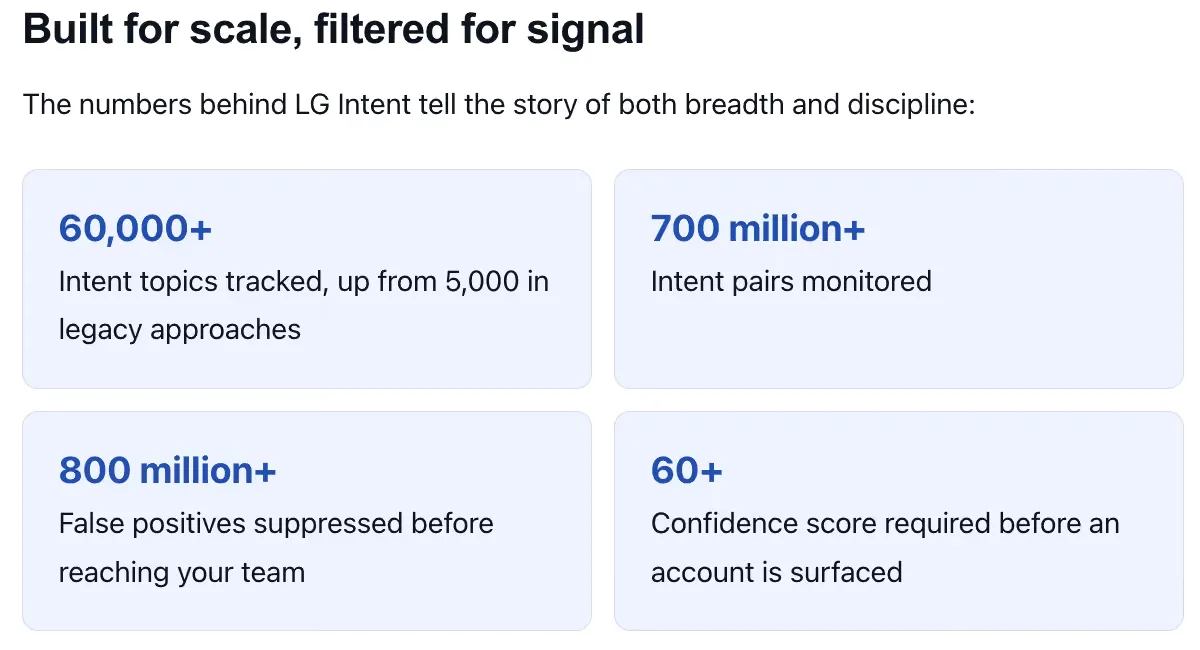
| Filtering | Raw topic feeds; cleanup falls to your team | AI suppression: 800M+ false positives blocked, 60+ confidence threshold |
| Topic coverage | Varies by provider | 60,000+ topics, 700M+ intent pairs |
| Best fit | Demand capture and immediate outreach | Demand capture plus earlier pipeline creation and prioritization |
The differentiator most comparisons miss: location-specific technographics, backed by company mapping
Most head-to-head write-ups stop at signal type and volume. The deeper difference is resolution. Traditional publisher-network intent providers report a surge at the domain level and stop there; they have no proprietary system for identifying which subsidiary, brand, or physical office actually produced that signal, or what technology that specific location already runs.
LG Intent is built on top of LeadGenius's core company-mapping data: verified parent-subsidiary hierarchies, brand structures, and office-level firmographics and technographics. That means:
- Location-specific technographic matching. Intent signals are checked against what the specific business unit or site already owns, not what the global parent happens to run somewhere else. A 40,000-employee company with 200 semi-autonomous subsidiaries doesn't get treated as one undifferentiated account.
- Entity-accurate targeting. Every surfaced signal is resolved to the correct legal entity or location before it reaches your team, so outreach lands on the office that's actually in-market instead of a misattributed HQ.
This is the scenario domain-level tools consistently get wrong: a global enterprise where one division already owns a competitor's product while a different division down the hall doesn't. Publisher-network intent sees one domain and one surge. LG Intent sees the org chart underneath it.
What traditional providers do well
Credit where due: when an account surges on a publisher network, that's a meaningful signal of active evaluation. If your motion is pure demand capture, calling accounts that are researching today, a research-based feed does that job.
The tradeoffs are timing and noise. In-market accounts are visible to every vendor watching the same feed, and raw feeds include installed-base accounts, poor-fit companies, and unvalidated one-off spikes that your team has to filter manually.
What LG Intent does differently
- Sees earlier. Predictive signals (a funding round, a key hire, an expansion announcement) often precede research surges by weeks or months.
- Filters automatically. Technographic matches (they already own it) and illogical intent (a 3-person company "evaluating" enterprise software) are suppressed before your reps ever see them.
- Scores holistically. Boosters and detractors across the account's whole ecosystem roll into one confidence score, and only 60+ accounts surface.
They don't find the same companies
Because the inputs differ, the outputs differ. In one internal example built on a single topic, a traditional publisher-network feed returned 31 companies while LG Intent surfaced 574, with limited overlap. Neither list is "wrong"; they're seeing different parts of the market. That's precisely why many teams run both.
When to use which
- Prioritize accounts researching right now: traditional feed works
- Build earlier-stage pipeline: LG Intent
- ABM with broader coverage: both
- Sharper lead scoring: both
- Whitespace and competitive steal-share: LG Intent, because it reveals accounts before they're obviously in-market
Bottom line
Choose a traditional provider for a strong active-research signal. Choose LG Intent when you want that same class of signal plus the leading indicators, minus the false positives. Choose both when you want the fullest view of account readiness from first signal to active evaluation.
See the accounts your current feed is missing. Request an LG Intent demo from LeadGenius.
Talk to a strategist