In March 2025, the B2B data world lit up with reports that LinkedIn had removed the company pages of Apollo.io and Seamless.AI. The immediate interpretation was dramatic: LinkedIn had picked two high-profile data vendors, punished them for browser-extension scraping, and warned the rest of the industry that it was next.
A year later, the picture is more complicated and more useful.
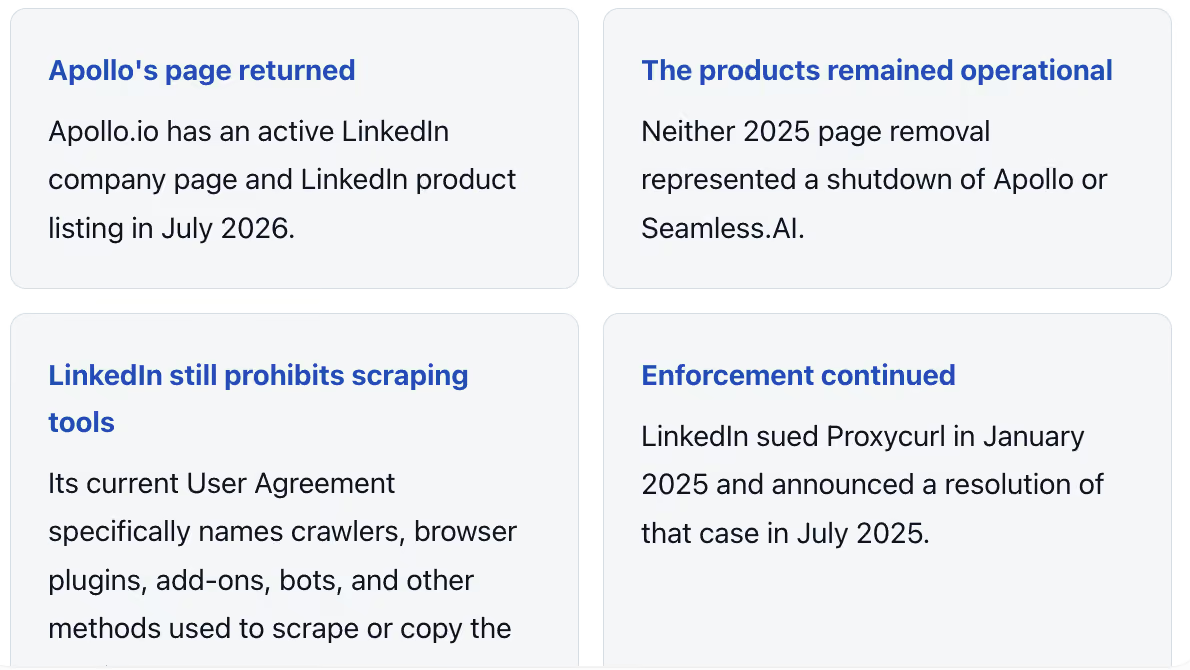
Apollo's LinkedIn company page is live as of July 2026, with current posts, employees, and product information. Apollo also continues to offer a Chrome extension and says it works across LinkedIn, Gmail, Salesforce, HubSpot, and other sites. Seamless.AI remains operational and still has an official LinkedIn product listing, even though a current official Seamless.AI company page was not readily discoverable in public search.
None of that means LinkedIn has softened its position. It means a missing company page is not enough evidence to explain exactly what happened, why it happened, or what a vendor's current data practices are.
What can we confirm?
What LinkedIn's current rules actually say
LinkedIn's User Agreement, effective November 3, 2025, prohibits users from developing, supporting, or using software, scripts, robots, crawlers, browser plugins, add-ons, or other technology to scrape or copy LinkedIn profiles and data. It also prohibits bypassing access controls, using unauthorized automation, and overlaying or modifying the service.
LinkedIn's help guidance on prohibited software and extensions makes the distinction clearer: the problem is not the mere existence of a browser extension. The problem is an extension that scrapes, changes LinkedIn's appearance, or automates activity without authorization.
That distinction matters because several established GTM vendors still offer browser extensions. An extension can display data already held by a provider, initiate a permitted workflow, or interact with another system. Its presence alone does not prove that it scrapes LinkedIn. Revenue teams need to understand what the extension actually does, what it reads, where the returned data came from, and what permissions support the workflow.
Why enforcement still matters
LinkedIn has repeatedly shown that the User Agreement is not decorative language.
- In 2022, LinkedIn resolved its case against hiQ with a permanent injunction preventing hiQ from scraping LinkedIn.
- LinkedIn also announced a 2022 resolution requiring Mantheos to delete scraped member data and destroy the software used to collect it.
- In January 2025, LinkedIn filed proceedings against Proxycurl over alleged scraping and fake accounts.
- In July 2025, LinkedIn announced that it had resolved the Proxycurl lawsuit.
- European regulators have separately scrutinized B2B contact collection. The French CNIL's KASPR action focused on lawful processing, transparency, retention, access rights, and collection of data that users had limited.
The legal lesson from hiQ is also more nuanced than the usual headline that "scraping public data is legal." The Ninth Circuit limited one theory under the federal Computer Fraud and Abuse Act for publicly accessible information. LinkedIn still prevailed on contractual grounds, and hiQ ultimately accepted a permanent injunction. Public visibility is not the same thing as unrestricted contractual, privacy, or commercial permission.
Was this simply Microsoft protecting Sales Navigator revenue?
It is reasonable to observe that LinkedIn has a commercial interest in protecting Sales Navigator, Recruiter, its APIs, and the value of its professional graph. It is not responsible to present revenue protection as the confirmed reason for a specific enforcement action unless LinkedIn says so or evidence establishes it.
The documented explanation is member privacy, platform integrity, contractual control, and prevention of unauthorized scraping. Commercial incentives may reinforce that posture, but they remain an inference.
What about Apollo, Seamless, ZoomInfo, Clay, and other vendors?
The old version tried to divide the market into clean categories: Apollo and Seamless scraped, ZoomInfo played by different rules, and Clay was merely a workflow tool. The modern data ecosystem is not that simple.
| Vendor type | What buyers should examine | Core risk |
|---|---|---|
| Large contact databases | Contributory networks, public-web collection, licensing, verification, extension behavior, and opt-out handling | A clean interface can hide mixed provenance underneath individual fields |
| Enrichment and workflow platforms | Which downstream providers supply data and whether users can connect unsupported scraping tools | The workflow layer can inherit the sourcing risk of every connected vendor |
| Browser-extension prospecting tools | Whether the extension reads or modifies LinkedIn, automates actions, or merely displays pre-existing provider data | User accounts and workflows may depend on behavior LinkedIn can restrict |
| Custom data providers | Source documentation, collection rights, field-level provenance, refresh logic, quality assurance, and regional compliance | "Custom" is only safer when the methodology is documented and governed |
Clay remains primarily a data orchestration and enrichment environment, but the compliance profile of a Clay workflow depends on the sources and agents connected to it. ZoomInfo, Apollo, Seamless.AI, Lusha, LeadIQ, SalesIntel, and other platforms each use different combinations of databases, web research, contributors, licensed sources, user inputs, and extensions. A brand-level label is not enough. The relevant unit of diligence is the source, field, workflow, and permitted use.
The real strategic risk: rented access
The most important lesson from 2025 was never that two company pages disappeared. It was that a large portion of the B2B data ecosystem is built on rented access.
If a vendor's coverage, freshness, or workflow depends heavily on another platform, the platform can change its controls, detection, pricing, permissions, or legal posture. Your provider may remain online while the part of the product your team relies on becomes less reliable overnight.
This is why data provenance is becoming a revenue-operations issue, not merely a legal checkbox. Source instability can create:
- Sudden drops in match rates or contact coverage
- Stale titles, employment records, and account assignments
- Broken enrichment or prospecting workflows
- Account restrictions for sellers using unsupported automation
- Compliance questions that cannot be answered at the field level
- Pipeline models built on signals that disappear without warning
What sales, marketing, and RevOps leaders should do
1. Ask for field-level provenance
"We use public sources" is not enough. Ask where names, titles, emails, phones, technologies, and signals originate; how they are verified; which sources are licensed; and which rights govern customer use.
2. Audit browser-extension behavior
Determine whether an extension simply retrieves provider-held data or reads, copies, overlays, modifies, or automates activity on LinkedIn. Ask whether seller accounts could be restricted for using it.
3. Test source concentration
Ask what percentage of coverage or freshness depends on a single platform. A diversified sourcing model is more resilient than a product whose apparent scale rests on one revocable source.
4. Prioritize permission, transparency, and suppression
Review lawful basis, privacy notices, opt-out processes, retention, do-not-call suppression, customer controls, and regional requirements. "Public" does not eliminate these obligations.
5. Move beyond static profile replication
Job titles and employer names are now commodity inputs. Durable GTM advantage comes from custom account signals, verified buying committees, onsite technologies, hiring trends, expansion, product launches, funding, ownership changes, and other context connected to a specific go-to-market motion.
The LeadGenius view: the future is custom and source-resilient
LeadGenius does not build its offering around scraping logged-in LinkedIn profiles. We create custom account and contact datasets from public web sources, permitted source relationships, AI-assisted research, and human-in-the-loop verification. We can also document the evidence and methodology supporting delivered fields.
More importantly, the future of B2B data is not a cheaper copy of a professional network. It is bespoke intelligence built around the questions your revenue team actually needs answered:
- Which companies truly fit our market?
- Which locations, subsidiaries, or business units matter?
- What changed at the account?
- Which technologies, hiring patterns, and growth signals create relevance?
- Who belongs in the buying committee?
- Can we activate the audience compliantly across regions and channels?
That is a more defensible data strategy because its value does not come from replicating one platform at scale. It comes from assembling the right evidence for a specific commercial decision.
The bottom line
The 2025 Apollo and Seamless page removals were a warning, but not quite the warning many people thought.
Apollo's page returned. The companies did not disappear. Browser extensions did not vanish. What remains is the structural conflict between platforms that want to control their data and vendors or users who want to extract value from it.
The winners will not simply be the vendors that avoid the next public takedown. They will be the revenue teams that know where their data came from, what rights support its use, how resilient the supply chain is, and how to turn custom signals into pipeline without depending on one rented source.
The question is no longer, "Who will LinkedIn ban next?"
The better question is, "Would our GTM strategy still work if one of our biggest data sources disappeared tomorrow?"
.avif)