
Intent data has left a lot of people with a bad taste in their mouths.
Not because the idea is wrong. The idea is great: spot the companies that are getting ready to buy, and talk to them first. The problem is what happens on a Tuesday morning when a rep gets a “surging account” alert and asks three fair questions.
Most of the time, nobody can answer. The score went up. That’s it. That’s the whole story.
So the rep either ignores the alert, or sends a vague “noticed you might be exploring…” email that the buyer can smell from a mile away. Neither one builds pipeline. And after a few rounds of that, the team stops believing the data at all.
Let’s break down why this happens, using plain language and real research, and then look at what actually works better.
First, what is intent data?
B2B intent data tries to answer one question: is this company acting like it might be interested in a problem, product or category?
Imagine you notice your neighbor reading a lot of travel blogs. You might guess they’re planning a trip. Maybe they are. Or maybe they just like travel blogs, or their kid has a school project on Italy. You saw a behavior. You guessed the intent.
That’s intent data. It almost never sees an actual decision to buy. It sees behavior (a page visit, a download, a comparison, a search on a partner site) and then interprets that behavior as interest. The interpretation is where things go sideways.
Intent data usually comes in four flavors, based on who collected it:
The four types of intent data
Each step down the list is further from what a buyer actually did, and closer to a prediction.
| Type | Whose data is it? | Simple example |
|---|---|---|
| First-party | Your company collected it | Someone visits your pricing page |
| Second-party | Another company collected it on its own site | A company compares you with a competitor on G2 |
| Third-party | A provider pulls together activity from many outside sources | Employees at an account suddenly read more about “data enrichment” |
| Modeled or composite | A platform blends several signals and predicts intent | An account gets an “in-market” score of 87 |
The real problem: a chain of guesses
Most traditional intent data isn’t one guess. It’s several guesses stacked on top of each other. And if any one of them is wrong, everything after it is wrong too.
Here’s a realistic example of how a “surging” alert gets made:
How one page load becomes a sales call
Every step is reasonable on its own. None of them proves the person the rep calls has a project, a budget, or any connection to the original activity.
That’s why the most common complaint about intent platforms sounds like this: “It tells us an account is surging, but it doesn’t tell our rep who to contact, what changed, why it matters, or what to say.”
Take the best-known model, the “topic surge.” A provider watches reading activity across a network of business websites, sorts it into topics, and flags a company when its reading on a topic rises above its normal level. Bombora, for example, compares the most recent three weeks against a 12-week baseline.1 That’s a clever way to spot change. But notice what it measures: more reading than usual. Not who’s reading. Not why.
A topic surge tells you a building is using more electricity than usual. It doesn’t tell you which room, which appliance, or why.
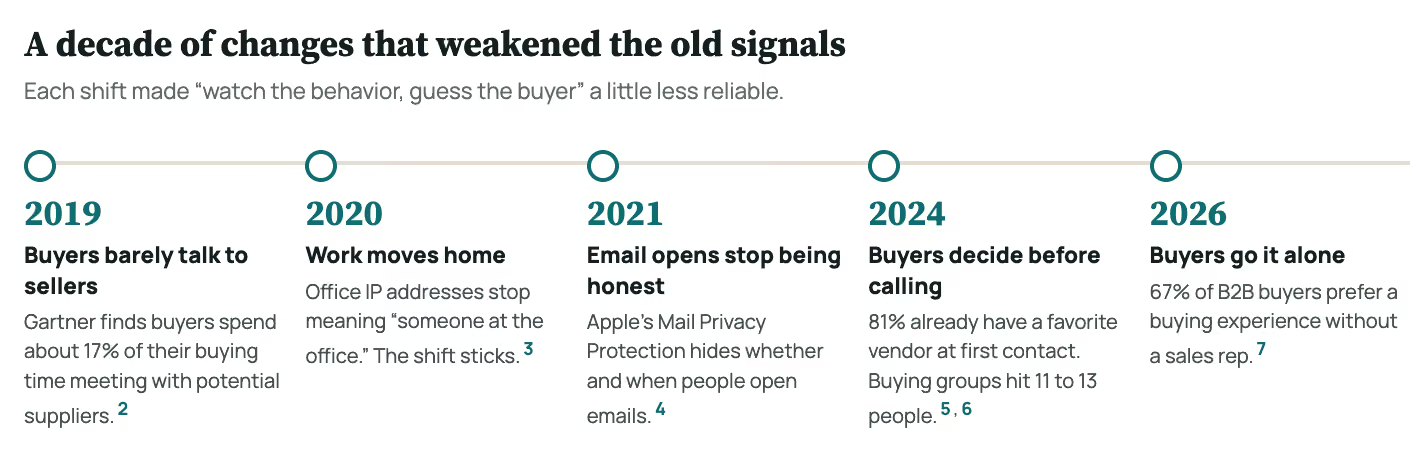
Ten years of change made the guessing harder
Intent data grew up in a world where buyers talked to sales earlier, worked from an office, and opened emails on computers that reported back honestly. Over the last decade, all three of those things changed.
A decade of changes that weakened the old signals
Each shift made “watch the behavior, guess the buyer” a little less reliable.
1. Buyers do most of the work before you ever hear from them
This one matters most. If buyers are nearly done by the time they talk to you, a signal that shows up late (or points at the wrong person) doesn’t just waste time. It shows up after the decision is basically made.
Buyers are making up their minds without you
Share of B2B buyers, from recent research by 6sense and Gartner.
Look at that 73%. Buyers aren’t just ignoring bad outreach. They’re avoiding the vendors who send it.8 A vague email triggered by an unexplained surge isn’t harmless. It can cost you the deal.
2. The “office” stopped being the office
A lot of intent data depends on matching an IP address to a company. That worked better when most people sat at a desk on the corporate network. It works a lot worse when people work from their kitchen table.
More work happens at home, where company matching gets shaky
3. Email engagement stopped telling the truth
In 2021, Apple introduced Mail Privacy Protection, which stops senders from knowing when (or whether) someone opened an email.4 Security scanners at big companies also “click” links automatically to check them for threats. So an account can look highly engaged when a robot did most of the engaging. Any intent score that leans on opens and clicks inherited that noise.
The buying group problem
Here’s the part that makes a surge alert feel so empty to a rep. Companies don’t buy things. People do. And there are a lot of them.
A surge sees a building. Your rep has to talk to people.
Forrester found that about 13 people are involved in a typical B2B purchase. A topic surge might be driven by just one of them, and you usually can’t tell which one.
That one reader could be the decision-maker. It could also be an intern writing a report, an analyst, a current customer, or an engineer reading for a project that got cancelled last week. The surge looks the same either way.
And the bigger the buying group gets, the less a single anonymous signal tells you. Forrester also found that 86% of B2B purchases stall at some point.6 More people means more places for a deal to get stuck, and a surge can’t tell you who’s holding it up.
What a better signal looks like: receipts
Here’s the shift. Instead of asking “how much is this account reading?”, ask “what actually changed at this company, and who owns it?”
Gartner’s research points the same way: 99% of B2B purchases are driven by some kind of organizational change.9 A new leader. A new location. A new product line. A merger. Budgets and projects follow change. So if you can see the change, you’re looking at the cause of buying, not just the side effects.
Same account. Two very different starting points.
A score asks for trust. Evidence earns it.
- No idea what drove the score
- No names, no roles, no buying group
- Nothing a rep can check or mention
- Hiring 14 data engineers this quarter
- Adopted Snowflake six months ago
- Launched a new AI business unit
- Three named directors researching data governance
The second card isn’t magic. Every line on it is something a rep can check, mention, and build a conversation around. That’s the whole difference. Evidence you can see is evidence you can use.
It also helps to know the difference between two things that often get lumped together:
Intent data vs. account signals
| Intent data | Account signal |
|---|---|
| Measures reading or engagement | Measures a real change in the business |
| “Employees are reading about ERP migration” | “The company hired a new CIO” |
| “The account compared CRM vendors” | “The company opened three new locations” |
| “Traffic to our pricing page went up” | “The company launched a new product” |
| Suggests interest | Explains the need and the timing |
To be fair, account signals aren’t proof of intent either. A new CIO doesn’t guarantee a new software purchase. But they give your team context, which is exactly what an anonymous surge is missing.
The six ingredients of a signal worth acting on
The fix isn’t to buy another score. It’s to stack a few simple, checkable questions on top of each other. When most of them have good answers, you have a real reason to reach out.
Six questions every signal should answer
If a signal can’t answer most of these, it isn’t ready for a rep.
What this means for each team
Use intent to decide which audiences get attention and helpful education. Don’t treat a surge as a lead. Treat it as a hint about where to spend.
Every alert should come with a reason you could say out loud to the buyer, and a named person to say it to. If it doesn’t, it isn’t ready.
Keep the raw evidence behind every signal, and check it against pipeline and revenue. If you can’t see what drove a score, you can’t tell whether the model works.
The bottom line
Traditional intent data is useful for deciding where to look. It’s dangerous when it’s treated as proof that someone wants to buy.
Buyers have changed a lot in ten years. They research alone, decide early, work from anywhere, and buy in groups of a dozen or more. Meanwhile, most intent scores still hand reps a number and a topic and wish them luck.
Reps don’t need more mystery. They need receipts: what changed, who’s involved, and why now. Interestingly, buyers want the same thing. In Gartner’s latest research, 69% of B2B buyers said they turn to sales reps to double-check what AI tools tell them.10 They still value a seller who shows up with real, checkable information.
“This account is hiring 14 data engineers, adopted Snowflake six months ago, and has three directors researching governance” will beat “Intent score: 87” every single time.
Signals your reps can actually say out loud
LeadGenius combines AI with human research to find the changes that matter at your target accounts, and the people in the buying group behind them. Every signal comes with the evidence.
See how LeadGenius worksSources
- Bombora, Company Surge methodology (3-week activity vs. 12-week baseline). bombora.com
- Gartner, B2B buying journey research (buyers spend 17% of buying time meeting potential suppliers; 6 to 10 decision-makers), as summarized by Documill.
- Barrero, Bloom and Davis, WFH Research, Survey of Working Arrangements and Attitudes, June 2025 update.
- Apple, “Apple advances its privacy leadership with iOS 15…”, June 2021.
- 6sense, 2024 Buyer Experience Report, October 2024.
- Forrester, The State of Business Buying, 2024, December 2024.
- Gartner, “Gartner Sales Survey Finds 67% of B2B Buyers Prefer a Rep-Free Experience”, March 2026.
- Gartner, “Gartner Sales Survey Finds 61% of B2B Buyers Prefer a Rep-Free Buying Experience”, June 2025.
- Gartner, The B2B Buying Journey.
- Gartner, “Gartner Survey Finds 69% of B2B Buyers Turn to Sales Reps to Validate AI-Generated Insights”, May 2026.
.avif)