
In my early twenties, I worked for a company called Envoy Data. We were what the industry calls a value-added reseller (a VAR, or sometimes a systems integrator). Our job was not to invent anything. It was to take technologies that already existed (access-control hardware from a company like HID, credential and identity systems from a company like Gemalto) and make them work together for large enterprise customers who did not have the time, the staff, or the patience to figure out the integration themselves.
This was a real service. If you have ever tried to get two enterprise software systems to talk to each other through a direct vendor relationship, you know the friction is not imaginary. Contracts, APIs that don't quite match, support tickets that bounce between two companies each blaming the other. A good VAR absorbs that friction and sells you the relief of not having to deal with it. That's a legitimate business. It is also, by its nature, a bounded one. You are paid for reducing friction between other people's products. You are not paid as if you built the products.
I keep coming back to that distinction, because I think it's the cleanest way to explain what's strange about Clay's valuation, and why it matters to anyone building a durable GTM data stack right now.
What Clay actually is
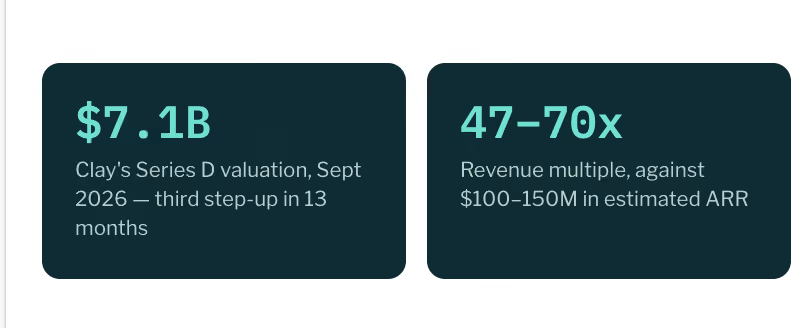
Clay just raised $115 million at a $7.1 billion valuation, in a Series D led by Wellington Management, with a roster of investors that includes Sequoia, a16z's Perennial fund, and several of Clay's own earlier backers stepping back in. That's the third valuation step-up in about thirteen months, from roughly $3.1 billion in an August 2025 Series C, to $5 billion in a January 2026 employee tender, to this. Each jump came faster than the last, and notably, two of the three came without a fully disclosed, traditionally priced round (tender offers and reported deals rather than the normal public accounting of a Series round).
Strip away the AI branding and Clay is, functionally, a VAR. It does not own the underlying data it sells access to. It calls out to a marketplace of data providers (enrichment vendors, intent-signal companies, firmographic databases), blends their outputs into one interface, wraps the whole thing in workflow automation and a large language model that can write formulas and summarize results in plain English, and charges you a markup for not having to manage those five vendor relationships yourself. It is, in the most literal sense, a very good, very fashionable version of what Envoy Data did with hardware twenty years ago: it removes integration friction and takes a cut for doing it. Call it a fancy spreadsheet with an AI copilot bolted on, sitting on top of somebody else's data.
That is a genuinely useful thing to sell. It is not obviously a $7.1 billion thing to sell.
The multiple doesn't hold together
Here's where the story gets uncomfortable once you run the numbers instead of reacting to the headline. Clay has publicly confirmed crossing $100 million in annual recurring revenue in December 2025, and third-party estimates from firms that track the company's growth put it around $150 million ARR by this past May. Take the more generous of those figures. A $7.1 billion valuation against $150 million in ARR is roughly a 47x revenue multiple. Take the more conservative, officially confirmed figure, and it's north of 70x.
Now compare that to the closest thing Clay has to a public-market analog: ZoomInfo, a company that (unlike Clay) actually owns a substantial proprietary data asset it has spent nearly two decades building. As of this month, ZoomInfo's market cap sits at roughly $1.1 to $1.2 billion. Do the division and that is almost exactly one-sixth of what investors just told Clay it's worth. One company owns its data outright and trades near 2x revenue. The other resells other people's data and is priced at somewhere between 47x and 70x. That gap isn't explained by AI making Clay's product six or seven times more valuable per dollar of revenue than owning the underlying asset outright. It's explained by the fact that private, late-stage AI rounds right now are being priced on narrative momentum, not on the unit economics underneath them.
One company owns its data outright and trades near 2x revenue. The other resells other people's data and is priced at 47 to 70 times revenue.
Where the money actually goes
Which raises the question most coverage skips: when a customer pays Clay $349 a month, or a large enterprise account pays $10,000 a month, how much of that actually reaches Clay's bottom line (its EBITDA, the thing left over after it pays its own bills)?
Clay doesn't grow its data. It buys it, at a markup, from providers who are themselves running businesses with their own margins. Every enrichment call, every API pull, every workflow step is a cost that scales roughly linearly with usage, not a fixed cost that gets cheaper per unit as Clay grows the way a piece of owned infrastructure would. That's a structurally different cost curve than a company that owns its core asset. It suggests thinner, more fragile margins than the growth headlines imply, and it's consistent with a company raising capital in unusually quick succession, at unusually steep step-ups, which is often less a sign of runaway success and more a sign that cash burn is outpacing revenue as usage scales.
Clay's own pricing history backs this up more directly than expected. In March of this year, Clay overhauled its entire pricing model. Before that change, if you brought your own API keys and ran your own workflows through Clay's platform, the orchestration itself was essentially free. You paid your data provider, not Clay. Sophisticated users figured this out and built entire agency businesses on top of that gap, extracting far more platform value than they were paying for. Clay's March update closed it: HTTP API calls, once complimentary, became metered "Actions" that cost money regardless of whether you were buying Clay's marketplace data or bringing your own. Clay was, in effect, subsidizing its heaviest users and had to claw that subsidy back to keep the unit economics from collapsing.
If that sounds familiar, it should. It's the same dynamic playing out right now across the entire LLM API layer, where providers are quietly tightening rate limits and reworking pricing tiers because a small number of users maxing out token usage were being subsidized by everyone else's bill. It's not a Clay-specific problem. It's a structural feature of usage-based AI businesses that haven't yet figured out how to price their heaviest users without losing money on them, and it's a sign that the underlying economics are less settled than a headline valuation suggests.
Clay hasn't disclosed EBITDA, gross margin, or burn rate publicly, so the "subsidizing usage" framing here is an inference from the pricing change and the pattern of raises, not a confirmed number from the company. The $150M ARR figure is a third-party estimate, not an audited or company-confirmed figure; the only hard number Clay has stated is $100M ARR as of December 2025. Both of those caveats push the true multiple somewhere between the 47x and 70x cited above, not below it.
What this actually signals
None of this means Clay is a bad company, or a bad tool. If you're a go-to-market engineer trying to stitch together prospecting data, enrichment, and outbound workflows without managing five vendor contracts, Clay is very good at that job, the same way Envoy Data was very good at making Gemalto credentials talk to HID readers so a Fortune 500 security team didn't have to. That's real value. It has just never, in any other era, been the kind of value that gets priced like ownership of the underlying asset.
When a value-added reseller with a thin, provider-dependent margin gets valued at six times a comparable company that actually owns its data, and needs to keep raising at higher multiples roughly every seven months to keep the lights on, that's not a story about one company's brilliance. That's a market telling you it has stopped pricing businesses on what they own and started pricing them on how fast the narrative is moving. That's usually the tell that you're closer to the top of a cycle than the middle of one.
Orchestration layers don't solve compliance. Sourcing does.
The part of this story that gets the least attention is the part that matters most to anyone running enterprise GTM: a marketplace that resells other providers' data inherits every one of those providers' compliance gaps, and adds a layer of opacity on top. LeadGenius sources contact data directly, with Human-in-the-Loop verification and built-in alignment to GDPR, CCPA, and LGPD, so your legal and compliance teams aren't reconstructing consent chains after the fact. That's a different business than a markup on a marketplace — it's why our data holds up under audit, not just under a demo.
More Field Notes
The Quiet Death of the Sales Chrome Extension
A protocol called MCP is replacing the browser overlays your reps click all day, and reshaping which vendors in the GTM stack actually keep their moat.
MARKET STRUCTUREThe Audience Layer Is Eating Ad Tech
Publicis just paid $2.2 billion for LiveRamp. The platforms are quietly losing the most important real estate in advertising.
PRIVACY & COMPLIANCEEnsure transparent, enterprise-grade data sourcing
How LeadGenius aligns contact data collection and activation with GDPR, CCPA, LGPD, and the regulations landing in boardrooms next.
.avif)