
Two lemonade stands are never really the same business
Even if they have the same number of kids working the table, one sells ten cups a day and one sells a hundred. Here's why watching the money move beats guessing every single time.
A database can tell you a business has 24 people and "probably" makes $5 to $10 million a year. But nobody at that company ever confirmed that number. It's a guess, built from public clues and averages of similar-looking businesses.
Think of it like guessing how much candy is in a jar just by looking at the jar's size. You can get close. You can also be way, way off. Two jars that look identical from the outside can hold completely different amounts on the inside.
And that's exactly the trap. Revenue ranges and employee counts are handy for a first, rough sort of the world. They fall apart the moment your business depends on knowing how much money is actually moving through a company, not how big its office looks from the outside.
What happens when you stop guessing and start watching
Here's the difference between "how many small businesses can a database describe" and "how many can it describe using something real." Out of 100 small businesses, here's how many you can say something true about:
Coverage of usable, evidence-backed business data — before and after adding transaction signal.
Same size backpack, very different amount of stuff inside
Picture two restaurants. Both have 20 employees, one location, and a database guess of "$1 to $5 million a year." On paper, they're twins. In real life, they're not even close.
Employee count tells you how the company is organized. What actually gets paid tells you how the business runs. For anyone selling payments, loans, payroll, or restaurant software, only one of those two things tells you if it's worth a phone call.
The little clues that are already sitting there
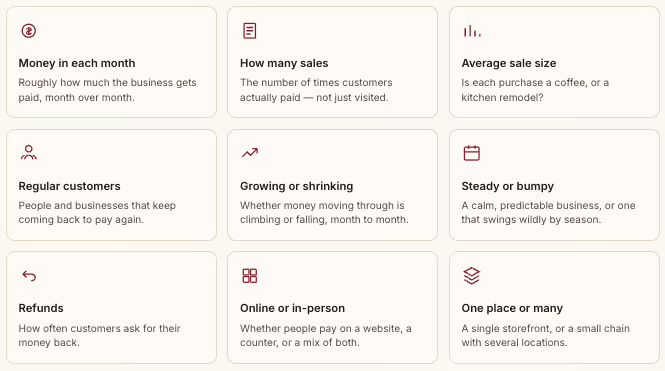
You don't need to peek into anyone's bank account. Real businesses leave a trail of ordinary, everyday clues just by operating — you only have to know to look for them.
None of these clues reveal what one shopper bought for dinner. They're bundled up and privacy-protected at the business level — enough to describe the business, not spy on the person paying it.
Ask a better question and you get a better list
The old way of finding customers asks a database a size question. The better way asks the market a behavior question.
The first question hands you a giant, undifferentiated pile. The second hands you a list that actually reflects how these businesses make money — which means it's a list your sales team can trust.
Not every business deserves the same attention
Once you can actually see how a business behaves, you can sort the whole market into who gets what kind of attention.
The goal was never to build the biggest possible list. It's to find the slice of the market that deserves your attention right now.
Two companies that stopped guessing
Same idea, real results.
Instead of chasing every business with a website, PayPal's team mapped merchants by real transaction volume, cleaned up who was who across messy international records, and handed sales a list worth calling.
"Food and beverage" as a category mixes food trucks with fine dining. Square's team built a sharper list using real operating details — location type, licenses, and how the business actually runs — not just an industry code.
One catch: the same store has a lot of nicknames
Raw transaction data is messy on its own. The same coffee shop might show up under its legal name, its storefront sign, its parent company, and three abbreviated versions of all of the above.
That matching work — figuring out that all four of those are actually the same coffee shop, then attaching its real website, phone number, and the person who runs it — is what turns a stray clue into something a sales team can actually use.
A clue by itself is just noise. A matched business without a way to reach anyone is just research. A matched business with real evidence and a real contact is something your team can act on today.
The real question was never "how many businesses exist"
It's "which ones are showing enough real proof — right now — to deserve our next dollar and our next conversation."
A revenue range can tell you roughly how big a business looks. Watching where the money actually moves tells you where it's worth showing up.
.avif)