
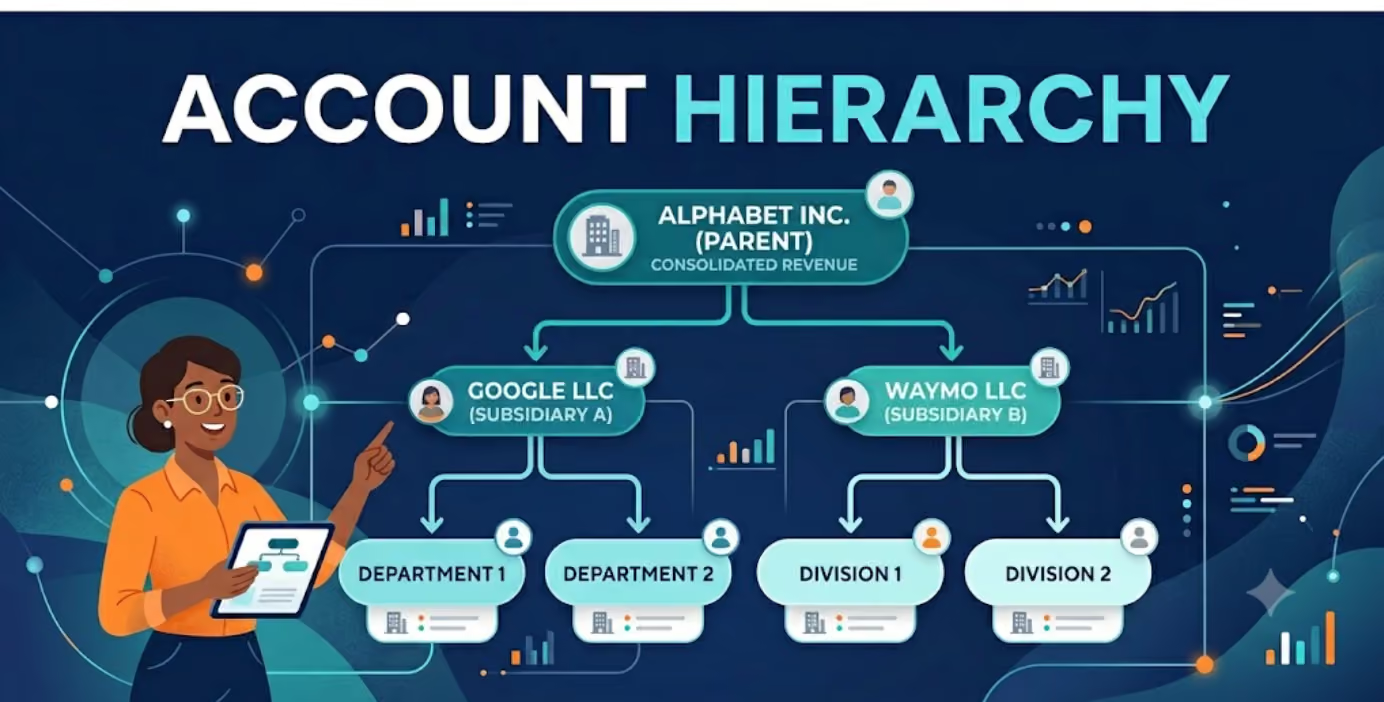
The reparenting problem, in motion
An acquisition closes. An account a rep owned on Monday becomes a child of an account a different rep owns. Watch what the deal does to the hierarchy.
Every revenue operations architect inherits the same quiet fiction: that the customer base is a stable set of accounts, each with a clean parent, a clean owner, and a clean territory. The CRM reinforces it. There is a Parent Account field, a tidy hierarchy view, an Account Owner, and a routing rule that sends new leads to the right rep. It looks settled.
It is not settled. It was never settled. And in the current cycle — where the largest technology companies are acquiring their way into adjacent markets at a pace that would have looked reckless a decade ago — the gap between the org chart in the CRM and the org chart in the real world has become the single most expensive piece of unmanaged risk in most go-to-market systems.
Consider the deal flow alone. In a single recent stretch, the megacap technology cohort and their peers closed or announced an extraordinary run of consolidation: a roughly $32B cloud-security acquisition by one search-and-cloud giant, a $69B infrastructure-software combination, a $68.7B gaming acquisition that took 21 months and multiple regulators to clear, a $35B engineering-software tie-up, and a $25B cybersecurity purchase, among others. Each of those transactions did something violent to somebody's account hierarchy.
A standalone target a rep owned on Monday is, the day the deal closes, a subsidiary of an account a different rep owns — possibly in a different region, a different segment, on a different comp plan, with a different quota implication. This article is about how the best RevOps architects actually think through that mess: the established best practices, where serious practitioners genuinely disagree, and what the real-world conflicts look like when the disagreements go unresolved.
Part 01What everyone basically agrees on
Before the disagreements, it's worth laying down the foundation nearly every credible RevOps architect accepts. These are the load-bearing ideas.
The native hierarchy field is not a hierarchy system
The standard Parent Account field in most CRMs is a single lookup pointing one level up to one other account. That is the entire native mechanism. It cannot tell you, from a standard field, whether an account has children. It cannot natively surface the ultimate parent three levels up as a queryable value you can route against. And when ownership changes at the parent level, nothing automatically propagates down to the children.
This matters because the whole point of knowing the ultimate parent is routing and rollup. A lead that matches to a small subsidiary needs to reach the account executive who owns the top of the corporate family. The most common version of this conversation is almost a cliché: "The matched account doesn't have an owner, but the parent always does. How do we get to the right owner automatically?"
The matched account is not always the route-to account
Most routing logic rests on a single assumption: the account you match a lead to is the account you route it to. That holds for simple, transactional sales. It collapses the moment you sell into the enterprise. A lead from a self-driving-car subsidiary probably belongs to the rep who owns its sprawling search-and-advertising parent. Get it wrong and two failure modes appear: a rep works a deal to the finish line only to discover it was a subsidiary of someone else's account, or a prospect tells a rep mid-conversation that they're already talking to one of the rep's colleagues.
Hierarchy routing failures are quiet
Flat routing failures are loud — a lead goes to the wrong rep, the rep flags it, it gets fixed. Hierarchy failures are silent. If a lead routes to the owner of a stale parent instead of the correct current regional owner, the receiving rep often has no idea anything is wrong. The error never surfaces as an error. It just shows up later as unexplained pipeline that leaked.
Routing rules are only as good as the data they read. Fix dedupe and ownership first, or every clever assignment rule simply distributes bad records faster.
— Widely repeated RevOps practitioner principlePart 02The disagreements that actually matter
This is where RevOps architecture stops being a checklist and becomes a set of judgment calls with real tradeoffs. Four debates are worth understanding deeply.
Debate 1 — Whose "parent" wins?
The deepest disagreement has a name: the account hierarchy dilemma. The question "Who is the customer?" has two correct but contradictory answers depending on whether you ask the CFO or the CRO.
Roll up to the ultimate legal parent — defined by ownership control. Serves compliance, credit risk, and tax consolidation. Follows the money.
Roll up to the effective buying center — the entity that actually makes purchasing decisions and dictates the tech stack. Follows decision-making power.
A luxury hotel carries a global brand, runs on that brand's systems, and presents as that brand — but the real estate was bought by a private-equity firm. Standard data rolls it up to the PE firm: legally accurate, commercially useless, because the PE firm doesn't dictate the property's software procurement. The brand does. Hence the emerging working rules: investors are not parents, governments are not commercial headquarters, and brand ecosystems can override legal lines.
Debate 2 — One hierarchy, or many?
Most CRMs natively store exactly one hierarchy. But an enterprise's legal structure looks nothing like how a sales team wants to organize accounts by territory, segment, or product.
One tree, one source of truth. Simpler to govern, easier to adjudicate, comprehensible to a new admin — at the cost of forcing every function to read a shape that doesn't match its work.
Separate legal, commercial, regional, and product views. More correct, far more to maintain. Start with a legal baseline, then layer GTM-specific trees on top.
Debate 3 — Build the automation, or buy a platform?
Native tools are free and flexible. A scheduled job matches on domain or company name and writes the parent field. Works at first — then every exception makes the flow heavier until developers and custom code arrive, and tech debt compounds.
Purpose-built tooling recalculates on reparenting, saves multiple views, surfaces whitespace, and routes off any hierarchy position without custom code — at the cost of vendor spend, lock-in, and dependence on someone else's refresh cadence.
An under-appreciated wrinkle: even teams that buy hierarchy data often find that field sales reports an acquisition before the provider's file reflects it — because providers refresh on a schedule, not in real time. That seam is exactly where a responsive, research-driven enrichment approach earns its keep.
Debate 4 — How aggressive should ownership SLAs be?
Response decay is brutal: contacting a web lead within five minutes versus thirty makes firms dramatically more likely to connect and qualify. Speed is a conversion lever, not a vanity metric.
A blunt "respond fast to everything" rule wastes your fastest capacity on low-intent traffic and burns out reps. SLAs set without honest capacity become theater reps learn to ignore.
The mature synthesis: tier the SLAs (hot / warm / cold), enrich before the clock starts and before routing, build an explicit escalation ladder with an after-hours rung, and set data-quality SLAs on the fields that determine ownership — not just response-time SLAs.
Part 03What the conflicts look like in the wild
Abstract debates are easy to nod along to. Left unresolved, they produce recurring, identifiable conflicts — made sharper by the current M&A tempo.
- The reparenting commission fight. A deal closes; the target becomes a child of an account owned by a different rep. Who gets credit for the in-flight opportunity? Who owns the renewal? Territory conflicts and commission splits rarely end well — and reps who feel cheated leave, forcing yet another reshuffle.
- The "we're both calling them" collision. Two reps prospect what looks like two companies but is actually a parent and its newly acquired subsidiary. The prospect notices. Pure artifact of a CRM that doesn't know two accounts are now one family.
- The stale-parent silent misroute. It doesn't surface until a pipeline review turns up opportunities routed to an entity that no longer exists in the form the CRM thinks it does. By then the trail is cold.
- The finance-vs-sales rollup argument in the QBR. Finance rolls up to the legal parent; sales to the buying center. The two numbers don't reconcile, the meeting derails into a definitions fight, and the dashboards lose credibility — worst during post-merger integration, when leadership most needs trustworthy numbers.
- The messy-middle ownership vacuum. After close but before integration, nobody clearly owns the combined accounts. Records drift, SLAs miss silently, customers get bounced between teams. The only known cure: decide ownership during diligence, not after.
Part 04Why the data layer is the real battleground
Every one of those disagreements bottoms out in the same place: the quality and freshness of the underlying entity data. You cannot route to the right owner if you don't know the true current parent. You cannot toggle between legal and commercial hierarchies if you only have one of them. You cannot hold a lead for enrichment-before-routing if your enrichment is thin or slow.
10,000 companies, 10,000 people — and a tail that won't automate
A scaled data vendor was asked to enrich and validate a 10,000-company / 10,000-person sample, structured to a three-tier legal hierarchy of business unit, global HQ, and global ultimate. The findings make the stakes tangible:
That 161-record residual is the whole ballgame. It's the live demonstration that "just buy the hierarchy" never fully resolves the problem — there is always a tail that requires human-in-the-loop resolution, and pretending otherwise is how silent misroutes get born. If a tenth of your contacts are junk and your system doesn't flag them, your SLA timers fire on records that were never workable.
The hierarchy definitions in that engagement explicitly distinguished branch, business unit, global HQ, and global ultimate — and noted the model could be modified based on client feedback. That clause is Debate 1 and Debate 2 in disguise: the right hierarchy depends on whether you're optimizing for legal liability or commercial coverage, and no single model is universally correct. The strategic argument — that a bespoke, continuously-researched data model reflects structural change faster than a static, periodically-refreshed database — maps precisely onto the field-reports-the-merger-first problem. In a fast M&A environment, the value of enrichment is measured by how fast it reflects a structural change, because the entire ownership-and-SLA edifice is downstream of that.
Part 05A working synthesis for architects
Strip the debates down to what a clear-eyed architect should actually do, and it comes to a handful of defensible positions — stated as positions, because reasonable practitioners will disagree at the edges.
- Maintain at least two hierarchies deliberately — a legal/financial baseline and a commercial/GTM overlay. Don't pretend one structure serves finance and sales equally. Adjudicate disputes by use case, not by decree.
- Treat the ultimate-parent question as a rules problem, not a field problem. Codify how you handle financial sponsors, governments, and brand ecosystems. Write them down.
- Enrich before you route, and route before you start the clock. This single sequencing discipline prevents more downstream conflict than any other rule.
- Tier your response SLAs and back them with data SLAs. A fresh parent-account field on your top accounts is worth more than a five-minute timer firing on a stale one.
- Pre-decide reparenting and integration ownership during diligence. The messy middle is where revenue leaks.
- Assume a permanent human-in-the-loop tail. Some meaningful share of your hierarchy will resist automated classification. Budget for the QA cadence rather than being surprised by it.
- Choose build-vs-buy on maintenance reality, not setup cost. Price the ongoing cost — developer time and silent-misroute risk — not just the license you avoid.
The deeper point underneath all seven: in a stable world, account hierarchy and ownership could be a configuration you set and forget. In the current world — where the largest companies reshape entire sectors through acquisition on a quarterly basis — hierarchy and ownership are a living system that has to be fed clean, fresh entity data and governed by explicit rules and measurable SLAs. The architects who treat it that way capture the expansion revenue inside their largest customers and route every lead to the rep who can actually close it. The ones who treat the CRM's tidy hierarchy view as the truth keep losing deals they never knew they had — quietly, which is the most expensive way to lose them.
Your hierarchy is only as fresh as your data
LeadGenius surfaces parent-child relationships, role changes, and buying-committee shifts in real time — AI for scale, humans-in-the-loop for the tail that won't automate.
Talk to a strategist.avif)