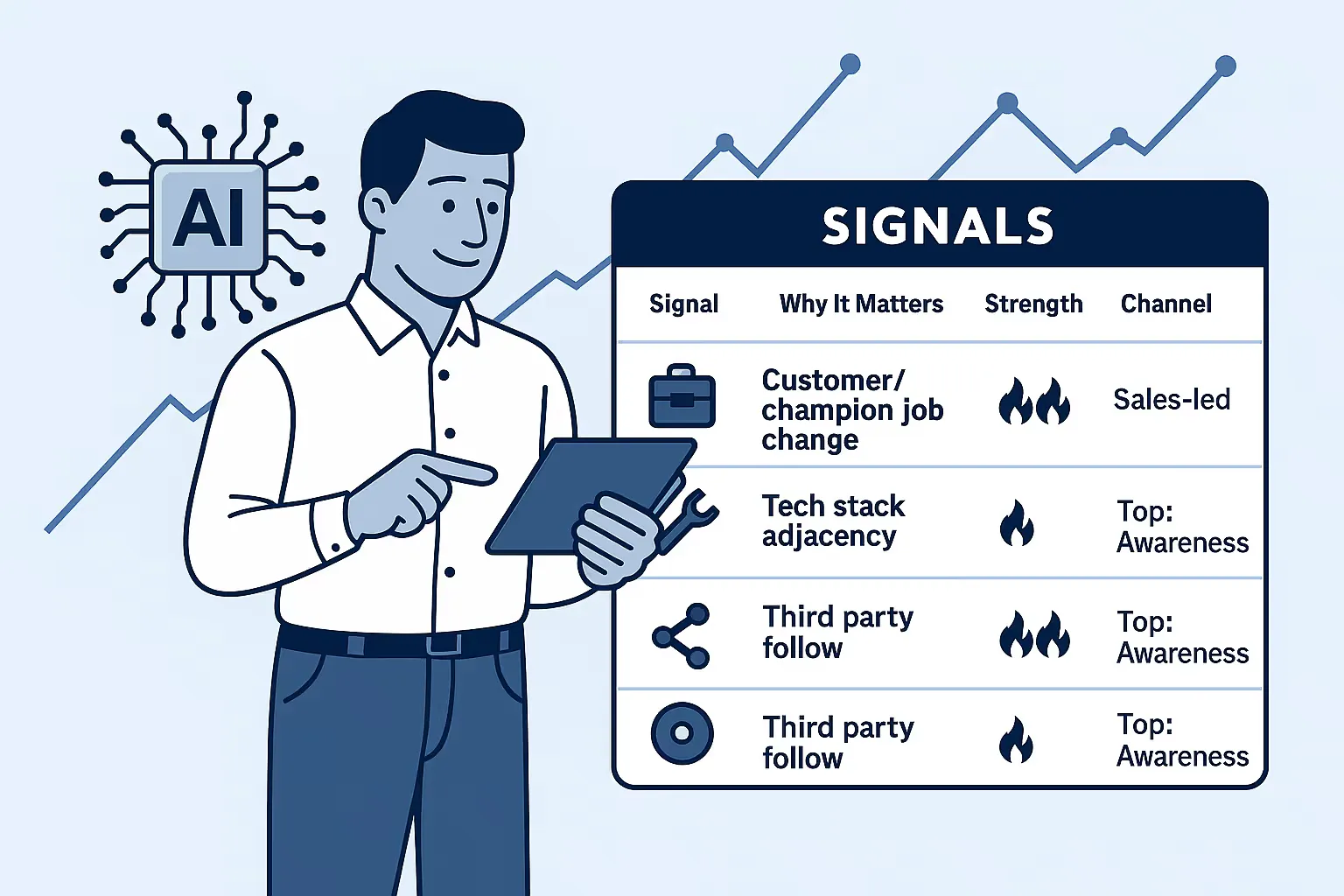
Two years ago, "signal-based selling" was the thing that separated sharp GTM teams from everyone else. Track a job change, a funding round, a hiring surge — and reach out before the competition even knew the account was in motion. It worked because almost nobody else was doing it well.
That advantage is gone. Not fading — gone.
Everyone has the same signals now
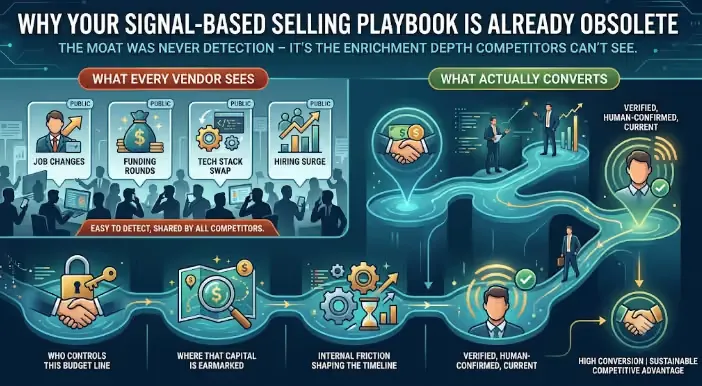
Walk into any RevOps stack today and you'll find the same intent data providers, the same trigger-based sequences, and the same "congrats on the new role" templates firing off within hours of a LinkedIn update. When a job change or funding alert is available to every SDR team with a budget for a data vendor, the signal stops being a differentiator and starts being noise.
The result is predictable: prospect fatigue. A VP who just took a new role isn't getting one thoughtful outreach message anymore — they're getting fifteen, all triggered by the same public event, all arriving in the same 48-hour window, all sounding vaguely the same.
Intent data didn't stop working because the concept was flawed. It stopped working because it commoditized. And commodity advantages don't win deals — they just raise the floor for table stakes.
Operational frameworks are necessary. They're also not the point.
A lot of the current conversation around signal-based selling is focused on operationalizing it better — building the workflows, sequencing the triggers, routing alerts to the right rep at the right time. Leaders like Steve Armenti have done real, valuable work articulating how modern GTM teams should structure this motion operationally.
But "how do we act on a signal faster" is a different question from "is this signal actually worth acting on." Most playbooks answer the first question in exhaustive detail and quietly skip the second — assuming the underlying data is accurate, current, and meaningfully connected to buying intent. Increasingly, it isn't.
Operational excellence without data integrity doesn't create an edge. It just automates mediocrity.
The real moat isn't detection anymore — it's depth
Detecting a signal was never the hard part. A job change, a funding announcement, a new executive hire — these are public. Anyone can build a scraper for them. The moat was never going to survive being that easy to replicate.
The actual competitive advantage now lives one layer deeper — in the enrichment. It's the difference between knowing a company raised a Series B and knowing which specific initiatives that capital is earmarked for, who on the buying committee actually controls budget, and what internal friction is likely to shape the timeline. That context doesn't exist in any public feed — it has to be found, verified, and connected.
Signal detection tells you where to look. Enrichment depth tells you what you're actually looking at. Only one of those is still scarce.
Scaling requires a different kind of data pipeline
This is where most teams hit a wall. Scaling signal-based selling has typically meant ingesting more raw data — more sources, more triggers, more volume flowing into the CRM. But volume without fidelity just scales the noise. More signals firing on inaccurate or shallow data doesn't produce more good leads; it produces more reps chasing more dead ends with more confidence than the data deserves.
The teams pulling ahead right now aren't ingesting more. They're verifying harder. Fewer signals, each one backed by proprietary, high-fidelity data that's been checked rather than assumed.
Human-in-the-loop verification, not just automated detection
Automated scrapers are excellent at detecting that something changed. They're far less reliable at confirming what it means, or whether it's still true by the time a rep acts on it. LeadGenius pairs AI-scale sourcing with human researchers who verify the signal itself — turning a generic trigger into a confirmed, high-conviction lead.
See how Contact Monitoring works →Where human verification still beats automation
This is the piece most vendors don't want to talk about, because it doesn't scale the way a pure software play scales: some of the highest-value context in B2B still requires a human to confirm it.
That distinction — generic signal versus verified, enriched intelligence — is quietly becoming the entire game. Signal-based selling isn't dead. But the version everyone's still running — public triggers, automated sequences, table-stakes intent data — stopped being an edge the moment it became available to every competitor with the same vendor contract.
If your playbook is still built on "we caught the signal first," it's worth asking honestly: first among whom? Because at this point, everyone caught it at roughly the same time.