
Imagine you're handed a phone book. Not a fresh one — one from ten years ago. Your job is to call every single number and try to sell something. Some numbers are disconnected. Some belong to people who moved. Some belong to businesses that closed years ago but never bothered telling the phone company. You won't know which is which until you dial.
That, more or less, is what it's like when a big company buys a list of "small businesses" from a data provider like ZoomInfo, Apollo, or Dun & Bradstreet, and hands it to a sales team. The list looks official. It has real company names, addresses, even a guess at how big each business is. But underneath, it's often that same out-of-date phone book wearing a nicer suit.
Wait — what's a "TAM," anyway?
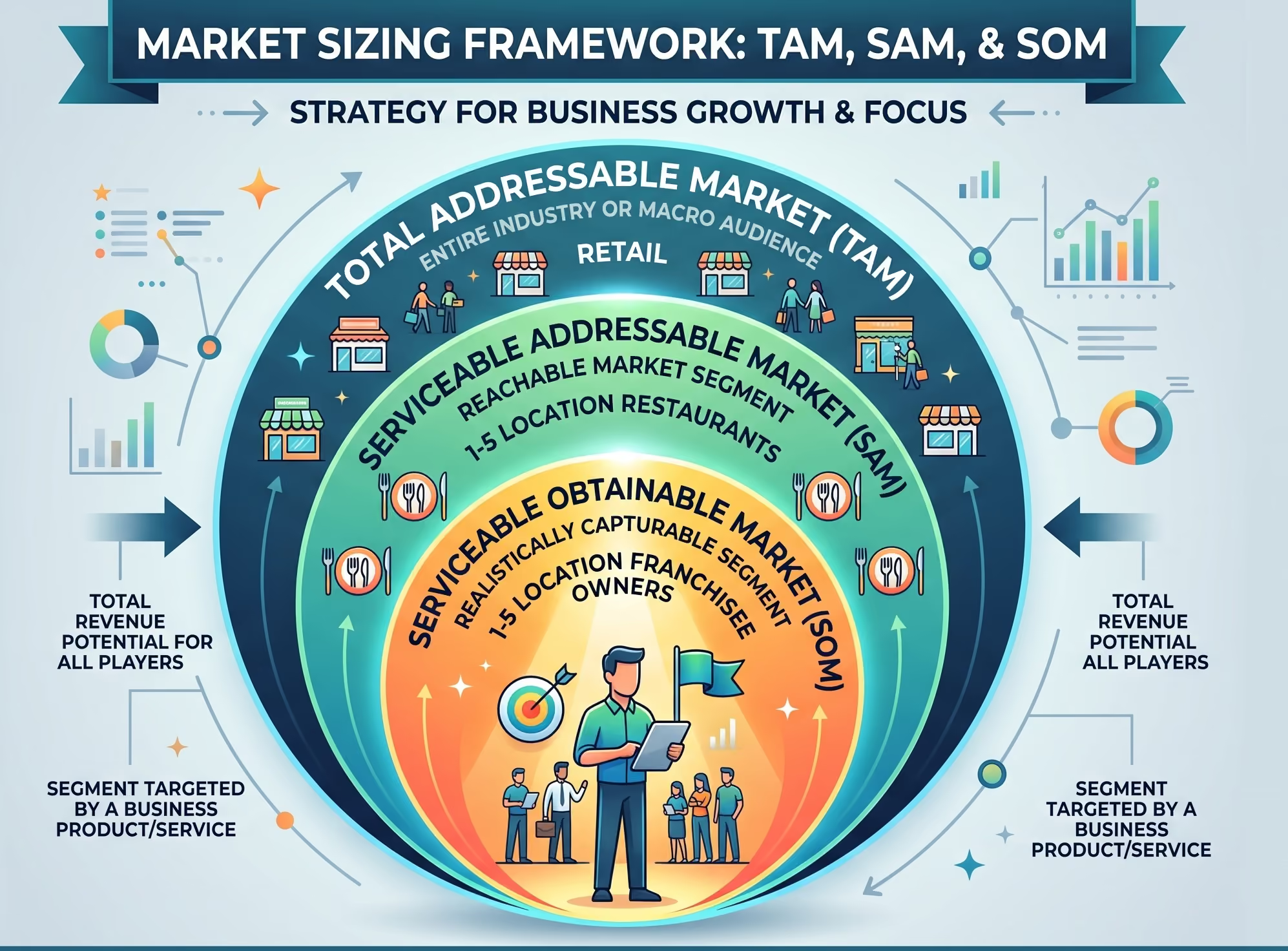
TAM stands for Total Addressable Market. It's just a fancy way of asking: "Out of everyone in the world, who could actually buy what I'm selling?"
If you sell software for restaurants, your TAM isn't "everyone." It's restaurants — probably specific kinds of restaurants. Building your TAM means drawing that circle: who's in, who's out, and who's worth calling first.
Most companies draw that circle using two lazy measurements: how much money a business makes (a guess) and how many people work there (also a guess). Neither one tells you if the business is even still open.
Why the old phone book keeps lying to you
Here's the part that surprises people: when a small business closes, it usually doesn't tell anyone official. The owner just... stops. No form gets filed. No box gets checked. The government record that says "this business is registered" can stay technically active for one to three years after the doors actually shut.
So a data company scrapes that government record, sees "active," and sells it to you as a lead. Your rep calls. Nobody answers. Multiply that by thousands of accounts, and you get sales teams spending most of their week dialing ghosts.
One real example: a large marketplace's small-business sales team checked how many of their leads actually had good, current information attached. The number was 9%. Ninety-one out of every hundred leads were basically useless the moment a rep picked up the phone.
A business being "registered" and a business being "open" are two completely different facts. Most data providers are only really good at telling you the first one.
So what do you do instead? Three ways companies fix this
The companies that solved this stopped trusting the phone book and started building their own — one that's actually checked, not guessed at. There are three main ways to do it, and each one answers a slightly different question.
Send in actual detectives
Instead of trusting a robot's guess, this method uses a robot to find the maybe-right answer, and then a human to double-check the fuzzy ones. Think of it like airport security: the easy bags sail right through the scanner, the confusing ones get pulled aside for a person to actually look at, and nothing suspicious just gets waved through on autopilot.
Amazon's small-business sales team was working off a list that was only 9% accurate. They rebuilt it using a data company (LeadGenius) that combined smart automated crawling with real people checking the confusing cases — is the storefront still live, did they post recently, does checkout actually work. Accuracy jumped from 9% to 70%. Same market, almost eight times better.
Watch what people do, not what they say
A business's self-reported revenue is basically a rumor. But how much money is flowing through their checkout? That's not a rumor — that's a fact, happening in real time. If you're a company that can see transactions, website traffic, or payment activity, you have a truth serum that ZoomInfo and Apollo simply don't have access to.
PayPal worked with LeadGenius to rebuild how it prioritized small-business accounts — not by revenue estimates, but by real signals tied to actual transaction activity. Within 90 days, that approach helped surface new deals worth more than $3 million in processing volume. Notice what they measured: real money moving, not "leads generated."
Let your own wins teach the model
Even after you know a business is alive, that doesn't mean it's a good customer for you specifically. So instead of using a generic "good customer" score built by a data vendor for every company on earth, this method looks backward at the customers who already bought from you and stuck around — and builds a scoring system trained on them.
Spekit took a standard data provider's records but scored accounts using their own closed-won history instead of the vendor's default formula. The accounts that scored higher on their model turned into customers 43% more often — and closed 58% faster.
The part where you actually build this
None of this means you have to throw away your data vendor. Most companies still use one as a starting skeleton — for basic facts like "this legal entity exists." What changes is that you stop treating the vendor's guess as the finish line. Instead, it becomes the first draft, and your own systems fill in the rest:
Build a "who to avoid" list, not just a "who to target" list
It's just as useful to know a business is dying (no website activity, no checkout, no recent filings) as it is to know one is thriving. Reps waste enormous time on accounts nobody bothered to cross off.
Don't use one formula for the whole world
A "good business" signal in Germany (clean government records) looks totally different in a country with weaker recordkeeping, where things like mobile payments or social media activity tell you more than any filing ever could.
Keep checking, forever
A business that was thriving six months ago might not be today. Treat your list like a living thing that needs regular check-ins — not a spreadsheet you download once a year and forget about.
Questions people usually ask at this point
Does this mean I should cancel ZoomInfo / Apollo / D&B?
No. Almost every company that does this well still licenses one of those as a starting skeleton — it's a fast way to get "this legal entity exists" for a huge number of businesses. The fix isn't dropping the vendor, it's refusing to treat their guess as the final answer. Their data becomes your first draft; your own checks fill in the rest.
Isn't hiring humans to check records expensive?
It's more expensive than doing nothing, yes. But it's cheaper than it sounds, because you don't check every record — just the confusing ones. The easy cases (clearly active, clearly dead) get sorted automatically. Humans only look at the fuzzy middle, which is a small slice of the whole list.
What if my company doesn't have transaction data like PayPal does?
Transaction data is the strongest signal, but it's not the only one. A live checkout page, a domain that's still renewed, recent job postings, recent social activity — these are all things you can check for free or cheap, without ever seeing a customer's bank account. Pick the signal that's closest to "this business can actually buy and use what I sell."
How often do I need to re-check the list?
Continuously, not once a year. A business that was thriving six months ago might have quietly closed since. Treat the list like a living thing with a "last checked" date on every record, not a spreadsheet you download once and trust forever.
Where do I even start if my team has never done this before?
Start small: pick the handful of signals that matter most for your product, and build a simple "who to avoid" list before a fancy "who to target" one. Cutting the obviously dead accounts out of a rep's queue is the fastest win, and it doesn't require any new technology to begin.
.avif)