
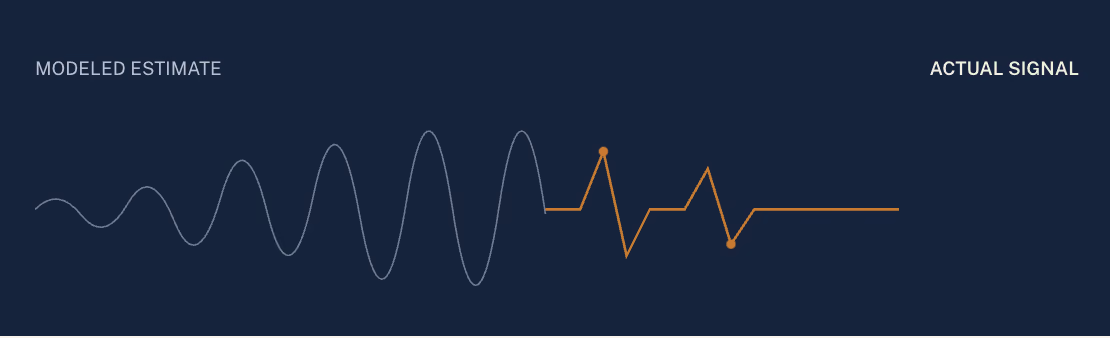
Every enterprise team selling into small and medium businesses eventually buys the same starter kit: a ZoomInfo or Apollo seat, a Dun & Bradstreet feed, a filter for "10–200 employees" and "$1M–$20M revenue." It feels like targeting. It has numbers in it. But almost none of those numbers come from the business itself — and the ones that do are often already out of date by the time they reach your CRM.
Think of it like guessing someone's weight from a blurry photo of their shoe. You can absolutely build a model that spits out a number. The number will look precise. It will also be wrong often enough that you can't tell, from the outside, when it's wrong — and that's the part that actually costs you pipeline.
This isn't a hit piece on any single vendor. It's about a decade-old habit: treating a rough first cut of the market as if it were the finished map.
TAM and SAM, without the acronyms doing the thinking for you
TOTAL ADDRESSABLE MARKET
Every business on Earth that could, in theory, ever use what you sell. If you process payments, that's "every business that accepts money." It's the ocean — enormous, and mostly useless as a work plan on its own.
SERVICEABLE ADDRESSABLE MARKET
The slice of that ocean you can actually reach and actually sell to today, given your product, your motion, your price point, and your geography. This is where the fish you can catch are swimming.
The mistake almost every enterprise SMB seller makes is spending 90% of their effort mapping the ocean and 10% figuring out where the fish actually are. A purchased list with two demographic filters on it is ocean-mapping. It tells you the theoretical size of your opportunity. It tells you almost nothing about which specific accounts, today, are worth a rep's time.
What a "revenue range" actually is
SMBs don't file quarterly earnings. So when a data provider shows "$1M–$20M" next to a company name, where did that come from?
Mostly: a model. The provider looks at industry code, employee count (itself frequently estimated from an old LinkedIn page or a stale web crawl), maybe square footage if they have it, and runs it through a statistical estimate that outputs a bucket. It's a guess, stacked on top of another guess, formatted to look like a fact.
And the underlying data these estimates lean on doesn't update the way you'd hope. An "About Us" page that says "our team of 12" might reflect a snapshot from three years and two rounds of layoffs—or two hiring sprees—ago.
The part that costs you pipeline: these databases don't know who's alive
A business can register with the state and never open. It can operate for two years and quietly close without formally dissolving anything. It can get acquired and rebrand while the original entity sits "active" in a filing somewhere, forever.
None of that shows up in a revenue-range filter. Most "Active" flags are based on legal registration status — which lags real-world reality by months, sometimes years. A meaningful share of any purchased SMB list is, right now, calling on businesses that are dead, dying, or were never really alive to begin with. Multiply that by fully loaded rep cost, and the "we bought a big list" strategy starts to explain a lot of quiet underperformance.
Why 2026 makes this worse, not better
AI has made it cheap to scrape the open web and stitch together company profiles that look more sophisticated than ever — cleaner fields, AI-written summaries, more rows. None of that improves the underlying truth signal: is this a real, active business that fits my specific product, right now. If anything, there's more synthetic-looking data competing with the real thing, and it's harder to tell which is which just by looking at it. Meanwhile SMB data decays faster than almost any other category. A snapshot from six months ago isn't a rounding error — it can describe a completely different business.
Stop describing your market in categories. Describe it in specifics.
Here's the shift that actually changes outcomes. Most companies write their ICP like this:
"We sell to restaurants and retail businesses."
That's a category, not a target. It's almost useless as instructions to a rep or a data model. Compare it with:
"We sell to quick-service restaurants that hold a liquor license and operate more than one location."
Or sharper still:
"We sell to franchise owners who operate three or more locations of a single brand."
These aren't industries — they're operating realities. A single-location sandwich shop owner has a different budget, a different buying process, and different pain than someone running twelve locations across three states. A generic "restaurant" filter treats them as the same account. They are barely in the same business.
This work is slower than typing a number into a filter box. It's also the difference between a list that produces meetings and a list that produces bounced emails.
Then go one layer deeper: find the signal, not the segment
Once your target is specific, ask the harder question: what does "good" actually look like for a business like this, in terms my product cares about? Most companies stop at industry-plus-size. The ones who win on SMB GTM go one step further and find the one or two signals that predict fit — regardless of what any database's revenue bucket says.
Could sell to any small business on Earth — which is exactly the trap of a huge TAM. The signals that matter aren't industry or headcount. They're website age, actual visitor traffic, and how much real money is moving through the business. A live, visited, transacting site is a business that's operating — not just registered.
On paper, a completely different buyer. But the strongest leading indicator turns out to be strikingly similar: actual revenue. Not a modeled bucket — the real thing. The best available proxy for real revenue is often real transaction volume, which correlates far more tightly with "this company can afford us and needs us" than any industry code ever will.
The pattern: stop asking what industry a business is in. Start asking what one real-world signal tells you this business is thriving and ready to buy — versus struggling, shrinking, or barely alive.
Where this data actually comes from
No single source gets you there. Every layer below is a piece of evidence, not a verdict on its own:
Blend these and you get something a static purchased list can never give you: a live read on trajectory, not just a snapshot of existence. Not just "is this a restaurant with 10–200 employees," but "is this a growing business worth calling right now, or a dying one that should quietly come out of the CRM before a rep wastes a quarter on it."
Turning this into CRM and warehouse discipline
None of this matters if it lives in a slide deck. Here's how it gets operationalized:
Define the ICP at the behavior level
Write a sentence a rep could say out loud and instantly picture the buyer — "franchise owners with three-plus locations of one brand," not "restaurants."
Pick your one or two product-specific signals
The GoDaddy traffic example, the HRIS transaction-volume example. Make these first-class fields in the warehouse, sitting next to — not instead of — basic firmographics.
Score fit and activity, don't just filter
Blend registry status, web liveness, local signals, and transaction data into a composite score instead of a single binary "active/inactive" flag.
Write the disqualification rule, not just the qualification rule
Decide explicitly what trajectory signals mean "pull this account from active prospecting" — falling review velocity, a dead website, declining transaction volume.
Refresh continuously, not annually
SMB data doesn't just go stale — it goes stale fast. A model that isn't re-run against current signals every few weeks is already lying to you again by next quarter.
The bottom line
The pre-built database isn't the villain here. It's a starting point that got mistaken for a finish line. Revenue ranges and employee counts are fine for the roughest possible cut of "does this business plausibly exist in the size range we care about." They were never built to tell you whether a business is thriving today, and they were never built to know your specific product's ideal buyer down to the level of "multi-unit franchise owner" or "liquor-licensed QSR."
That precision has to be built on real, current signals: registry data, live web behavior, local listing activity, and — where you can get it — actual transaction volume. It's more work than typing a number into a filter box. It's also the only version of this that produces pipeline, instead of a very confident-looking list of ghosts.
Build your ICP from real signals, not modeled guesses
LeadGenius blends registry data, live web and local signals, and transaction-level intelligence into a single, continuously refreshed view of who's actually active in your market — and who isn't.
Talk to a data strategist.avif)