
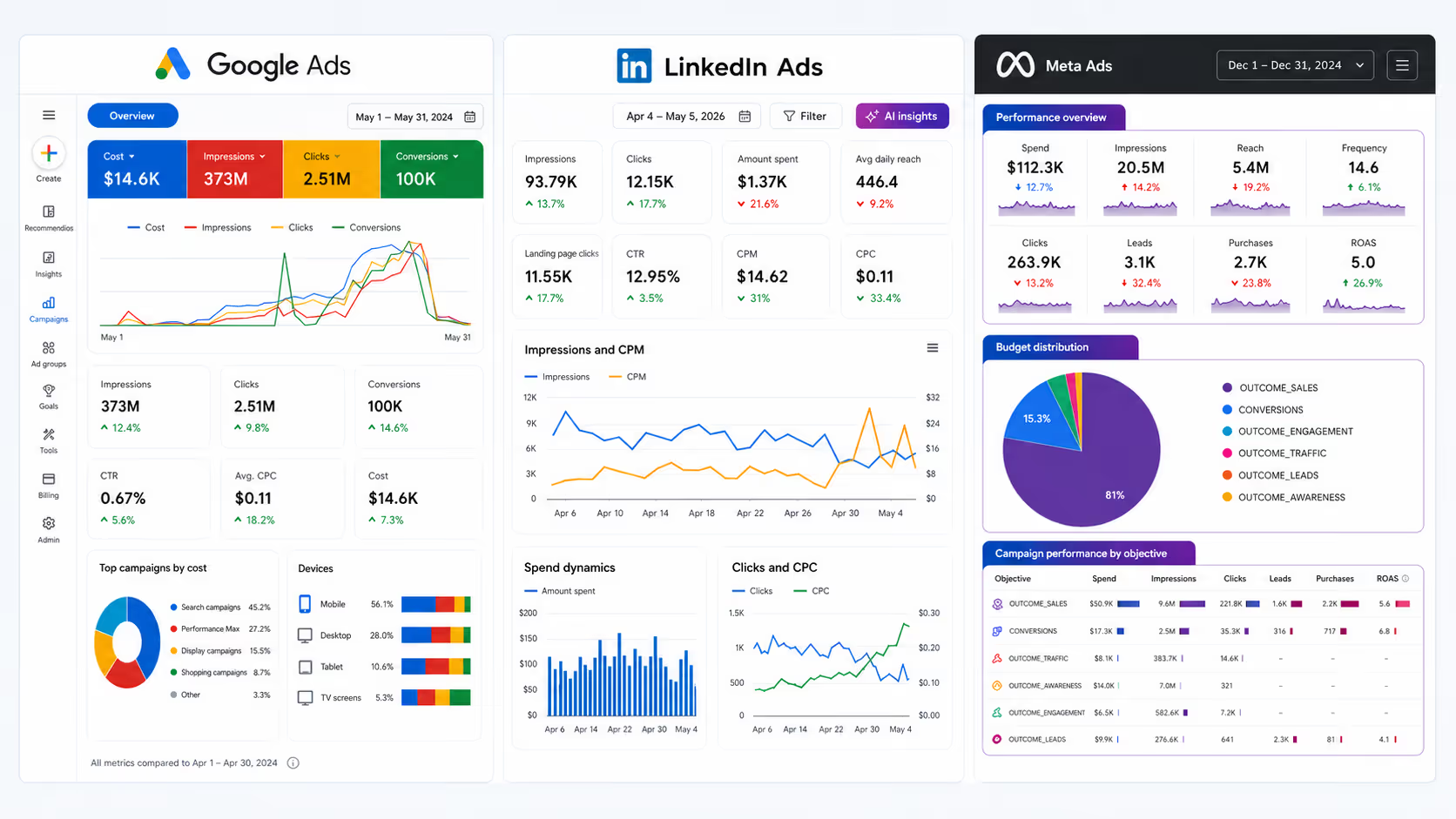
A digital marketing leader recently asked us a sharp question: "If Meta, Google, and LinkedIn already show me my ad performance, why do I need another layer on top?" It's a fair thing to ask. It also contains a quiet assumption that costs B2B marketing teams a great deal of money.
The assumption is that platform reporting is the same thing as marketing intelligence. It isn't. It never has been. The platforms are designed to optimize their outcome, not yours. They are scorekeepers for the game being played inside their own stadium — and they are not, and were never built to be, a coherent picture of your funnel.
Here's what that distinction actually looks like in practice, and why we built AdGenius as a layer above the platforms rather than another one of them.
What you see in Meta, Google, and LinkedIn is platform-level transparency. What AdGenius gives you is business-level intelligence and decisioning across platforms. One tells you what happened inside a walled garden. The other tells you what's actually happening to your pipeline.
Platforms show you what happened inside their walls
Meta Ads Manager is excellent at telling you which ads ran on Meta. Google Ads is excellent at telling you which keywords converted on Google. LinkedIn Campaign Manager is excellent at telling you which sponsored posts performed on LinkedIn.
This is useful. It's also incomplete in ways that quietly drain your budget.
What platforms tell you
- Which ads performed
- Which audiences clicked
- Cost, CTR, conversions
- In-channel ROAS
What platforms can't tell you
- What those users did across other channels
- Whether those conversions were already in your pipeline
- Which accounts actually matter vs. noise
- Where you're double-paying to reach the same people
Every platform has a structural incentive to make its own channel look good. That's not a conspiracy — it's just how attribution works when each platform owns its own ruler. Meta will happily take credit for a conversion that LinkedIn warmed up and Google closed. Google will do the same. Multiply that across four or five paid channels and you don't have measurement; you have a polite fiction with a spreadsheet attached.
02AdGenius shows you what's actually happening across your funnel
This is where the difference stops being theoretical. Take a recent Performance Blueprint we built for a GRC platform running a Q2 paid pilot. The platforms could tell them what their LinkedIn CPMs looked like and what their AdWords spend was returning. What the platforms couldn't tell them was the thing that actually mattered:
/book-a-demo and the giftcard page
No single ad platform will ever surface that picture. Meta doesn't know about your visitor identification. Google can't see what someone did on LinkedIn before they searched. LinkedIn won't tell you that 130 people spent nearly ten minutes on a specific landing page that didn't exist a quarter ago. Each platform sees its own slice. AdGenius sees the whole loaf.
It does this by doing two things the platforms structurally can't do.
Unifying identity across channels
- Connects anonymous traffic to the actual companies and accounts behind it
- Tracks behavior across LinkedIn, Google, programmatic, display, and native — in one identity graph
- Stitches engagement signals into a single account-level timeline instead of four siloed dashboards
Prioritizing who actually matters
- Not all clicks are equal — and platforms don't know that
- Someone spending 9:49 on a high-intent comparison page is not the same human as a 12-second bouncer
- AdGenius converts that into Segment 1 vs. Segment 4 retargeting strategy automatically
The platforms treat both visitors identically. AdGenius treats them as completely different revenue opportunities — because they are.
03Platforms optimize tactics. AdGenius optimizes strategy.
Meta will never tell you, "You're over-invested here, move budget to Google or programmatic." That sentence is not in their incentive structure. It can't be. Their reporting is built to defend their channel, not to suggest the channel isn't working as hard as the others.
Platforms optimize within a channel. AdGenius optimizes across them.
Concretely, that looks like reallocating budget across LinkedIn, Google, display, programmatic, and ABM based on where incremental performance actually exists — not where the platform tells you performance exists. It looks like preventing channel overlap, where you're paying three times to reach the same buying committee. It looks like surfacing the moments where your highest-intent visitors are being completely missed by retargeting because the pixel logic is fragmented across four ad accounts.
This is the difference between a tactician and a strategist. Both are valuable. Only one of them tells you when to stop doing what you're doing.
04Platforms report conversions. AdGenius diagnoses leakage.
This is where the gap becomes uncomfortable for most marketing leaders, because it's where the bill comes due.
A platform says "You got 32 conversions this month."
AdGenius says "Your bounce rate climbed from 60% to 66% while traffic grew. You're paying to drive visitors who leave immediately. Your highest-intent cohort isn't being retargeted, and 130 people spent ten minutes on a page that has no follow-up sequence behind it."
Those are not the same level of insight. One is a number on a dashboard. The other is a sentence that changes what you do tomorrow morning.
This is the entire reason AdGenius exists as a layer above the platforms rather than a replacement for them. You still need Meta to run Meta ads. You still need Google to run search. What you don't have — and what no individual platform will ever build for you — is the connective tissue that turns four sets of in-channel reports into one coherent answer to the question your CFO is actually asking, which is: "Where is the money going, and what is it buying us?"
Ad platforms show marketing performance. AdGenius shows pipeline impact.
This is the punchline that lands in the CRO meeting:
- Identifies in-market accounts already engaging with your brand
- Suppresses closed-won and existing pipeline accounts via burn-pixel logic, so you stop paying to retarget customers
- Connects ad spend directly to opportunity creation in your CRM, not just clicks in a platform UI
The platforms don't know your Salesforce reality. AdGenius is built around it.
Platforms = fragmented datasets. AdGenius = unified CDP plus activation layer.
If you've ever tried to manually stitch ad platform data, web analytics, CRM activity, and intent signals into a single account view, you already know what we're solving. AdGenius combines:
- CRM data (accounts, opportunities, lifecycle stage)
- Web behavior (page-level intent, session quality, return visits)
- Ad engagement across all paid channels
- First-party identity resolution and visitor-to-account mapping
...into a single profile you can actually act on — not five exports waiting for someone to reconcile them in a Google Sheet at 11pm on a Thursday.
The simplest way to think about it
Most teams think they have an ad performance problem. They usually don't.
What they actually have, in some combination, is:
- A visibility problem across channels
- An identity problem — they don't know who is actually engaging
- A budget allocation problem dressed up as an optimization problem
The platforms cannot solve any of those — because they are the silos. Asking Meta to fix your cross-channel attribution is like asking one player on a team to explain the strategy of the entire league. They have an excellent view of their own performance. They have no view at all of yours.
Platforms tell you how each player performed.
AdGenius tells you why you're losing games — and what lineup to run instead.
Where to go from here
If any of this sounds like the kind of conversation you've already had internally — about why your dashboards don't agree, why retargeting feels leaky, why your CFO keeps asking questions you can't fully answer — that's exactly the gap AdGenius was built to close. The platforms aren't going anywhere. They shouldn't. They're just not the right vantage point to run a multi-channel B2B program from.
The right vantage point is one level up.
See what your funnel actually looks like.
If you want a real picture of where your paid spend is leaking, where your highest-intent accounts are going un-retargeted, and how to reallocate budget across channels — we'll build you a custom Performance Blueprint. No platform can produce one. That's the point.
Book a 15-min AdGenius walkthrough Explore AdScopeAbout AdGenius by LeadGenius — AdGenius is a cross-channel paid media intelligence and optimization platform built for B2B marketing teams. We unify identity, engagement, and spend across LinkedIn, Google, programmatic, display, and ABM into a single decisioning layer — so you can stop optimizing channels and start optimizing pipeline.
.avif)