What Does an AdGenius Performance Blueprint Consist Of?
An AdGenius Performance Blueprint is a custom, data-driven paid media diagnosis that combines funnel analysis, channel strategy, audience targeting, a 90-day flight plan, and KPI targets to show digital marketing leaders exactly where demand is leaking and what to do next.
Guide
Most paid media audits are either too shallow to be useful or too generic to change anything.
An AdGenius Performance Blueprint is different. It is not a templated checklist or a vague “here are some ideas” document. It is a custom, data-driven breakdown of how a company’s paid media engine is actually performing, where demand is leaking, and what should happen next. It is built from real ad account data, website behavior, CRM context, and visitor-level signals so the output is practical, not theoretical. See the example below.
Executive Brief & Action Plan
What this Performance Blueprint means — and what to do about it
The Big Picture
You don't have a traffic problem. You have a conversion problem — and a goldmine you haven't mined yet.
Organic traffic has quadrupled (~17/day → ~71/day). LinkedIn is your #1 social channel (192 users/month) and Google AdWords is already converting. But there's a problem hiding in the good news: bounce rate got worse (60% → 67%). More people are arriving, and more are leaving faster.
Meanwhile, 232 people have visited demo pages — 102 standard, 130 on the giftcard page — and the giftcard visitors spent nearly 10 minutes there without a single follow-up ad being served to them.
This Performance Blueprint's $10K/month isn't about finding an audience. It's about amplifying what's already working and converting the warm pool that already knows you. Fix bounce rate in parallel and you'll get disproportionate returns from the same spend.
The Diagnosis
Where the Performance Blueprint is pointing you
Not the problem
Top of funnelTraffic is already 4x up
→
The real problem
Middle of funnelConvert the 232 raised hands
Key Takeaways
8
1
Retargeting is your #1 unlock
232 demo-intent visitors haven't seen follow-up ads. Likely 15+ incremental bookings from this cohort alone.
2
The giftcard page is a hidden signal
130 visitors, 9:49 avg time on page. These are your hottest leads — treat as a separate, higher-priority segment.
3
LinkedIn is proven — don't overthink it
#1 organic social source already. Paid just scales a known winner. Don't test exotic audiences.
4
Bounce rate is the bottleneck
Driving more traffic to pages that bounce at 67% wastes paid spend. Fix landing pages = more demos from same $10K.
5
Canada is quietly #2
118 users, 5.6% of traffic. Worth a small English-Canada LinkedIn test in Month 2.
6
UAE punches above weight
46 users averaging 10+ minutes on site — high-intent enterprise prospects worth targeted ABM.
7
A cyber newsletter is already sending traffic
dispatch.cybersecurityhq.com drove 28 organic users. A sponsored placement would be cheap and highly targeted.
8
AdWords is already converting
35 users/month at current spend. Scaling to $2,500/mo should 7–10x volume if keywords and LPs hold up.
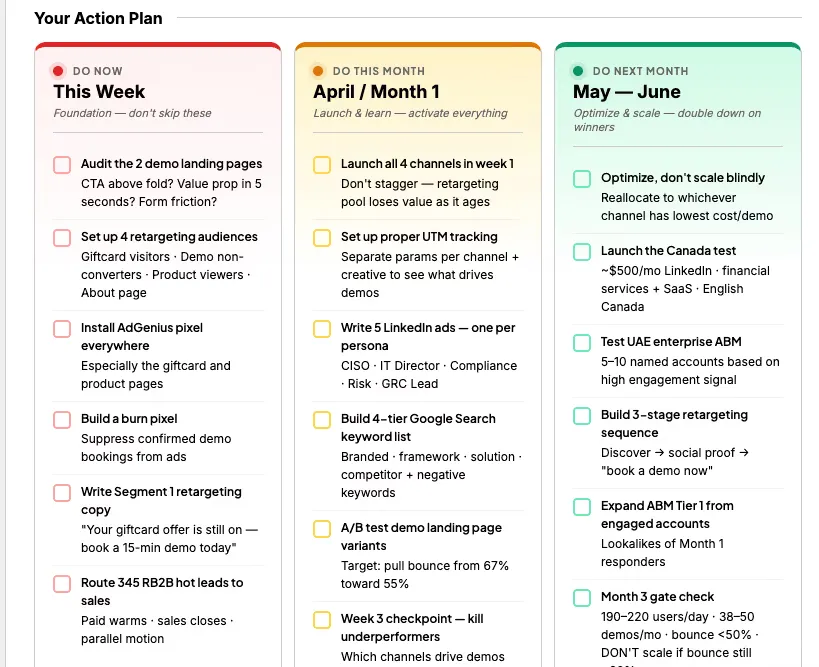
Your Action Plan
Do Now
This Week
Foundation — don't skip these
Audit the 2 demo landing pagesCTA above fold? Value prop in 5 seconds? Form friction?
Set up 4 retargeting audiencesGiftcard visitors · Demo non-converters · Product viewers · About page
Install AdGenius pixel everywhereEspecially the giftcard and product pages
Build a burn pixelSuppress confirmed demo bookings from ads
Write Segment 1 retargeting copy"Your giftcard offer is still on — book a 15-min demo today"
Route 345 RB2B hot leads to salesPaid warms · sales closes · parallel motion
Do This Month
April / Month 1
Launch & learn — activate everything
Launch all 4 channels in week 1Don't stagger — retargeting pool loses value as it ages
Set up proper UTM trackingSeparate params per channel + creative to see what drives demos
Write 5 LinkedIn ads — one per personaCISO · IT Director · Compliance · Risk · GRC Lead
You don't have a top-of-funnel problem. You have a middle-of-funnel problem.
People are finding you — traffic is up 4x. They're interested enough to visit demo pages — 232 of them. Your job isn't to find more people. It's to convert the ones already raising their hand. Prioritize everything through that lens.
The full data, channel breakdowns, and KPI targets follow below ↓
Performance Blueprint — Acme INC Q2 2026 Pilot
April – June 2026 · $10,000/month · 4-channel mix · Powered by RB2B + AdGenius pixel data
102 /book-a-demo non-converters130 /book-a-demo-giftcardAdGenius pixel segmentsRB2B 345 hot leads
ABM display$1,500/mo · 15%
FormatDisplay · named accounts
Est. CPM$35–50
Impressions/mo~35,000
Est. CTR0.20%
Est. clicks/mo~70
Est. visitors/mo~55
Deloitte, IBM, Bain, ServiceNowWells Fargo, HCA, LogicGateRB2B enterprise named list
Updated channel logic: LinkedIn is confirmed as the dominant traffic driver — 192 organic users/month, making it the #1 social source. Paid LinkedIn will amplify a channel already proven to work. AdWords is now confirmed active (35 users) — increasing to $2,500/mo will scale what's already converting. The retargeting pool has grown: 102 standard /book-a-demo visitors plus 130 /book-a-demo-giftcard — 232 total warm prospects vs. 120 previously.
New signal — /book-a-demo-giftcard (130 visitors, avg 9:49 time on page): 130 people spent nearly 10 minutes on average — exceptional engagement. These should be Segment 1 in retargeting, above standard /book-a-demo visitors. Creative: "You've been considering Acme INC. The giftcard offer is still available — book your 15-min demo today."
Now live
Month 1 — April
Launch · $10,000 · Baseline ~71/day organic
LinkedIn ads$3,500
Google Search$2,500
Programmatic retargeting$2,500
ABM display$1,500
Target users/day 120–150
Target demos +20–28
Priority: Activate 232 demo intent retargets Day 1
Optimize
Month 2 — May
Optimization · $10,000
LinkedIn ads$3,500
Google Search$2,500
Programmatic retargeting$2,500
ABM display$1,500
Target users/day 155–185
Target demos +28–38
Focus: Pause low performers, optimize bounce rate
Month 3 — June
Scale + prove · $10,000
LinkedIn ads (top performer)$3,500
Google Search$2,500
Programmatic retargeting$2,500
ABM display$1,500
Target users/day 190–220
Target demos +38–50
Focus: Scale winners, reduce bounce 66% → 48%
Why targets are revised up: The prior Blueprint assumed a ~17/day baseline. New data shows Acme INC is already at ~71 users/day organically — a 4x improvement before paid media even launches. With $10K/month paid on top of a 71/day organic floor, Month 3 can realistically reach 190–220 combined users/day.
Key issue — bounce rate: Bounce rate worsened from 60.25% → 66.57% despite traffic growth. Paid media spend risks driving traffic that immediately leaves. Before scaling beyond $10K/month, Acme INC needs CTA improvements, clearer value prop above the fold, and retargeting creative sequences matched to each visitor segment.
LinkedIn targeting
Confirmed working: LinkedIn already driving 192 organic users/month — #1 social source. Paid amplifies a proven channel.
Job titles: CISO, VP Information Security, Director Compliance, GRC Manager, Chief Risk Officer, IT Director
Seniority: Director, VP, C-suite, Senior Manager
Industries: Financial Services, IT/SaaS, Healthcare, Government, Energy
Company size: 201–10,000 employees
Gender split: 53.99% male / 46.01% female — message both equally
Top age bands: 18–24 (30.1%) and 35–44 (26.8%) — skewing younger than expected
ABM Tier 2: Veeam, Datadog, LogicGate, Boehringer Ingelheim, Mount Sinai, Commonwealth of MA
Messaging: "Your team already explored Acme INC — ready for the full platform demo?"
New signal — dispatch.cybersecurityhq.com (28 users, 20-sec avg session): A cybersecurity newsletter is already referring traffic to Acme INC. Worth exploring a sponsored placement there as a low-cost complement to paid media. Cybersecurity newsletter readers are high-intent GRC prospects by definition.
LinkedInGoogle SearchProgrammaticABM display
Channel
Budget
Apr
May
Jun
Apr CPV
Jun CPV
LinkedIn
$3,500
310
390
460
$11.29
$7.61
Google Search
$2,500
260
320
380
$9.62
$6.58
Prog. retargeting
$2,500
520
600
670
$4.81
$3.73
ABM display
$1,500
55
68
80
$27.27
$18.75
Total paid
$10,000
1,145
1,378
1,590
$8.73
$6.29
* Organic baseline: ~71/day (2,126/mo). Combined paid + organic Jun projected: ~2,620–2,720/month. Primary KPI: demo bookings — target 38–50/month by Month 3 (vs. 32 current conversions).
Revised success metrics at Month 3: Users/day reaching 190–220+, demo bookings growing from 32 to 45+, bounce rate improving from 66.57% toward 48%, /book-a-demo-giftcard cohort driving at least 15 incremental demos via retargeting, and blended CPV below $6.30.
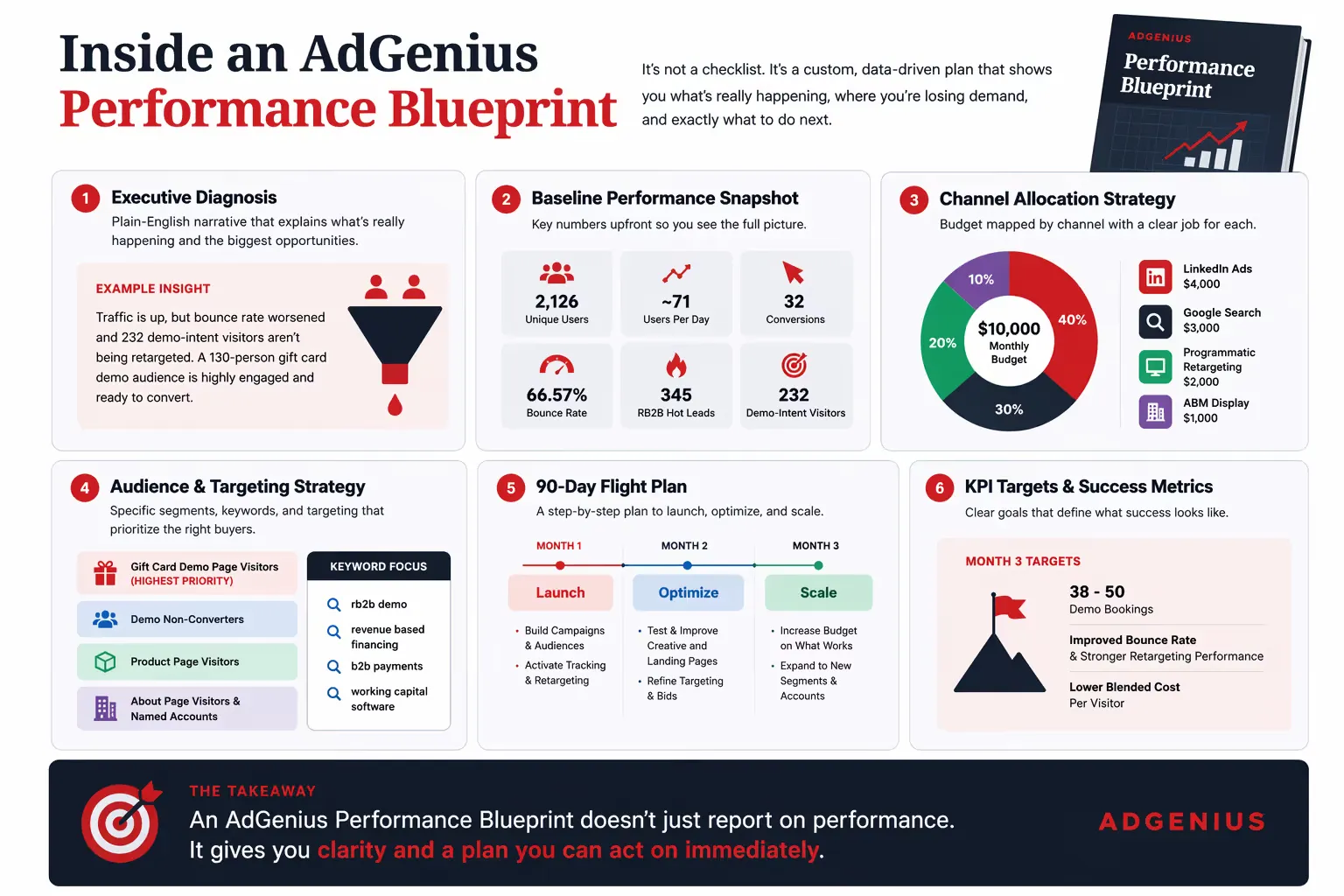
At its core, the blueprint consists of six major pieces.
First, it includes an executive diagnosis. This is the plain-English narrative that explains what is really happening in the funnel. In the Acme INC example, the big takeaway was not “go buy more traffic.” It was that traffic had already grown significantly, while bounce rate worsened and a large pool of demo-intent visitors was sitting unworked. The blueprint surfaced 232 warm demo-page visitors, including a 130-person gift-card page audience with exceptionally high engagement. That turns a fuzzy marketing conversation into a very clear business problem.
Second, it includes a baseline performance snapshot. That means the important numbers are laid out immediately: unique users, daily traffic, conversions, bounce rate, warm leads, demo-intent visitors, and current paid media conditions. In the Acme INC blueprint, that included 2,126 unique users, roughly 71 users per day, 32 conversions, a 66.57% bounce rate, and 345 RB2B hot leads.
Third, it includes a channel allocation strategy. The blueprint does not just say “test LinkedIn” or “maybe try Google.” It maps budget by channel and ties each one to a job. In this example, spend was distributed across LinkedIn ads, Google Search, programmatic retargeting, and ABM display, each with projected traffic contribution and a specific role in the mix.
Fourth, it includes audience and targeting strategy. This is where the blueprint gets specific about who to target, how to segment them, and which audiences deserve priority. That includes LinkedIn personas, retargeting pools, keyword groups, named accounts, geographies, negative keywords, and messaging angles. In the Acme INC version, the highest-priority segment was gift-card demo-page visitors, followed by standard demo non-converters, product-page visitors, and about-page viewers.
Fifth, it includes a monthly flight plan. This is the action layer. The blueprint typically lays out a 90-day sequence: launch in Month 1, optimize in Month 2, and scale in Month 3. It also calls out what has to be fixed before scale happens, like landing page friction or bounce rate problems, so the team does not pour more money into a leaky funnel.
Finally, it includes KPI targets and success metrics. This means clear goals for traffic, demos, efficiency, and conversion improvement. In the Acme INC example, the blueprint set a Month 3 target of 38–50 demo bookings, improved bounce rate, stronger retargeting performance, and lower blended cost per visitor.
That is really what makes an AdGenius Performance Blueprint valuable. It is not just a report. It is a decision document. It shows where the opportunity already exists, where budget is being wasted, and what a smarter 90-day plan should look like.
The best part is that it gives digital marketing leaders something most audits do not: clarity they can act on immediately.
Share
Related Resources
Guide
The Performance Blueprint: Your paid media decoded.
Most B2B companies spend thousands on digital ads every month and have no idea what's actually working. The AdGenius Performance Blueprint is a comprehensive, data-driven audit that strips away the guesswork—showing you exactly where your budget is producing results, where it's leaking, and what to do about it.
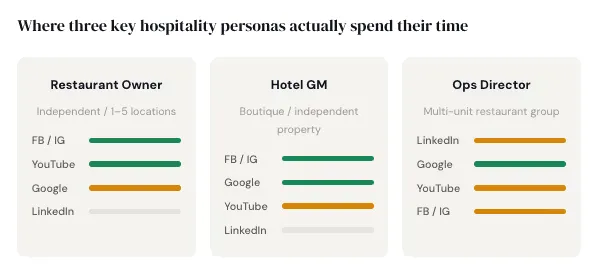
How the Performance Blueprint Changes the Conversation for Digital Marketers in Hospitality SaaS
Most B2B SaaS marketing playbooks were built for selling to knowledge workers — people who sit at computers eight hours a day, browse LinkedIn during lunch, and evaluate software by downloading whitepapers and attending webinars.
Why multichannel marketing breaks down in B2B and how to fix it
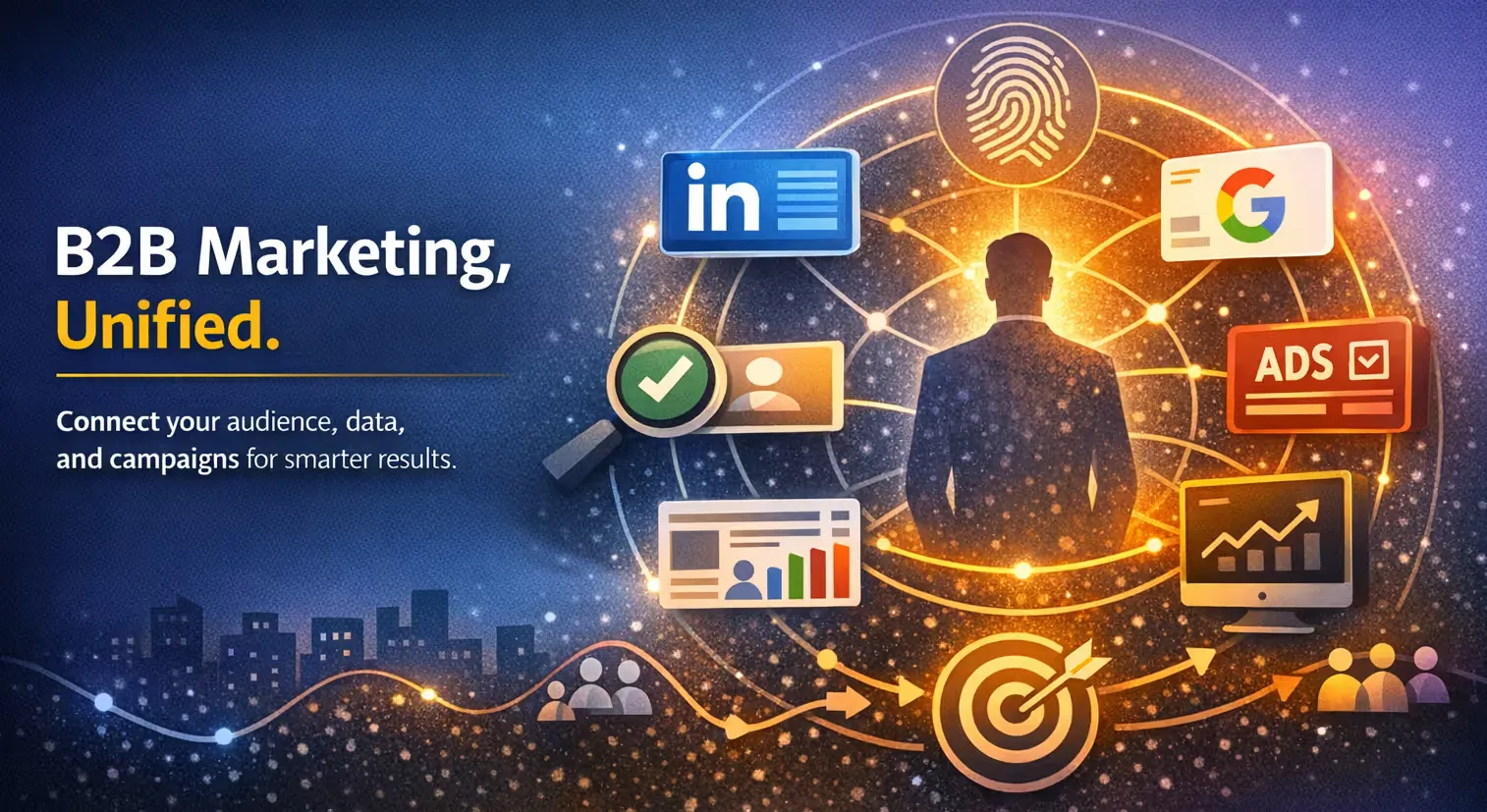
AdGenius helps B2B marketers turn disconnected paid channels into one coordinated growth engine by improving audience quality, identity resolution, frequency control, and cross-channel optimization. Instead of letting LinkedIn, Google, Meta, and programmatic operate in silos, AdGenius helps teams reach the right buyers with a consistent story, lower wasted spend, and measure performance against real revenue outcomes.