
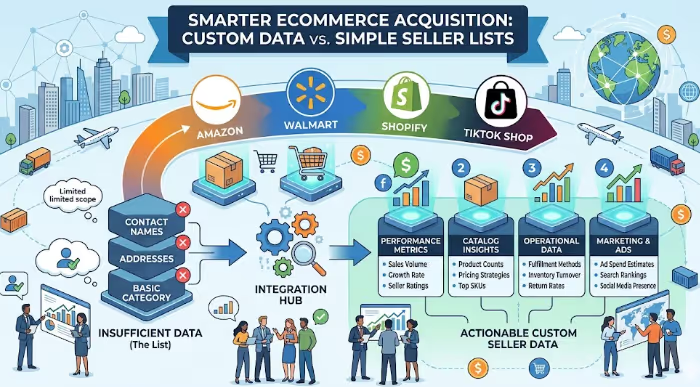
Amazon Seller and Shopify Store Data: Why a Seller List Is Not a Marketplace Acquisition Strategy
A seller list is not a marketplace acquisition strategy. Learn how custom ecommerce seller data helps marketplace, fintech, logistics, and SaaS teams identify and reach the right merchants across Amazon, Shopify, TikTok Shop, Walmart, and beyond.
A Seller List Is Not a Marketplace Acquisition Strategy
Search for "Amazon seller list" or "Shopify stores database," and you will find plenty of options. Some promise millions of sellers. Some offer merchant exports. Some scrape storefronts. Some provide store URLs, categories, product counts, estimated traffic, or generic contact information.
That can be useful. But it is not a marketplace acquisition strategy.
A marketplace team does not need a random list of sellers. It needs to know which sellers are worth pursuing, which ones fit the ideal profile, which ones are expanding, which ones are reachable, and which message will make them pay attention.
If your team is recruiting merchants for a marketplace, selling ecommerce software, targeting Shopify brands, expanding a seller ecosystem, building a partner channel, or identifying cross-border ecommerce opportunities, a basic seller database will only get you part of the way there.
The real value comes from qualified seller intelligence. That means seller category, product type, storefront activity, country, platform, contact details, growth signals, social footprint, technology usage, fulfillment indicators, marketplace presence, ownership information, and enough context to segment the seller into a real campaign.
In other words, you do not need more ecommerce data. You need ecommerce data that explains who to target and why.
Why Generic Seller Databases Underperform
Most ecommerce seller databases are built around what is easy to observe. Storefront URL. Marketplace presence. Product category. Seller name. Review count. Platform. Estimated traffic. Maybe an email. Maybe a social handle.
That data is helpful, but it often misses the questions that matter for GTM execution.
The questions a generic database cannot answer
- Is this seller active and growing?
- Is the seller a brand, reseller, distributor, manufacturer, or dropshipper?
- What country or region does the seller operate from?
- Is there a real business entity behind the storefront?
- Who owns partnerships, operations, logistics, ecommerce, or growth?
- Does the seller use Shopify, WooCommerce, Amazon, Walmart, TikTok Shop, eBay, Faire, or another marketplace?
- Is the seller already selling cross-border?
- Does the seller fit the category, size, price point, or maturity profile we want?
- Can we reach the right person with a verified email or phone number?
- What signal suggests they are ready for our offer now?
A generic seller database might tell you the store exists. It rarely tells you whether the seller belongs in your sales motion.
Marketplace acquisition is expensive. Teams spend money on outbound, paid media, partnerships, events, enablement, incentives, and sales headcount. If the underlying dataset is too broad or poorly qualified, every downstream motion becomes less efficient. Bad seller data creates bad targeting. Bad targeting creates bad conversion. Bad conversion creates the illusion that the market is not interested.
List vs. Intelligence: What's Actually Different
The gap between a seller list and seller intelligence is not a feature gap. It is a structural one. Here is how they compare in practice.
What Qualified Seller Intelligence Should Actually Cover
If you are recruiting merchants, selling to brands, or building a partner channel, the dataset should be built around your acquisition motion. The fields that matter most are usually the ones generic databases skip.
Seller identity and structure
Is this a brand, a reseller, a distributor, a manufacturer, or a dropshipper? Is there a registered business entity behind the storefront? Is the seller part of a larger ownership group operating multiple stores across platforms? These distinctions change everything about how the seller should be approached.
Platform footprint
Sellers rarely live on one platform. A brand may have a Shopify storefront, an Amazon listing, a Walmart marketplace presence, a TikTok Shop, an Instagram shop, and a wholesale Faire account. Understanding the full footprint, not just where you happen to have discovered them, changes how the seller is qualified.
Geography and cross-border activity
For marketplace, logistics, and fintech teams, geography is not just a country filter. It is a signal about expansion stage, payment needs, shipping requirements, and regulatory complexity. A seller already operating across borders has different needs than a domestic-only operator.
Contact path beyond info@
The right contact varies by use case. Partnerships, operations, logistics, ecommerce, and growth functions all sit in different places inside a merchant business. A generic support inbox will not get you to the person who can say yes.
Buying readiness signals
Hiring activity, new product launches, new marketplace listings, recent funding, new fulfillment partners, technology changes, and social engagement patterns all hint at when a seller is in motion. Those signals are the difference between a campaign that interrupts and a campaign that lands at the right time.
Who Needs This Kind of Seller Data
The teams that benefit most from custom seller intelligence are the ones whose entire pipeline depends on identifying the right merchants at the right time:
- Marketplace acquisition teams recruiting sellers to a new platform
- Ecommerce SaaS companies selling to Shopify, BigCommerce, or WooCommerce brands
- Fintech and payments providers targeting merchants by volume or category
- Logistics and fulfillment companies identifying sellers ready to upgrade operations
- Cross-border ecommerce enablers finding sellers expanding into new regions
- Partner and channel teams building reseller or affiliate ecosystems
- Advertising platforms qualifying ecommerce brands by maturity and category
- B2B wholesale platforms recruiting brand suppliers
Platforms and Ecosystems Worth Mapping
Marketplace and ecommerce intelligence is not limited to Amazon and Shopify. The seller universe spans dozens of platforms, each with different sellers, different signals, and different acquisition opportunities.
Questions to Ask Before You Buy Seller Data
The diligence list for marketplace and ecommerce GTM teams
- How do you identify whether the seller is active versus dormant?
- Can you distinguish brands from resellers, distributors, manufacturers, and dropshippers?
- Can you map sellers across multiple platforms?
- Can you provide verified contacts for partnerships, operations, or ecommerce leadership?
- Can you classify by category, price point, and maturity?
- Can you surface growth signals like new launches, hiring, or funding?
- Can you support cross-border identification?
- Can you tie multiple storefronts to a single ownership group?
- Can the audience be refreshed and monitored over time?
- Can you build custom fields specific to our acquisition motion?
If the provider can only answer the first one or two with confidence, you are looking at a list, not an intelligence layer.
The Bottom Line
The teams winning at marketplace acquisition and ecommerce GTM are not the ones with the longest seller list. They are the ones with the right seller intelligence: qualified, segmented, verified, and built around the way they actually go to market.
A static export tells you who exists. A custom merchant dataset tells you who to target, why they fit, when they are in motion, and how to reach the right person inside the business.
That is the difference between buying records and building a pipeline.
Build a custom merchant dataset
Tell us the platforms, categories, seller types, geographies, and signals that matter to your acquisition motion. We will build, verify, and deliver a merchant audience designed around your campaign, not someone else's database.
Build a Merchant Audience →.avif)