Best B2B Data Providers for DACH and Germany: Why Regional Coverage Beats Generic Global Databases
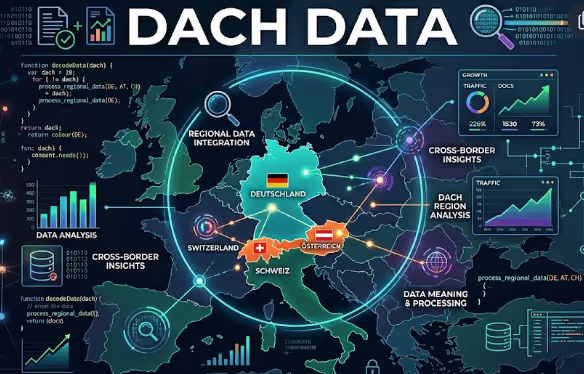
Germany is not just another country filter in your database. DACH is not just "Europe, but German-speaking." Learn what to look for in a regional B2B data provider, and why hierarchy mapping, contact verification, and compliance handling matter more than total record count.
Germany Is Not Just Another Country Filter in Your Database
For a lot of global sales and marketing teams, Germany looks deceptively simple.
You open your sales intelligence platform. You click "Germany." You add a few employee-size filters. Maybe you add "IT," "Operations," or "Finance" as a department. Then the platform spits out a list that looks good enough for a campaign.
And that is usually where the problem starts.
The real question is not whether your vendor has records in the region. The real question is whether those records are useful enough to support your actual go-to-market motion.
That means accurate company coverage. Local title interpretation. Valid contact paths. Verified work emails. Appropriate compliance handling. Location-level accuracy. Parent-child mapping. Buying committee coverage. And enough context to understand why one account should be prioritized over another.
In other words, the best B2B data providers for Germany and DACH are not simply the companies with the biggest European database. They are the providers that can translate a market into an executable sales motion.
That is a very different bar.
Why DACH Data Breaks Generic Sales Intelligence Platforms
Most sales intelligence platforms were built around a simple premise: collect as many companies and contacts as possible, organize them into searchable fields, and let revenue teams filter their way into a list.
That model works best when the market is easy to classify, the titles are easy to normalize, the data sources are abundant, and the buyer is searching for broad coverage rather than precision.
DACH rarely works that way.
Germany, Austria, and Switzerland have distinct business structures, different market behaviors, different privacy expectations, and different levels of data availability. If your vendor treats them like a generic regional dropdown, your campaigns will inherit all the gaps.
A German company may have multiple legal entities, regional offices, operating divisions, subsidiaries, and local branches that do not map neatly to the global parent record. A person's title may not translate cleanly into an American-style job function. The "right" contact may sit in a local operating unit rather than at the global headquarters. Phone coverage may vary widely by role and source. Direct outreach may require more careful compliance handling than a generic U.S. outbound campaign.
International GTM does not fail all at once. Sales reps stop trusting the list. SDRs burn time on dead ends. Marketing runs campaigns into the wrong contacts. Regional teams complain that headquarters does not understand the market. Pipeline targets get missed, and everyone starts blaming execution. But execution was not the original problem. The original problem was that the data was not built for the market.
What the Best DACH B2B Data Providers Should Actually Deliver
If you are evaluating B2B data providers for Germany or DACH, the buying criteria should go beyond "Do you have contacts in Germany?" That question is too easy.
A better question is: "Can you build a dataset that reflects how our buyers actually exist in this market?"
-
Local company coverage, not just global headquarters
For DACH campaigns, company identity is often more complicated than a single domain and a single HQ address. You may need to know the operating location, the regional subsidiary, the local office, the branch network, the franchise unit, the dealer location, the manufacturing site, or the business unit that actually owns the problem you solve.
A generic global record often collapses those distinctions. That is fine for a dashboard. It is not fine for outbound. For revenue teams, hierarchy mapping is not an academic exercise. It determines account ownership, routing, territory planning, ABM strategy, and whether the rep actually knows who to call.
-
German-language title interpretation
A title is not useful just because it is translated. It has to be interpreted. Many sales intelligence tools normalize global titles into broad departments and seniority levels. That may work for simple segmentation, but it can fail when your campaign depends on identifying a very specific operational buyer, technical influencer, regional decision-maker, or functional owner.
The question is not only, "What does this title mean in English?" The better question is, "Would this person actually be involved in the buying process for this product?"
-
Contact verification that reflects regional realities
In many international markets, contactability is the hardest part of data quality. A vendor may have names and titles. That does not mean they have verified emails, working phone numbers, accurate locations, or enough confidence for a sales team to act.
The strongest providers combine automation with research, validation, QA, and market-specific review. That is where the difference between a list and a usable dataset becomes obvious.
-
Compliance-aware sourcing and delivery
DACH buyers tend to be more sensitive to data privacy, and global revenue teams need a provider that understands compliance as part of the workflow, not a PDF attached after the sale. A strong provider should help teams understand where the data came from, when it was sourced, how it was verified, and how it can be used.
Compliance is not the opposite of growth. In international markets, compliance is what lets growth scale without creating unnecessary risk.
-
Custom segmentation and account signals
The biggest mistake teams make in DACH is assuming that firmographics are enough. Industry, revenue, employee count, and country are useful, but they rarely explain timing, propensity, or fit. The more specific your product, the more likely you need custom signals such as installed technologies, hiring trends, new office openings, funding or ownership changes, partner relationships, product launches, ecommerce activity, social presence, local market expansion, supply chain signals, website language and localization, and specific certifications or licenses.
Why LeadGenius Is Different for Germany and DACH
LeadGenius is built for GTM teams that have outgrown the limits of static data. That usually happens when a company moves into a new region, expands into a more specific segment, needs buying committee coverage, or discovers that its existing database is not good enough outside its home market.
The LeadGenius model is different because it does not start with the assumption that one prebuilt database already has the answer. It starts with the customer's actual GTM motion:
- Who are you trying to reach?
- Which countries matter?
- Which accounts are truly in-market?
- Which locations are relevant?
- Which personas belong in the buying committee?
- Which custom fields would make this campaign perform better?
- Which signals should trigger prioritization?
Then LeadGenius builds, verifies, enriches, and delivers the data around that use case. That difference is especially important in DACH because regional nuance is not optional. It is the whole game.
For example, Workplace by Facebook needed quality international contact data across EMEA, LATAM, APAC, and North America after falling into the trap of buying contact lists that created poor quality and low coverage. Intercom needed one provider for global data coverage across teams and regions, and its global sales team saved thousands of hours while sourcing tens of thousands of targeted contacts.
Those examples point to the same lesson: global data quality is not about claiming coverage everywhere. It is about being able to produce useful data where your team actually needs to sell.
Questions to Ask Before Choosing a Germany or DACH Data Provider
Before you choose a provider, ask questions that expose whether the vendor has real regional capability or just international inventory.
- How do you source and verify contacts in Germany, Austria, and Switzerland?
- Can you support German-language title interpretation and persona mapping?
- Can you identify local branches, subsidiaries, operating units, and parent-child relationships?
- Can you build custom fields beyond standard firmographics?
- Can you map buying committees across departments?
- Can you provide verification details and source-level transparency?
- Can you support compliance review and suppression workflows?
- Can you refresh or monitor the data over time?
- Can you deliver a sample based on our actual ICP rather than a generic export?
The answer you want is not "Yes, we have DACH data." The answer you want is "Show us your ICP, your target countries, your required fields, and your campaign motion. We will show you what is findable, verifiable, and usable."
That is the difference between buying records and building a market.
The Bottom Line
The best B2B data provider for Germany and DACH is not necessarily the vendor with the largest database. It is the provider that can produce the most accurate, compliant, and campaign-ready dataset for your specific market motion.
If you are running a generic global campaign, a static database may be good enough. But if you are building pipeline in Germany, expanding across DACH, launching regional ABM, mapping buying committees, or asking reps to trust the data, then "good enough" becomes expensive very quickly.
Germany is not just another country filter. DACH is not just another regional checkbox. And international pipeline does not come from pretending every market behaves the same. It comes from building the data around the way the market actually works.
Request a DACH coverage sample
See what LeadGenius can find, verify, and enrich for your target market. Bring us your ICP, target countries, and required fields, and we will show you what is actually findable.
Request a Sample →.avif)