
Best Sales Intelligence Tools for International Sales Teams
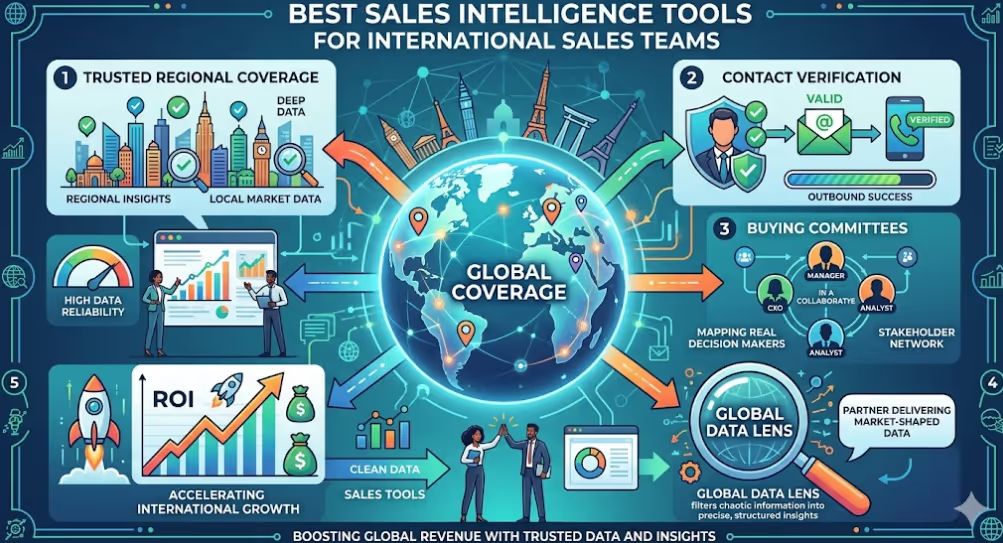
International sales teams need more than a large database. They need regional coverage they can trust, contact verification that holds up under outbound, buying committees that reflect the real sales process, and a partner who can deliver data shaped by the market, not the other way around.
The Problem With "Global" Sales Intelligence
Every sales intelligence platform says it has global coverage. That is the easy claim. The harder question is whether the data is good enough to support an international revenue motion.
There is a huge difference between a platform that contains international records and a sales intelligence partner that can help your team build pipeline across regions. One gives you searchable inventory. The other gives you market coverage, contact confidence, compliance support, and the ability to execute campaigns in countries where your existing database starts to fall apart.
When buyers search for the best sales intelligence tools for international sales, they are not really asking which platform has the most records. They are asking: which partner can actually support my international GTM motion?
A sales team expanding into the UK has a different problem than a team expanding into Germany. A LATAM campaign has different data challenges than an APAC campaign. A named-account strategy in EMEA requires different buying committee coverage than a mid-market outbound motion in North America. Phone coverage, title normalization, language, legal structure, corporate hierarchy, privacy expectations, and source availability all change by market.
Why International Sales Breaks Standard Data Tools
Most sales intelligence tools were designed to make prospecting faster. They help teams search for companies, filter by firmographics, find contacts, export lists, and push data into CRM or sales engagement tools. That is useful. But it is not the same as international readiness.
Regional coverage is uneven
A provider may be strong in North America and thin in Brazil. Strong in the UK and weak in Eastern Europe. Strong in enterprise software and weak in local services. Strong in headquarters data and weak in branch-level data.
The issue is not whether the vendor has "global" data. The issue is whether they have the specific coverage your campaign requires. If you sell to manufacturers in Germany, fintech companies in Singapore, restaurant groups in Mexico, or healthcare providers in the UK, generic global coverage does not tell you enough. You need data matched to your market, segment, persona, and motion.
Phone and email quality varies by country
In the U.S., many teams expect broad email coverage, mobile phone availability, and direct dial access. Those expectations do not translate cleanly across every international market. Some regions have less reliable phone coverage. Some have different business communication norms. Some have stricter privacy expectations. Some have fewer public sources for certain roles.
A tool that works well for U.S. SDRs may produce disappointing results when dropped into a global outbound program without regional validation.
Titles do not always normalize cleanly
International sales teams often rely on title-based targeting, but title normalization becomes messy across languages and business cultures. A literal translation may not identify the true buying role. A seniority label may not reflect actual influence. A department category may hide important differences between local operations, regional ownership, and global decision authority.
Company hierarchy gets more complicated
Global accounts are rarely simple. A target company may have regional subsidiaries, local offices, parent entities, holding companies, franchise locations, distributors, partners, or operating units. The right record may not be the global parent. The right contact may not sit at headquarters.
If your sales intelligence tool cannot map those relationships, your CRM becomes a junk drawer with nicer labels.
Compliance is not a footnote
International data has to be handled with more care. Privacy rules, sourcing transparency, suppression requirements, lawful basis, consent expectations, and outreach channel restrictions can vary by region. For global revenue teams, compliance cannot be handled after the list is purchased. It needs to be part of the data strategy from the beginning.
What to Look For in a Sales Intelligence Tool for International Sales
If your company is expanding globally, evaluating sales intelligence tools should be less about feature checklists and more about risk reduction. The right tool should help you answer five questions.
-
Can we trust the data in the specific countries we care about?
Do not accept a generic global coverage claim. Ask for market-specific proof. If your target regions are DACH, UK, France, Benelux, Nordics, Brazil, Mexico, Australia, Singapore, India, Japan, or Eastern Europe, ask what coverage looks like in those exact markets. Better yet, ask the provider to build or enrich a sample based on your actual ICP.
-
Can the provider support our actual buyer model?
International sales rarely depends on one contact per account. If your motion requires multiple personas, the provider should be able to map buying centers across departments, regions, and seniority levels. Salesforce's global ABM challenge is a useful example: the team needed at least two contacts per buying center globally across IT, service, marketing, and sales to execute ABM playbooks. That is a different problem than simply buying one decision-maker per account.
-
Can the provider produce custom data points?
The future of GTM data is not bigger databases. It is more specific intelligence. International sales teams often need custom fields that standard platforms do not carry. The provider should be able to build data around your sales motion instead of forcing your strategy into their default filters.
-
Can the data be refreshed, monitored, and operationalized?
International data decays quickly. People change roles. Companies open offices. Subsidiaries restructure. Hiring patterns shift. SAP's use case points to this evolution. Instead of relying only on named account lists, the team wanted dynamic signals about companies and contacts to determine when, who, and why to reach out. That is the difference between list building and account intelligence.
-
Can the provider deliver into our workflow?
The best data is useless if it cannot be activated. International teams need delivery models that work with their CRM, marketing automation platform, sales engagement tools, regional routing rules, data governance processes, and campaign timelines. A sales intelligence tool should make your GTM system cleaner, not more chaotic.
LeadGenius: Built for Complex Global GTM Motions
LeadGenius is a strong fit for international sales teams because it is not built around the assumption that every customer wants the same database. LeadGenius delivers real-time, compliant B2B contact data powered by AI and human-in-the-loop research, with global coverage and flexible delivery.
The best use cases tend to come from teams that are doing one of the following:
- Expanding into a new country or region
- Building a global named-account program
- Filling gaps in existing CRM coverage
- Replacing poor-quality international list purchases
- Mapping buying committees across multiple personas
- Enriching inbound leads with business identities
- Building custom segments that prebuilt tools do not support
- Monitoring account signals across global territories
Workplace by Facebook
Replaced poor-quality international list purchases with verified contact data across EMEA, LATAM, APAC, and North America.
Intercom
Sourced tens of thousands of targeted contacts and saved thousands of hours for its global sales team.
Google Cloud
Improved global named-account coverage and turned generic inbound emails into business contacts.
Salesforce
Achieved complete buying-center coverage to support global ABM playbooks across IT, service, marketing, and sales.
Different companies. Same underlying issue. International sales intelligence is not just about finding more contacts. It is about building the data foundation that lets global teams prioritize, route, personalize, and execute with confidence.
Where Standard Sales Intelligence Tools Still Fit
This is not an argument that every company should abandon standard sales intelligence platforms. Tools like ZoomInfo, Apollo, Lusha, Cognism, Clearbit, and others can be useful for broad prospecting, quick lookups, U.S.-heavy motions, simple list building, and rep-driven workflows.
The problem appears when teams ask those tools to solve problems they were not designed to solve. If your market is broad, your targeting is simple, and your data requirements are standard, a self-serve platform may work well.
But if you need accurate regional coverage, custom segmentation, compliance-aware sourcing, buying committee mapping, global account hierarchy, or enrichment in hard-to-cover markets, you may need a different approach. That is where LeadGenius fits, not as another database to search, but as a custom data partner for the markets and segments your existing tools cannot reach well enough.
The Bottom Line
The best sales intelligence tool for international sales is not always the one with the biggest logo wall or the largest database. It is the one that can answer your regional GTM question with useful, verified, compliant, and campaign-ready data.
International sales teams do not need another generic export. They need market coverage they can trust. They need contacts their reps can actually reach. They need buying committees that reflect the real sales process. They need data that understands countries, languages, hierarchies, compliance, and custom signals.
They need a partner that can say, "Show us the market you want to win, and we will build the data around it." That is the future of sales intelligence.
Request a regional coverage test
See how LeadGenius performs against your target market, ICP, and required personas. We will build a sample dataset against the exact countries, segments, and contact profiles that matter to your motion.
Request a Coverage Test →.avif)