
There’s something revealing about the way new categories get introduced.
The language centers on improvement. Efficiency. Lift. Better inputs. Higher percentages.
The story is always about progress — rarely about structure.
Clay’s move into advertising follows that familiar arc.
The premise sounds reasonable: take the data already sitting inside your CRM, enrich it with additional identifiers, and increase the likelihood that platforms can recognize those people. The outcome is measurable. Match rates climb. Campaign setup feels more successful. Fewer records disappear into the void.
That is real progress. It is also not the problem that defines modern B2B advertising.
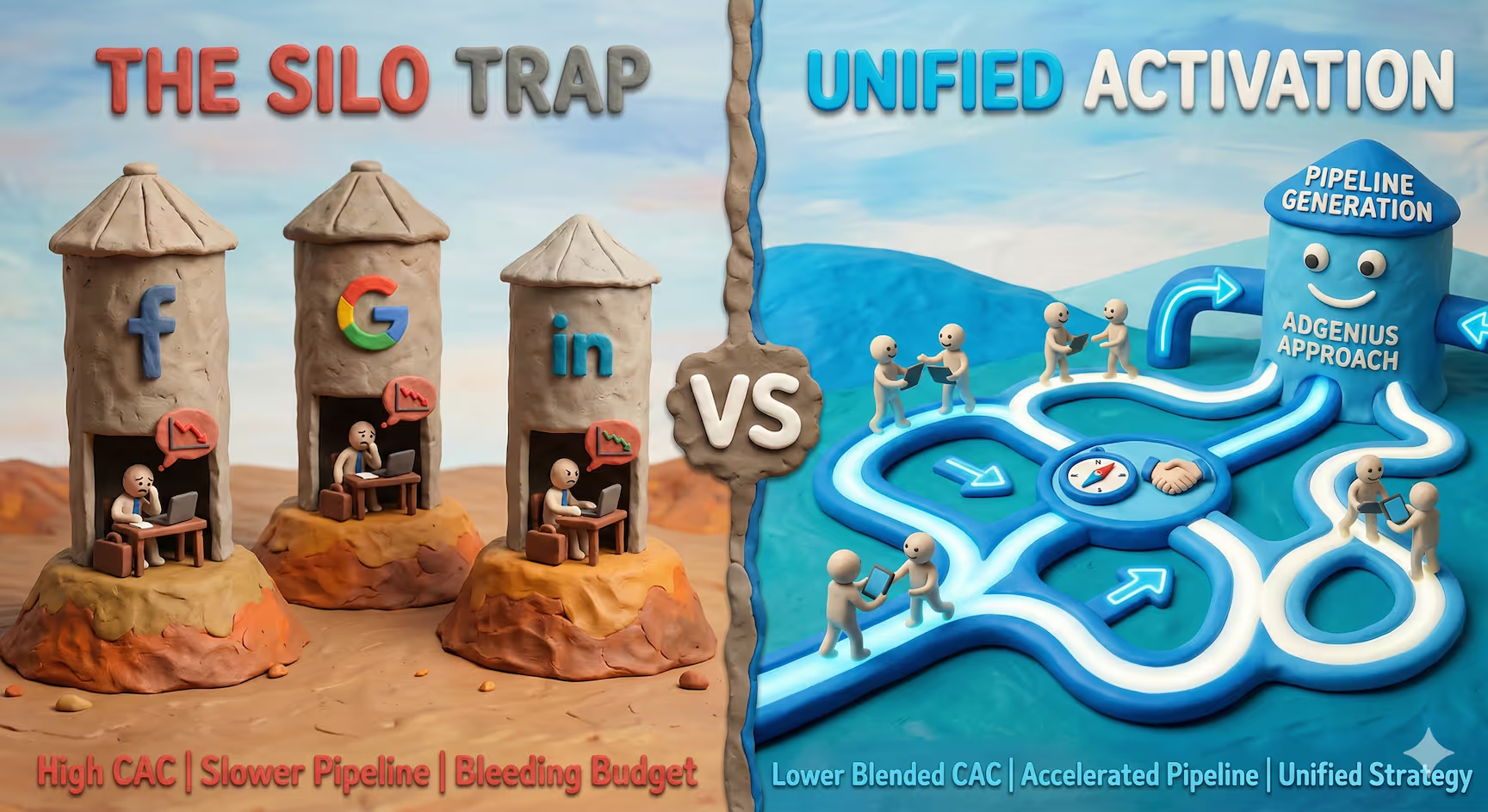
Because the core constraint in digital advertising isn’t recognition. It’s fragmentation.
For more than a decade, the industry has operated under a quiet assumption: if you can get more of your audience into each platform, performance will follow. Identity resolution became the proxy for effectiveness. Matching became synonymous with strategy.
But matching is an input. Optimization is a system. And systems determine outcomes.
What actually happens after the audience is expanded is far less discussed.
The same enriched list is distributed across multiple environments — LinkedIn, Meta, eventually Google — each operating according to its own incentives, learning models, and definitions of success. Measurement splinters. Budget decisions become platform-specific negotiations. Specialists emerge not because marketing is complex, but because the architecture demands separation.
The result is predictable: improved audience recognition inside disconnected ecosystems.
In other words, better visibility inside the same walls.
This is the tension at the center of the current excitement. Increasing match rates feels like progress because it improves what is easy to measure. But it leaves untouched what is hardest to solve: coordination.
The cost of fragmentation is subtle.
It shows up as duplicated learning.
Conflicting attribution.
Budgets drifting toward whichever dashboard feels most convincing.
Rising costs explained away as market dynamics rather than structural inefficiency.
Tools that enhance audience preparation address the front door of advertising.
They do not address what happens once you are inside.
And that distinction matters, because most budget loss doesn’t occur during audience upload. It occurs during optimization — when each platform competes for spend while operating without shared context.
The industry has spent years refining inputs to siloed systems.
What remains underbuilt is the layer that interprets performance across them.
This is the shift that is starting to define the next phase of B2B advertising: not richer audiences inside individual platforms, but a unified view that treats platforms as distribution channels rather than decision makers.
A system where budget moves based on audience behavior, not platform reporting.
Where signal quality matters more than audience volume.
Where performance is evaluated across environments rather than within them.
Seen through that lens, the excitement around higher match rates begins to look less like a breakthrough and more like a continuation — an incremental improvement to a model whose limitations are already visible.
The uncomfortable reality is that platforms benefit from isolation. Each environment is optimized to demonstrate its own value. None are designed to show you the whole picture.
So progress defined purely as “more people matched” risks reinforcing the very structure that constrains outcomes.
Better inputs into fragmented systems still produce fragmented results.
The companies that gain advantage will not be the ones that recognize the most users inside a single platform. They will be the ones that understand where their audience actually converts — and can reallocate attention and spend accordingly.
The conversation, in other words, is moving from recognition to orchestration.
And that is a fundamentally different problem to solve.
.avif)