Article
HRIS Advertising Intelligence Report
The definitive map of where HRIS advertisers spend, what they say, and what they're getting wrong. Built on ad library data, technographic pixel audits, and competitive spend analysis.
A deep analysis of HRIS advertising strategy in 2026, including ADP, Rippling, Gusto, Deel, and Namely. Learn which channels are saturated, which buyers are ignored, and where payroll and HR software brands can gain a cost-efficient edge.
The HRIS and payroll software market has a visibility problem hiding inside a spend problem.
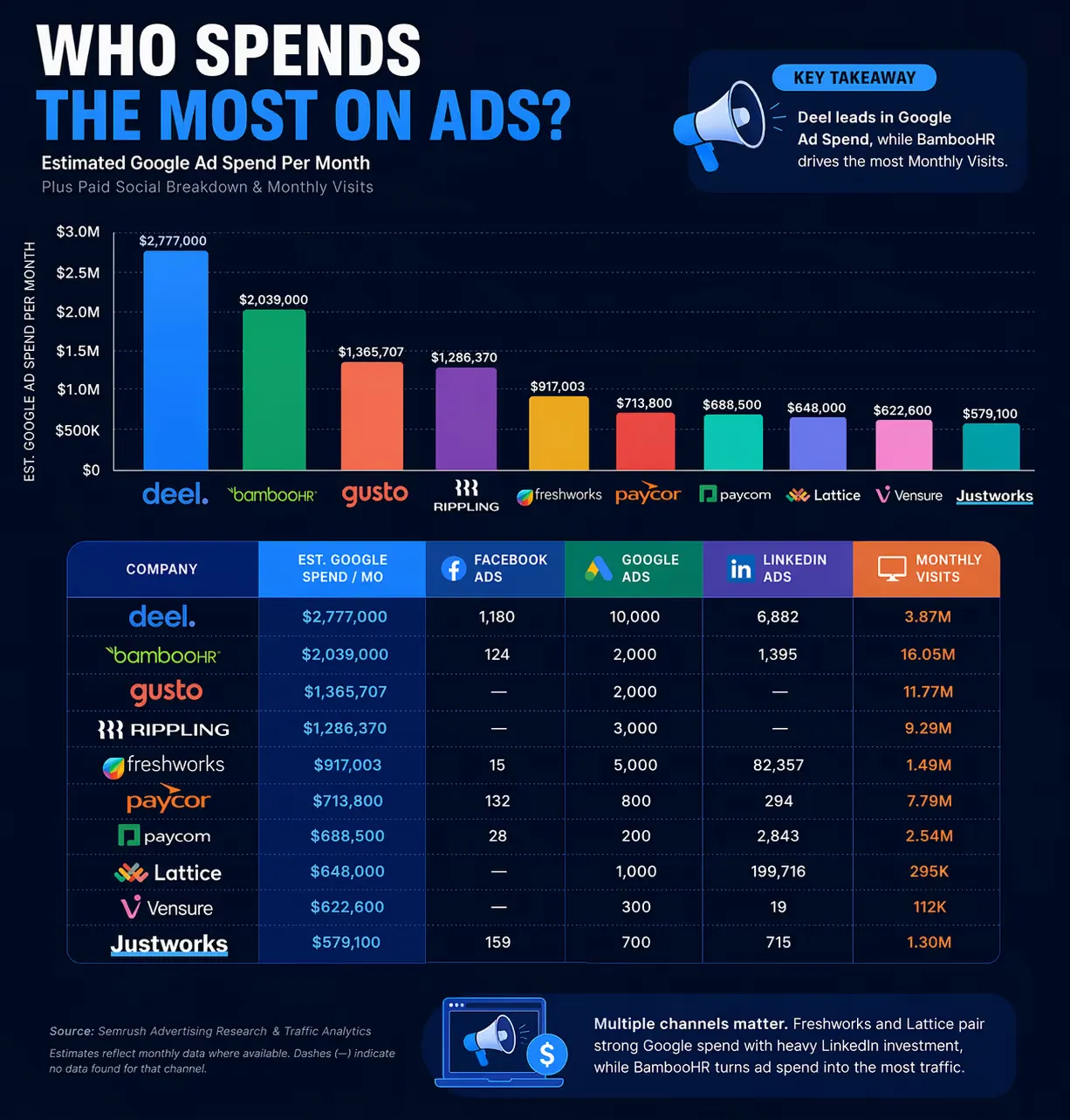
The biggest brands in the category are active across search, social, and display. They are producing hundreds of ads, running on multiple platforms, and investing heavily in measurement tools. On paper, that looks like category maturity.
In practice, most of that effort is aimed at the same audience, in the same environments, with the same kind of messaging.
That creates the central opportunity in HRIS advertising today:
The category is crowded where buyers are expensive and oddly quiet where buyers are cheaper, earlier in-market, and easier to educate.
The most overlooked audience is the vertical SMB owner-operator. These are the restaurant operators, logistics owners, franchise managers, ecommerce founders, home services operators, and small business decision-makers who often act as the HR department, finance lead, and operator all at once. They are critical buyers in the SMB segment, yet very few HRIS brands speak to them directly.
Instead, most competitors continue to lean on:
That approach may defend brand presence, but it does not create much room for differentiation.
If you want the simplest possible version of this report, here it is:
HRIS advertisers are over-invested in LinkedIn and Search, under-invested in Meta, YouTube, Reddit, and TikTok, and largely disconnected from the real language and buying behavior of SMB operators.
That gap is not small. It is likely the most underpriced growth opportunity in the category right now.
This is a competitive view of how leading HRIS vendors are approaching paid media, creative strategy, and measurement infrastructure.
The analysis looks at:
Which brands appear across LinkedIn, Google, Meta, YouTube, Reddit, TikTok, and X, and where they seem to be leaning in versus merely maintaining a footprint.
What each company is saying in-market, how they frame the problem, where they rely on trust or compliance messaging, and how much they tailor content to specific audiences.
Which vendors have the infrastructure to retarget, sequence, and optimize across the funnel, and which appear to be generating exposure without much orchestration.
How each competitor appears to balance brand demand, paid acquisition, and channel mix.
Where challengers can attack with better channel choice, more specific positioning, and stronger creative-market fit.
Most HR software brands are solving for the same market pressure in the same way.
They want qualified demand from companies evaluating payroll, HR, benefits, compliance, onboarding, and workforce management solutions. So they default to the safest playbook:
The problem is that once everyone adopts the same playbook, those channels stop being an advantage. They become table stakes.
That is exactly what appears to be happening in HRIS.
Being active on LinkedIn and Google does not make a brand distinctive in this market. It simply means the company is playing the game.
For most HRIS vendors, those channels are no longer where the edge is built. They are where budget gets defended.
The real question is no longer:
“Are you advertising on LinkedIn and Google?”
It is:
“Where are you building an advantage that other HRIS advertisers still do not own?”
A large share of HRIS messaging assumes the buyer looks like a classic business software evaluator:
That assumption holds up reasonably well in mid-market and enterprise accounts.
It breaks down in SMB.
In smaller businesses, the buyer is often an owner, operator, finance lead, or general manager. They are not searching like an HR professional. They are not consuming content like an HR team. And they are not using HR jargon when they think about payroll or people operations.
They are asking questions like:
That difference matters because it changes everything:
One of the clearest findings in the category is that some of the most promising channels for SMB buyer reach remain lightly contested.
That matters because the cost structure is different.
For many HR tech advertisers, LinkedIn can be one of the most expensive places to reach a business audience. Google Search is useful, but highly competitive and often reactive. Meanwhile, platforms like Meta, Reddit, YouTube, and TikTok offer:
For the owner-operator audience in particular, these channels can be dramatically more practical than LinkedIn.
If the buyer is not readily discoverable through job-title targeting, then paying premium LinkedIn CPMs to chase them is often a poor trade.
That is why the channel gap matters so much.
The HRIS category appears to be paying premium prices to reach the most obvious audience while underinvesting in the channels where overlooked demand can be educated earlier and more cheaply.
Across the category, competitor behavior tends to fall into two broad patterns.
These are brands with mature measurement infrastructure, strong brand awareness, and broad channel discipline. Their ad strategy is usually designed to reinforce trust, reduce perceived risk, and defend share.
These companies tend to have:
In this group, ADP and Rippling fit most clearly.
These brands are still investing aggressively, but often with more creative movement, sharper positioning, and more willingness to explore differentiated narratives or emerging channels.
They usually show:
In this group, Gusto and Deel fit most clearly.
Some brands show strong channel experimentation but lighter sequencing, weaker measurement depth, or inconsistent orchestration.
That often creates a strange mix of visibility and inefficiency.
Namely is the clearest example of this pattern.
ADP looks like an incumbent protecting territory.
Its advertising posture leans heavily into trust, compliance, and risk reduction. That makes sense for a market leader with broad enterprise relationships and a large installed base.
ADP benefits from a mature ad tech foundation and broad measurement depth. Its stack suggests the ability to connect retargeting, paid media, and CRM workflows at a high level. That means it can run sophisticated audience orchestration and learn across channels.
Its messaging also reinforces legitimacy. Much of the creative signals institutional credibility rather than category disruption.
The downside of that approach is that it can become emotionally flat and operationally generic for SMB audiences.
ADP often sounds like it is speaking to HR professionals, compliance stakeholders, or multinational buyers. That opens a lane for challengers to speak more directly to owner-led businesses.
A payroll message built for restaurants, local service businesses, logistics operations, or contractor-heavy employers will often feel more relevant than broad compliance-heavy copy.
The opportunity against ADP is not really to out-corporate them. It is to out-relate them.
Rippling appears to be the most expansive advertiser in the set.
The company shows strong channel coverage, significant creative activity, and a serious performance infrastructure. This looks like a brand that wants to dominate attention, not just participate in the market.
Rippling combines high channel presence with strong technical instrumentation. That gives it an advantage in sequencing and performance visibility.
Its creative strategy is also more flexible than ADP’s. It moves between authority positioning, conversion-driven messaging, and social proof.
This creates a more active, full-funnel feel.
The biggest concern is that some of its conversion tactics may create noise instead of true buying intent.
When a brand leans too hard on demo incentives, it can generate volume that looks good in dashboard reporting but performs worse deeper in the funnel.
That creates an opening for a smarter challenger:
Rippling also appears to leave room in community-led environments. If a buyer wants peer validation, operator stories, or problem-solving content rather than polished ads, there may still be open ground.
Gusto has one of the clearest brand identities in the category.
Its advertising feels more natural for SMB than many competitors, and it does a better job than most at sounding like a business built for smaller companies rather than just another enterprise software vendor repackaging itself for the segment.
Gusto’s strongest asset is coherence.
The brand voice, creative choices, and acquisition messaging tend to line up. There is a stronger emotional layer here than in most HRIS advertising, and the company seems more willing to reduce friction through pricing clarity and trust signals.
That matters in SMB.
Even when the brand feels SMB-friendly, it still seems to speak to a generalized small business identity.
That is useful, but it is not the same as speaking to specific vertical realities.
There is still a major difference between:
Those buyers do not want broad “small business” language. They want to see themselves.
That means the attack surface against Gusto is specificity.
Deel stands apart because it does not look like a standard HRIS advertiser.
Its brand story leans more toward founder energy, global growth, and operating infrastructure for modern companies. That makes it memorable, but it also changes who the message is really for.
Deel has a differentiated story.
Instead of leading with pure compliance or payroll utility, it appears to position itself around global business enablement, startup momentum, and cross-border operational capability.
That can work well for venture-backed, distributed, or internationally oriented companies.
The challenge is that this story does not map neatly to many domestic SMB payroll buyers.
A local business owner trying to simplify HR admin or avoid payroll headaches is not necessarily looking for a platform framed around global founder infrastructure.
That creates a clean opening for competitors that stay focused on practical operating pain in U.S. SMB contexts.
In other words, Deel may be compelling, but not always relevant.
Namely is the most interesting weakness in the group.
It seems willing to show up in more places and test more formats than some larger competitors, which is directionally smart. But that same breadth can become inefficient if the underlying measurement and sequencing are not mature enough to support it.
Namely looks more open to channel diversity than most of the market.
That matters because too many HRIS advertisers are still locked into a narrow LinkedIn-and-Search worldview. Namely’s broader experimentation suggests a healthier instinct around discovery and top-of-funnel testing.
The issue is not awareness. The issue is conversion architecture.
If a company creates lots of impressions, launches plenty of creative, and appears across multiple channels, but lacks strong stage-based retargeting and tight orchestration, the result is often scattered demand generation rather than controlled pipeline creation.
Namely looks like a brand that can be out-sequenced more easily than outspent.
That is a useful lesson for the whole category.
HRIS and payroll software are not impulse purchases.
These deals often involve:
That means the buyer journey is not one ad and one conversion. It is a sequence.
A serious HRIS advertising strategy needs to support:
Without that, a brand ends up doing the same thing to everyone:
same message, same offer, same landing path, regardless of context
That is one of the fastest ways to drive up acquisition cost.
The category is full of phrases like:
None of those are wrong. They are just weak.
They are broad claims that do very little to reduce perceived risk for a buyer with a specific operating problem.
The most effective HRIS creative opportunity is not a better slogan. It is a more concrete promise.
Examples of more effective framing include:
That kind of message works better because it does three things at once:
This is where the biggest creative whitespace still exists in HRIS.
There are three major disconnects between how the category advertises and how the SMB buyer actually behaves.
Owner-operators are not reliably discoverable through title-based B2B targeting.
They spend time in places like:
Yet much of the category still behaves as though LinkedIn is the center of the SMB universe.
It is not.
The average SMB operator does not speak in HR software terminology.
They care about:
A category built around HR language will keep missing operator urgency.
Demo-first CTAs are often too heavy for SMB owner-operators.
This audience responds better to tools and assets that feel immediately useful, such as:
The best offer is often not “book time with sales.”
It is “help me solve part of the problem right now.”
The answer is fairly straightforward:
That means combining:
The winner in this category is unlikely to be the brand with the most ads.
It will be the brand with the best feedback loop between audience signals, creative specificity, and cross-channel orchestration.
Start with assets that provide real value to the buyer and help qualify interest naturally.
That includes:
At the same time, launch into underowned channels where the audience is more accessible and media costs are less punishing.
Most HRIS brands still treat creative as a single message problem. It is not.
Different audiences need different proof at different moments.
That means building content for:
Without this layer, paid media is noisy. With it, the system can actually learn.
High reach is not the goal. High demo volume is not even the goal.
The real objective is pipeline efficiency.
That means cutting channels, offers, and messages that create cheap engagement but weak revenue outcomes, and scaling the combinations that move people toward meaningful sales conversations.
If you lead demand generation, paid media, or growth in HR tech, the lesson is pretty clear.
You do not need to outspend the category leaders everywhere.
You need to be sharper where they are lazy.
That usually means:
The category still has plenty of money in motion. What it lacks is enough brands willing to break from the same tired channel and creative assumptions.
That is where the upside is.
There is no single best channel for every HRIS company. Google Search and LinkedIn remain important, but they are heavily contested. For SMB-focused HRIS brands, Meta, YouTube, Reddit, and TikTok may offer better reach efficiency and stronger access to owner-operator audiences.
LinkedIn works well for title-based B2B targeting, but many SMB HRIS buyers are owners or operators rather than formal HR leaders. That makes LinkedIn useful, but often incomplete.
The biggest gap is the lack of vertical-specific SMB messaging. Most HRIS brands still use broad, generic language instead of creative tied to real operating realities like tipped wages, seasonal labor, contractor onboarding, or multi-location compliance.
Payroll and HR software companies should improve performance by combining stronger audience segmentation, more specific creative, underused channels, and funnel-stage sequencing tied to buyer behavior.
Based on this analysis, ADP and Rippling appear strongest in measurement maturity and overall infrastructure, Gusto appears strong in brand coherence and SMB accessibility, Deel stands out with a differentiated global narrative, and Namely shows broad experimentation but weaker orchestration.
The HRIS advertising market is not short on spend. It is short on precision.
Too many brands are still buying the same attention, in the same environments, with the same message architecture. That may preserve share, but it does not create much leverage.
The next real wave of advantage in HRIS paid media will come from brands that can do four things better than the market:
That is the opening.
And right now, it is still wide open.
Article
The definitive map of where HRIS advertisers spend, what they say, and what they're getting wrong. Built on ad library data, technographic pixel audits, and competitive spend analysis.
Guide
HR platforms sell into HR, finance, and IT at once, across companies of every size. That breadth breaks generic databases, and it is why HRIS revenue teams lean on bespoke account intelligence.
Article
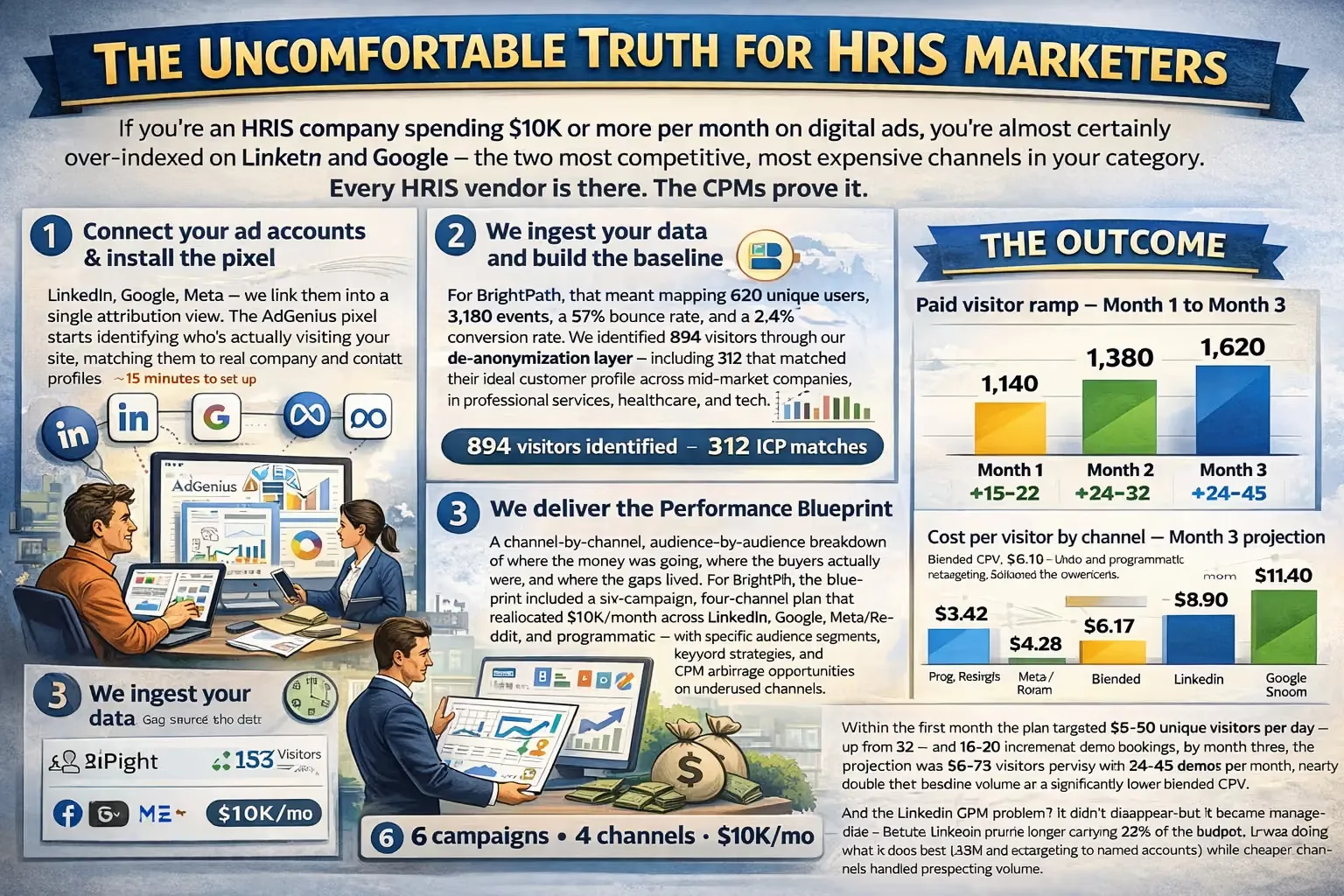
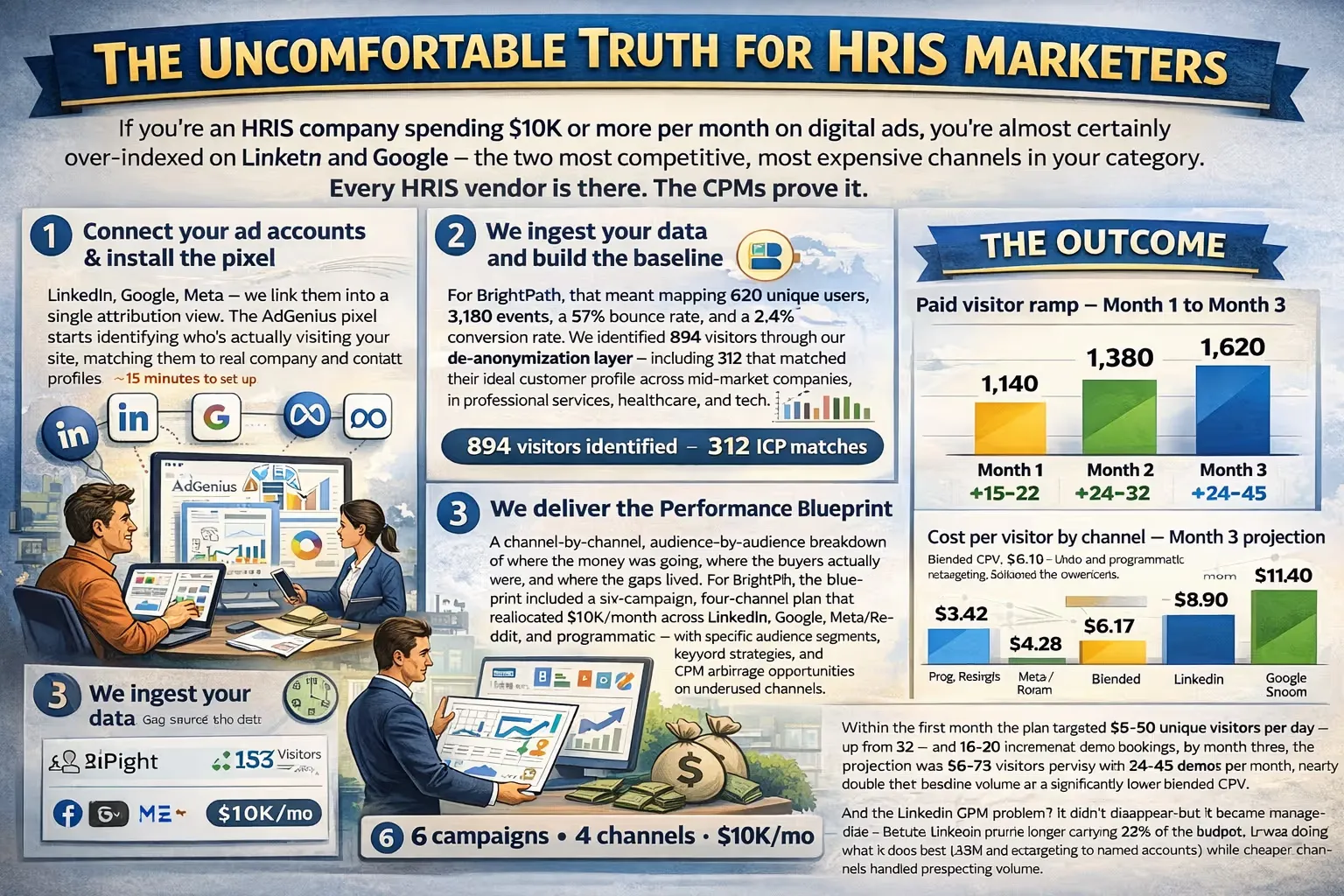
For HRIS digital marketing leaders: most paid media waste is not coming from creative or conversion tactics, but from overfunding saturated channels like LinkedIn and Google while missing cheaper, high-intent pipeline in underused channels and unretargeted demo traffic.

Get precise, compliant, and on-demand contact data—tailored to your business needs.