Article
The HRIS Paid Media Trap
Most paid media waste is not coming from creative or conversion tactics, but from overfunding saturated channels.
9 Best Practices for Maximizing ROI Across Every Ad Platform
Cross-channel campaigns deliver 13% higher ROAS
vs. single-channel approaches — yet only 9% of marketers have fully adopted cross-channel strategies
Global ad spend surpassed $1.14 trillion in 2025 and is projected to grow another 7% in 2026. But spending more does not mean spending smarter. For every dollar invested in programmatic advertising, less than 44 cents actually reaches consumers as viewable impressions on valuable inventory, according to World Federation of Advertisers analysis. The rest evaporates across fragmented platforms, duplicated attribution, and siloed campaign management.
This is the Fragmentation Tax—the compounding cost of running disconnected campaigns across Google, Meta, LinkedIn, TikTok, CTV, and every other platform vying for your budget. Each platform reports through its own lens, each claims credit for the same conversions, and each optimizes in isolation. The result: bloated spend, misleading metrics, and marketing teams drowning in dashboards that tell conflicting stories.
Cross-channel paid media orchestration is the antidote. It means unifying your ad strategy, creative deployment, audience targeting, and performance measurement across every paid channel—not just running ads in more places, but running them as a single, coordinated system. Here’s what you need to know to build a cross-channel strategy that actually works.
The goal of a cross-channel paid media strategy is to deliver differentiated, personalized, and relevant ad experiences to targeted audiences across every platform where they spend attention—maximizing conversions and lifetime value while minimizing waste.
This goes beyond multichannel (running separate campaigns on separate platforms) and even omnichannel (consistent messaging across channels). True orchestration means your campaigns are interconnected: budget allocation responds dynamically to performance, audiences are suppressed and sequenced across platforms, and creative is adapted to each channel’s native format while maintaining a unified narrative.
In practice, cross-channel orchestration requires three capabilities working together: unified audience intelligence (knowing who to reach and where), coordinated campaign execution (deploying and adjusting across platforms simultaneously), and integrated measurement (attributing results holistically rather than per-platform).
The advertising landscape has shifted in ways that make siloed campaign management not just inefficient, but competitively dangerous.
Marketers now operate across an expanding universe of platforms. Search accounts for 25% of ad spend, social media 17%, streaming video 17%, display 15%, and retail media a surging 22%. Each platform has its own bidding logic, audience definitions, attribution windows, and reporting interfaces. Over half of marketers cite executing cross-channel communications as their biggest challenge—a figure that jumped 33% in a single year.
When a prospect sees a LinkedIn ad, clicks a Google search result, and converts through a Meta retargeting campaign, every platform claims the win. A single purchase can appear as three separate conversions in three dashboards. This overreporting leads teams to pour budget into channels that look productive but may not actually be driving incremental results.
Brands implementing cross-channel strategies achieve 89% customer retention rates versus 33% for those with weak multichannel approaches. Customers interacting across multiple channels spend 30% more. Using three or more channels in campaigns drives a 14.6% increase in sales. The data is unambiguous—orchestration is not a nice-to-have; it is a revenue multiplier.
The foundation of cross-channel orchestration is a single, unified view of your target audience. Without it, you are running parallel campaigns to fragmented segments, with no way to coordinate frequency, sequencing, or suppression.
Start by consolidating your first-party data—CRM records, website behavior, product usage, prior ad engagement—into a centralized identity layer. This might be a Customer Data Platform (CDP), your CRM, or a purpose-built audience management tool. The key requirement is that you can resolve identities across the platforms where you advertise.
Then enrich that foundation with third-party intelligence. Contact-level technographic data, firmographic signals, and intent indicators transform a basic target list into a multidimensional audience map that tells you not just who to reach, but where and when they are most receptive.
AdGenius in Action
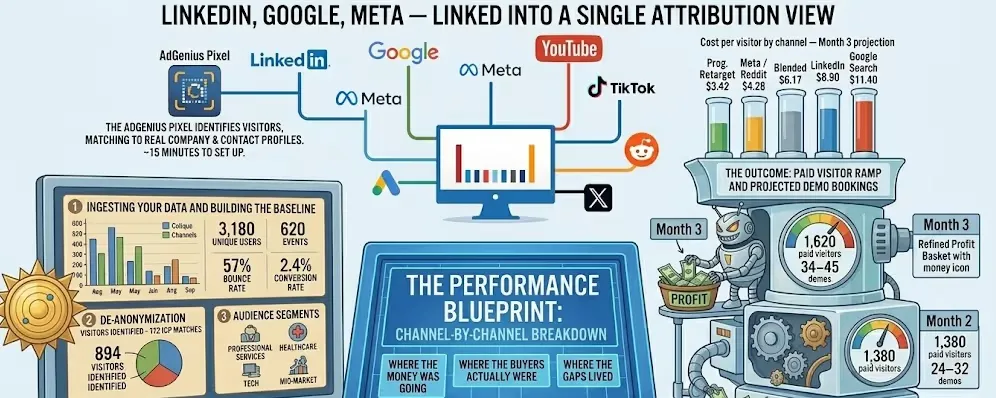
AdGenius ingests your first-party audience data and layers in LeadGenius’s Contact-Level Technographics to build unified audience segments that deploy consistently across Google, Meta, LinkedIn, and programmatic channels—eliminating the manual CSV uploads and per-platform audience builds that fragment most campaigns.
Static budget allocation—deciding in January that 40% goes to Google, 30% to Meta, and 30% to LinkedIn—assumes stable performance across twelve months. In reality, channel efficiency fluctuates weekly based on competitive pressure, seasonal patterns, algorithm changes, and creative fatigue.
The shift toward dynamic allocation is already underway. Brands that use real-time budget optimization see measurable efficiency gains, with documented cases of 10-19% improvements in CPA and overall performance by making continuous in-flight adjustments across channels.
Build your budget framework around outcomes, not channels. Define your target CPA or ROAS at the campaign level, then let performance data dictate where each dollar flows. Review weekly at minimum. If LinkedIn CPC spikes, shift budget to Google Display remarketing. If TikTok creative is outperforming, lean in before fatigue sets in.
AdGenius in Action
AdGenius’s cross-channel dashboard surfaces unified cost-per-outcome metrics across all active platforms, enabling your team to rebalance spend in real time based on which channels are delivering against your actual business goals—not platform-reported vanity metrics.
Broad audiences waste budget. Hyper-specific audiences limit scale. The art of cross-channel targeting is building segments that are precise enough to drive relevance but expansive enough to sustain spend across platforms.
Look beyond basic demographics. The most effective B2B segments combine firmographic filters (industry, company size, growth stage) with technographic signals (what tools they use, what they are evaluating), behavioral data (content consumed, pages visited), and intent indicators (actively researching solutions in your category).
Critically, your segments should be defined once and deployed everywhere. The same “Enterprise HRIS evaluators” segment should target LinkedIn Sponsored Content, Google Search remarketing, Meta lookalike audiences, and programmatic display—with consistent definitions, synchronized suppression lists, and coordinated frequency caps.
Pro Tip
Test your segmentation by analyzing conversion rates per segment across channels. If a segment converts well on LinkedIn but poorly on Google Display, the issue may not be the channel—it may be that the segment needs different creative for different stages of the buying journey. Use segment-level performance data to inform creative strategy, not just budget allocation.
The most common cross-channel mistake is not a targeting error or a creative failure—it is launching campaigns without clearly defining what you are measuring and how you will attribute results.
When every platform claims credit for conversions through its own attribution window (Meta defaults to 7-day click/1-day view; Google defaults to 30-day click; LinkedIn defaults to 30-day click/7-day view), a single conversion can appear three times across your dashboards. Only 30% of CMOs feel confident in their ability to measure marketing ROI accurately.
Before launching, define your conversion events at the campaign level (not the platform level), standardize your attribution window across platforms, implement UTM tracking with consistent naming conventions, and establish a source of truth—typically your CRM or a cross-channel analytics platform—that deduplicates conversions.
AdGenius in Action
AdGenius provides unified conversion tracking that normalizes attribution across platforms, deduplicates cross-channel conversions, and maps ad-influenced interactions to actual pipeline and revenue in your CRM—so you measure real business outcomes, not inflated platform metrics.
The biggest optimization lever in cross-channel advertising is not finding the cheapest clicks—it is eliminating the structural waste that bleeds budget before a single ad serves.
Start with audience validation. Are you targeting business email addresses that no longer exist? Phone numbers that are not reachable? Job titles that changed six months ago? Stale data degrades targeting precision across every channel simultaneously. An invalid email list does not just waste email spend—it poisons your CRM-based lookalike audiences on Meta and your matched audiences on LinkedIn.
Next, address overlap. If the same prospect is seeing your ads on LinkedIn, Google, and Meta simultaneously with no frequency coordination, you are tripling your cost per impression on that individual. Cross-channel suppression—removing converted leads from all active campaigns in real time—is one of the fastest ways to reclaim budget.
Finally, measure with an Effective Conversion Rate: use the total audience size as your denominator, not delivered impressions or clicks. This creates an apples-to-apples metric that lets you compare true channel efficiency without the distortions of platform-specific funnel metrics.
A LinkedIn ad is not a resized Google Display banner. A TikTok video is not a cropped YouTube pre-roll. Each platform has distinct creative conventions, and audiences punish lazy repurposing with lower engagement and higher costs.
Nearly 40% of video ads are expected to involve generative AI in their creation by 2026, and AI-generated creative can significantly improve performance when adapted to platform-specific formats. But the key word is adapted. The message should be consistent; the execution should be native.
Build a creative framework with three layers: a shared narrative (the core story and value proposition that applies everywhere), channel-adapted formats (vertical video for TikTok and Stories, carousel for LinkedIn, responsive display for Google), and audience-personalized variations (different pain points, industries, or use cases within the same channel).
Pro Tip
Creative is the new targeting. As platform algorithms rely more on broad audiences and less on detailed targeting parameters, the creative itself determines who sees and engages with your ads. Invest in creative testing as aggressively as you invest in audience testing. A/B test headlines, visuals, CTAs, and formats—and use the results to inform creative strategy across all channels.
The most perfectly targeted, brilliantly creative ad is worthless if it does not actually reach the audience. Deliverability in paid media encompasses ad approval rates, policy compliance, domain reputation, and landing page quality scores—and it varies significantly by platform and region.
Privacy regulations are evolving rapidly and unevenly. GDPR governs European audiences; CCPA/CPRA applies in California; other states and countries have their own frameworks. Each platform interprets these regulations differently, affecting what targeting data you can use and how you track conversions.
Work with your legal team to establish a compliance framework that covers your advertising footprint. Ensure your landing pages meet platform-specific quality standards. Monitor ad rejection rates as a leading indicator of compliance issues. And audit your tracking implementation regularly—consent management changes can silently break your attribution without triggering any platform alerts.
Retargeting across channels is where orchestration delivers its most measurable impact. A prospect who visited your pricing page should not see the same top-of-funnel awareness ad on LinkedIn that a cold audience sees. They should see a bottom-of-funnel offer—a case study, a demo CTA, a competitive comparison—on whichever platform they use next.
Combining email and SMS retargeting in marketing strategies results in up to 30% higher conversion rates. The same sequencing logic applies to paid media. Build audience stages—awareness, consideration, decision—and ensure each stage triggers the appropriate creative and offer across all active channels.
The most effective retargeting engines also incorporate suppression: once a prospect converts (downloads a resource, books a demo, becomes a customer), they are removed from prospecting campaigns immediately across all platforms, and optionally moved into a customer expansion sequence instead.
AdGenius in Action
AdGenius automates cross-channel audience sequencing by syncing your CRM pipeline stages with platform-specific audience lists. When a prospect moves from MQL to SQL, their ad experience updates across Google, Meta, and LinkedIn simultaneously—no manual list uploads, no day-old data, no stage mismatches.
The final discipline—and arguably the most important—is measuring cross-channel performance with a framework that produces comparable, trustworthy metrics across every platform.
Platform-reported metrics are necessary but insufficient. Each channel’s reporting is optimized to make that channel look productive. Your measurement framework should sit above individual platforms and answer business-level questions: What is the blended cost per qualified lead across all channels? Which channel combinations produce the highest conversion rates? What is the incremental impact of adding a channel versus the cost of maintaining it?
Implement an Effective Conversion Rate methodology: use the full audience size as your denominator for each channel, regardless of impressions served or messages opened. This eliminates the distortions created by comparing email open-based conversion rates against SMS delivery-based rates or display impression-based rates.
Review weekly, optimize monthly, restructure quarterly. Cross-channel orchestration is not a set-and-forget strategy—it is a continuous improvement loop where measurement drives every decision.
Pro Tip
Evaluate results across both top-line revenue and ROI. A campaign with lower absolute revenue but higher ROI may be a better use of budget than a high-revenue campaign with thin margins. Present both metrics to stakeholders to tell the complete performance story.
Building a single audience identity layer—fed by first-party CRM data and enriched with contact-level intelligence—eliminates the fragmented targeting that wastes budget and confuses measurement. When you know exactly who you are reaching on every platform, you can coordinate frequency, sequence messaging, and suppress converted prospects in real time.
Platform dashboards are built to sell more ad spend on that platform. Your measurement framework should be built to identify what actually drives revenue. Centralize attribution in your CRM, deduplicate conversions, and use Effective Conversion Rates to compare channels on equal footing.
Static quarterly plans cannot keep pace with the velocity of modern paid media. Dynamic budget allocation, real-time audience syncing, and continuous creative testing transform your cross-channel strategy from a plan into a system—one that compounds performance improvements over time.
LeadGenius empowers B2B marketing and sales teams with the data intelligence they need to target precisely, engage effectively, and convert consistently. Our platform combines Contact-Level Technographics, firmographic enrichment, and intent signals to power account-based strategies across the entire revenue lifecycle.
AdGenius is LeadGenius’s cross-channel paid media orchestration platform, purpose-built for B2B teams running campaigns across Google, Meta, LinkedIn, and programmatic channels. AdGenius unifies audience deployment, budget allocation, creative management, and performance measurement into a single platform—eliminating the fragmentation tax that bleeds ROI from disconnected campaign management.
With AdGenius, marketing teams can:
Article
Most paid media waste is not coming from creative or conversion tactics, but from overfunding saturated channels.

Guide
Why more budget isn't fixing your pipeline, and why the system can be working perfectly while your business gets less efficient by the quarter.

Article
What Cross-Channel Blindness Actually Costs B2B Advertisers

Get precise, compliant, and on-demand contact data—tailored to your business needs.