
For all the talk about digital fatigue, inbox overload, and rising paid media costs, direct mail has quietly remained one of the most effective ways to break through.
Not because it is old-school.
Because it is physical.
Because it is harder to ignore.
Because when it is done well, it feels intentional.
The problem is that most direct mail programs are still built with a lazy data model.
A company gets selected.
A contact gets pulled.
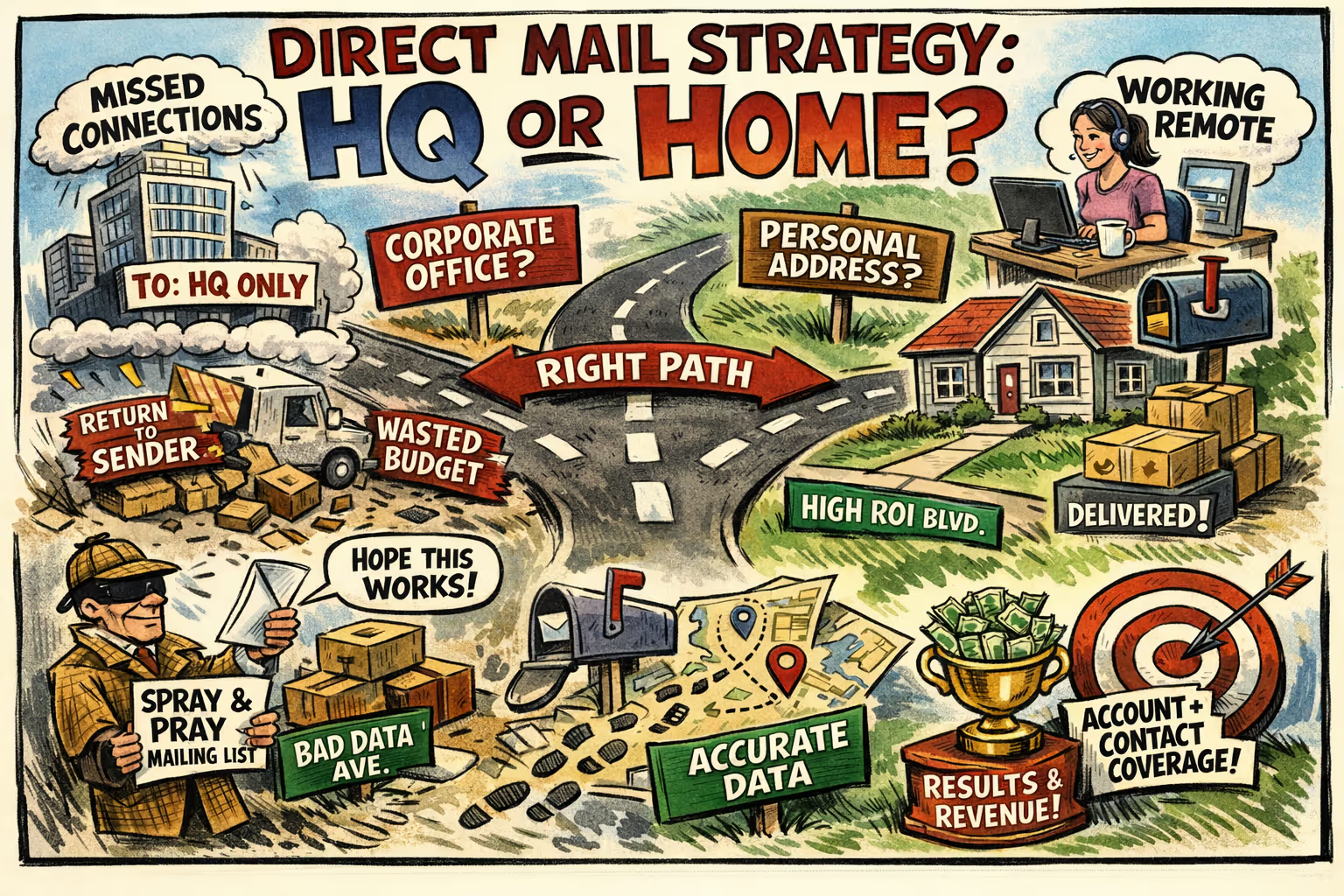
A package gets sent to headquarters.
And everyone hopes it somehow finds the right person.
That might have worked a decade ago. It does not work nearly as well now.
Modern direct mail is not just about finding a corporate mailing address. It is about reaching a specific person, in the place they are most likely to actually receive something.
That is where the strategy changes.
The real direct mail problem is not creative. It is delivery logic.
Most teams think about direct mail as a branding or campaign execution motion:
- pick accounts
- pick titles
- build the gift or message
- send the package
- wait for response
But the real failure point usually happens before the box ever leaves the warehouse.
It happens in the data layer.
Because there is a major difference between:
- having a company address
- having a contact at that company
- knowing where that contact is actually based
- identifying the most relevant office for that individual
- verifying whether mail is likely to reach them there
Those are not small differences. They are the difference between a campaign that creates meetings and a campaign that creates waste.
Why headquarters is often the wrong answer
Let’s use a simple example.
Say you want to reach a specific person at Salesforce.
Most data providers will give you Salesforce’s corporate location. In many cases, that means San Francisco.
But that does not mean your contact works there.
They may sit in Chicago.
They may be tied to a regional office in Atlanta.
They may support an enterprise territory from Dallas.
They may work remotely full-time and rarely, if ever, step into a corporate office.
So if your direct mail logic starts with “company = one mailing address,” you are already lowering your odds of delivery.
The smarter approach is person-based and proximity-based.
Start with the contact.
Understand where that person is based.
Map them to the closest relevant corporate office tied to that geography.
Then verify whether that is the best delivery endpoint.
That one change alone can materially improve deliverability.
The shift from account-based direct mail to person-aware direct mail
The best direct mail programs are still account-based.
But they are not account-only.
That distinction matters.
A unified direct mail strategy should work across two layers:
1. Account coverage
You want broad enough coverage across your target account list to make direct mail operationally scalable.
That means knowing:
- which accounts are eligible
- which geographies are practical to ship to
- which offices exist
- which locations are active and relevant
- how many reachable contacts exist per account
2. Contact-level precision
You also need confidence that the actual people you care about can be reached.
That means understanding:
- which titles matter
- where those individuals are based
- which office location is most relevant to them
- whether a verified contact address is available
- how to prioritize office delivery versus personal delivery where appropriate and permitted
That is the difference between sending packages at companies and sending them to people who work at companies.
The first is a volume tactic.
The second is a pipeline tactic.
Why contact address verification became so important
This use case accelerated hard during COVID.
When offices emptied out, a lot of direct mail programs broke almost overnight.
Teams had budget.
They had target accounts.
They had strong messaging.
But they had nowhere reliable to send the package.
That forced a change in how marketers thought about physical outreach.
Instead of asking, “What is the company’s address?” they started asking:
“Where is this person actually reachable?”
That is where contact address verification became so valuable.
In remote and hybrid work environments, verified personal mailing data can help teams continue high-value direct mail motions that otherwise would not be possible through office-based routing alone.
And while office attendance has returned in many organizations, the market has not gone back to a clean headquarters-centric model. A huge percentage of professionals still work remotely or hybrid. Which means mail strategy still has to reflect how people work now, not how databases were built ten years ago.
The key point here is not “send everything to someone’s house.”
The key point is optionality.
If the right corporate office can be identified and confidently used, great.
If not, verified contact address data can become an important fallback for specific campaigns, specific segments, and specific use cases — where permitted and managed carefully.
That flexibility is what keeps direct mail viable in a hybrid world.
How customers build a stronger direct mail strategy with LeadGenius
The strongest direct mail programs we see are not built around one data field. They are built around a layered coverage strategy.
LeadGenius helps customers think about direct mail in a more complete way:
First: maximize contact-to-account coverage
Before anything gets mailed, customers need to know whether they have enough of the right people inside the right accounts.
That means:
- expanding coverage across target accounts
- identifying missing decision-makers and influencers
- finding role-specific contacts by function, seniority, and geography
- improving match rates between named accounts and reachable people
Direct mail gets expensive fast when coverage is thin.
If you only have one incomplete contact per account, your campaign is fragile.
If you have multiple relevant titles mapped cleanly to an account, you create optionality and improve odds of engagement.
Second: route the contact to the most logical business location
Once the right contacts are identified, the next question is not just “do we have an address?” but “do we have the right address?”
That is where customers use LeadGenius to connect contact geography to relevant office geography.
Instead of defaulting to headquarters, the strategy becomes more nuanced:
- where is this person based?
- what is the nearest relevant office?
- is that office active and practical for delivery?
- does that address align with how this organization actually operates?
This is especially important for enterprise accounts with dozens or hundreds of office locations.
Third: use contact address verification when office routing is weak
For some campaigns, especially executive gifting or high-value ABM motions, customers need another path.
When office-based delivery is unreliable, verified contact address data can help fill the gap.
This is particularly useful when:
- the contact is known to be remote
- the company has limited office footprint
- the office is not clearly tied to the individual
- campaign economics justify higher-precision delivery
- the sender wants to reduce failed package rates on expensive mailers
Again, the value is not just the address itself.
It is the ability to choose the best delivery path for that person.
Fourth: unify the strategy instead of treating every record the same
The best customers do not run one blanket rule across the whole campaign.
They segment.
For example:
- Tier 1 accounts: send to verified contact-specific office or verified personal address where appropriate
- Tier 2 accounts: prioritize nearest relevant office tied to the contact
- Tier 3 accounts: use account-level office delivery only when person-level precision is unavailable
That kind of hierarchy keeps costs rational while improving deliverability where it matters most.
Best practices for high-performing direct mail campaigns
If I were writing the playbook for a modern B2B direct mail program, it would look like this:
1. Start with people, not addresses
Do not begin with a warehouse full of company locations.
Begin with the buying committee.
Who are the titles you actually need to influence?
Who matters by segment, account tier, and motion?
Direct mail performs better when the list is built around relevance, not just mailable records.
2. Treat headquarters as a fallback, not a default
For multi-location companies, headquarters is often the easiest address to find and one of the worst places to send.
A better sequence is:
contact → contact geography → closest relevant office → verified delivery choice
That reflects how organizations actually work.
3. Build depth inside the account
Single-threaded direct mail is risky.
Even if one gift lands, you still may not create enough momentum.
The better approach is to build contact depth by account:
- decision-maker
- budget owner
- functional stakeholder
- influencer
- possible champion
This improves both campaign resilience and account-level learning.
4. Match campaign type to address confidence
Not every campaign deserves the same level of investment.
For lower-cost mailers, office-based routing may be good enough.
For premium sends, custom gifts, executive outreach, or tightly orchestrated ABM plays, higher address confidence is worth paying for.
The economics should change based on the value of the motion.
5. Coordinate mail with digital and outbound
Direct mail works best when it is not alone.
The strongest programs usually coordinate:
- email touches
- paid social or display against the account
- SDR outreach
- gifting notification or follow-up
- post-delivery call or LinkedIn touch
Physical mail should be part of a sequence, not a random act of hope.
6. Respect compliance, privacy, and brand optics
This part matters.
Just because you can send physical mail does not mean you should do it carelessly.
Especially with verified personal address use cases, teams need clear internal rules around:
- campaign appropriateness
- regional requirements
- data handling
- audience sensitivity
- brand experience
The best direct mail programs feel thoughtful, not invasive.
That is not just an ethical point. It is a performance point.
7. Measure deliverability, not just response
A lot of teams only measure meetings and pipeline.
That matters, of course. But it is incomplete.
You should also be measuring:
- contact-to-account coverage
- addressable contact rate
- deliverable contact rate
- package failure/return rate
- office-route success versus contact-verified success
- performance by segment, geography, and campaign type
If you do not know where your physical delivery logic is failing, you cannot improve it.
The bigger opportunity: direct mail as a coverage problem, not just a channel
This is the part many teams miss.
Direct mail is often treated like swag logistics.
Or gifting software.
Or a creative campaign layer.
But at its core, it is a data and coverage problem.
If you cannot identify the right people, map them to the right locations, and verify deliverability with enough confidence, your creative does not matter nearly as much as you think.
That is why the strongest direct mail strategies are built on a unified data foundation:
- account intelligence
- contact identification
- title-based targeting
- office mapping
- contact address verification
- deliverability prioritization
When those pieces come together, direct mail becomes much more than a novelty channel.
It becomes a serious way to create signal, differentiate outreach, and break into accounts that have become numb to digital touchpoints.
Summarizing Thoughts
Direct mail is not back because marketers got nostalgic.
It is back because digital channels are crowded, buyers are harder to reach, and physical outreach still creates real attention when it is executed intelligently.
But the winning teams are not the ones sending more packages.
They are the ones using better delivery logic.
They do not assume headquarters equals reachability.
They do not confuse account coverage with contact coverage.
They do not treat every record the same.
And they do not leave deliverability up to chance.
They build direct mail around the person, the account, and the most likely path to delivery.
That is where LeadGenius fits.
Not just by helping customers find a place to send something, but by helping them build a smarter system for deciding who to send to, where to send it, and how to maximize the odds it actually lands.
.avif)