
1. We Start With the Team’s Product-Level ICP
Before any modeling happens, LG aligns on the actual product motion for that sales team — not a generic “developer” segment.
We capture attributes such as:
- Required skills to deploy or integrate their product
- Adjacent technologies or frameworks that commonly co-exist with the solution
- Typical seniority, titles, or functions who evaluate, buy, and implement
- Industry verticals where adoption historically performs best
This becomes the Product-Specific Skill Graph, our baseline for everything else.
2. We Map That Skill Graph Against Global Developer Signals
This is where the bespoke magic happens — and where ZoomInfo/Apollo simply can’t compete.
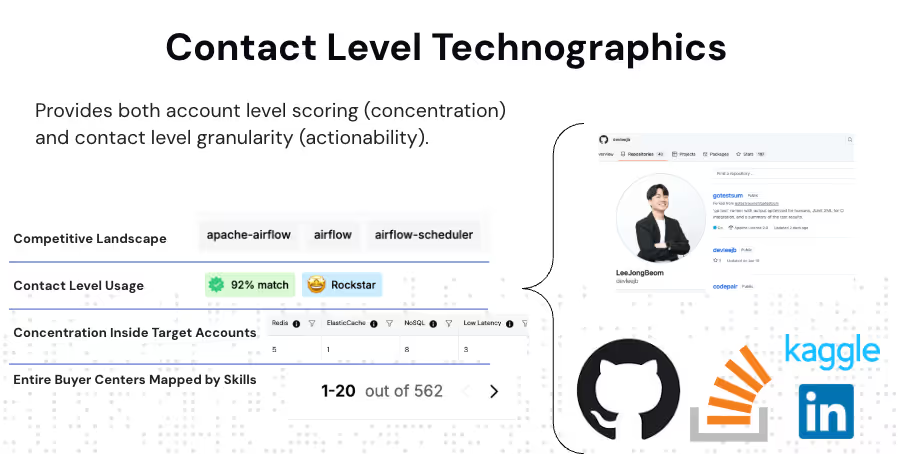
Using our continuously updated corpus of 60M+ developers and engineers, LG runs the product’s skill graph against real-world activity from three primary sources:
GitHub
- ML reads commit logs across 300M repositories
- We infer skills based on actual contributions
- We measure depth via:
- Recency
- Frequency
- Length of time practicing a skill
- Complexity of the work (file changes, code ownership patterns)
- Job titles, roles, tool stacks
- Endorsements, listed skills, project summaries
- Promotion velocity and seniority (signals of influence)
Stack Overflow / Kaggle
- Q&A activity
- Topic expertise
- Engagement depth (helping, answering, solving)
This cross-source fusion lets us identify who actually uses a technology, not who merely claims to.
3. We Roll Usage Up to the Account Level
Each developer signal is matched to their employer using:
- Contact-level emails
- Domain verification
- Onsite technology fingerprints
- Public company metadata
- Multi-source identity stitching
That gives you a company-level view of:
- Count of developers using skills essential to your product
- Relative density vs. company size (usage intensity)
- Trend lines (is adoption rising or falling?)
- Geographic distribution (helpful for territory planning)
This is why LG beats static databases — we’re not inferring usage from job titles; we’re deriving it from real behavioral activity.
4. We Tailor Density Maps for Each Sales Team’s Motion
Because each product team has unique needs — different buyers, different integrations, different technical dependencies — LG customizes each density map.
Examples:
For a DevOps tooling sales team
We map usage of: Kubernetes, Terraform, Docker, Jenkins, GitLab runners, etc.
For a data engineering product
We map: Airflow, dbt, Spark, Databricks, Python proficiency, ML pipelines.
For an API-first workflow platform
We map: REST usage, GraphQL, serverless patterns, Node/Python/Go activity.
We’re not giving a one-size-fits-all “developer profile.”
We’re giving a product-correlated adoption map.
5. The Output: A Usage Density Map That Tells the Sales Team Where to Go First
Each salesleader ends up with:
- Accounts ranked by real usage intensity
- Signals that match their product’s adoption requirements
- Regional/territory breakouts
- A list of the specific developers influencing the toolchain
- Contactability (emails, phones, LinkedIn URLs) for those developers
This is how we help Marketing prioritize campaigns, RevOps optimize TAM, and Sales focus on accounts that actually show propensity to adopt.
.avif)