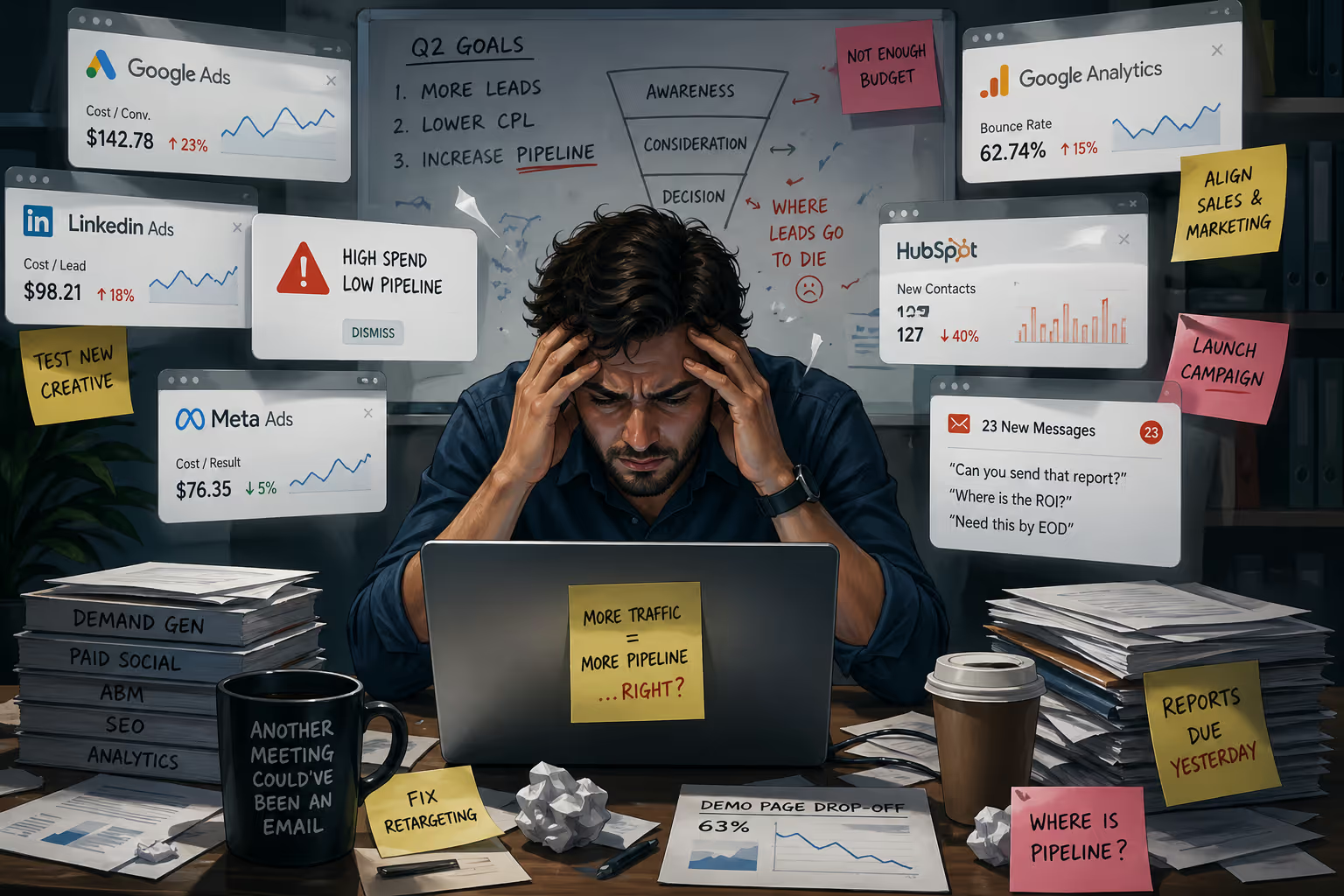

Hospitality SaaS is a $6 billion market growing at nearly 12% annually. There are over 100 companies competing across restaurant POS, hotel PMS, labor scheduling, inventory management, and guest experience. And the vast majority of them are running a paid media playbook designed for a buyer that doesn't exist — the hospitality decision maker who lives on LinkedIn.
That buyer is a fiction.
The real buyers in hospitality — restaurant owners, hotel general managers, property managers, operations directors — spend their professional lives on the floor, not at a desk. When they go online, they're scrolling Instagram for design inspiration, watching YouTube demos of POS systems, sharing vendor recommendations in Facebook groups, and reading Google reviews of software they've heard about from another owner at a trade show. LinkedIn is where they accepted a connection request three months ago and haven't been back since.
This isn't a guess. It's what the data shows every time we run a Performance Blueprint for a hospitality SaaS company.
The Hospitality Buyer Is Not an Enterprise Buyer
Most B2B SaaS marketing playbooks were built for selling to knowledge workers — people who sit at computers eight hours a day, browse LinkedIn during lunch, and evaluate software by downloading whitepapers and attending webinars. If you're selling cybersecurity to CISOs, that playbook works. If you're selling compliance software to VP Informations Security, it works. If you're selling HRIS to HR Directors at tech companies, it works.
But hospitality buyers don't fit that archetype, and forcing them into it is the most expensive mistake in the category right now.
Notice the pattern. LinkedIn is the weakest channel for two of the three core personas. It only shows meaningful engagement for the multi-unit operations director — and even there, it's third behind Google and YouTube. The independent restaurant owner and boutique hotel GM, who make up the bulk of the addressable market, are overwhelmingly on Meta platforms and YouTube.
The Cost of the Wrong Playbook
When hospitality SaaS companies default to LinkedIn-heavy media plans, the economics get brutal fast. Here's why:
First, the audience is small and shared. There are only so many restaurant owners and hotel GMs in the US. Every company selling to them on LinkedIn — Toast, Square, SpotOn, Lightspeed, Cloudbeds, Guesty, 7shifts, and dozens more — is bidding on the same finite audience. CPMs climb. Frequency rises. CTR declines. You pay more every quarter for less.
Second, the match rate is poor. LinkedIn's audience targeting relies on professional profiles being accurate and complete. A restaurant owner who listed their title as "CEO" at "Best Pizza LLC" six years ago and never updated it looks very different to the algorithm than "Restaurant Owner, 3 locations, evaluating POS systems." The targeting data is thin for this segment.
Third, the opportunity cost is enormous. Every dollar going to $95+ LinkedIn CPMs is a dollar not going to Meta at $14 CPMs, YouTube at $22 CPMs, or programmatic retargeting at $8 CPMs — channels where these buyers actually spend time and where the cost of reaching them is a fraction of what LinkedIn charges.
| Channel | Avg CPM | Audience fit | Best for |
|---|---|---|---|
| $95–$130 | Weak for SMB | Multi-unit ops directors, ABM only | |
| Google Search | $18–$32 CPC | High intent, high cost | Long-tail terms, not head terms |
| Meta (FB / IG) | $12–$18 | Strong | Owners, GMs, visual product demos |
| YouTube | $18–$28 | Strong | Product walkthroughs, how-to content |
| Programmatic | $6–$10 | Strong | Retargeting site visitors, demo non-converters |
The most expensive mistake in hospitality SaaS marketing isn't overspending. It's spending in the wrong room — optimizing LinkedIn campaigns for an audience that barely logs in, while ignoring the channels where your buyers are actively researching their next vendor.
What the Smart Companies Are Doing Instead
The hospitality SaaS companies that are winning the paid media game right now have figured out something simple: follow the audience, not the playbook.
That means Meta-first prospecting. Facebook and Instagram are where independent restaurant owners and hotel GMs spend real time. The CPMs are 85% lower than LinkedIn. The targeting — based on interests, behaviors, and page engagement — actually maps to how these buyers identify themselves. A restaurant owner follows restaurant industry pages on Facebook. They follow food photography accounts on Instagram. That's targetable signal that LinkedIn doesn't have.
It means YouTube for product education. When a restaurant owner is evaluating a new POS system, they don't download a whitepaper. They watch a 4-minute YouTube demo. They search "Toast vs. SpotOn comparison" or "best restaurant POS 2026." YouTube is the second-largest search engine, and for hospitality buyers, it's the primary product research channel. Pre-roll and in-stream ads on these searches put your product in front of someone at the exact moment they're evaluating.
It means programmatic retargeting as the conversion engine. Every hospitality SaaS company has site visitors who evaluate the product and leave. Without de-anonymization and cross-channel retargeting, those visitors disappear. With it, you can follow them to Facebook, Instagram, and the display web at $6–10 CPMs and bring them back to the demo page. In every blueprint we've run for hospitality, this segment delivers the highest ROI at the lowest cost per visitor.
And it means LinkedIn for what it's actually good at: ABM retargeting. The multi-unit restaurant group with an operations director who does use LinkedIn? Message ads to that specific person, after they've already visited your site, work. But that's a $1K/month retargeting play, not a $12K/month prospecting strategy.
The Market Is Big Enough to Demand Better Strategy
Across restaurant POS, hotel PMS, vacation rental management, labor scheduling, inventory and food cost, online ordering, reservations, guest experience, revenue management, marketing and loyalty, and food safety — the hospitality SaaS landscape has become intensely competitive. Companies like Toast, Square, Cloudbeds, Guesty, 7shifts, OpenTable, and dozens more are all fighting for the same buyers.
In that environment, channel efficiency isn't a nice-to-have. It's a survival mechanism. The companies that figure out where their buyers actually spend time — and build their media strategy around that reality instead of the B2B default — will outgrow their competitors at a fraction of the acquisition cost.
How the Performance Blueprint Changes the Conversation
We built AdGenius around a simple premise: before you scale spend, you should know where your audience actually lives, where your highest-intent visitors are leaking, and where the real CPM arbitrage exists.
The Performance Blueprint takes 15 minutes to set up. We connect your ad accounts, install the AdGenius pixel, and start ingesting data. Within a week, we deliver a full channel-by-channel, audience-by-audience breakdown that shows you the mismatch between where you're spending and where your buyers are — and a concrete plan to close that gap.
For hospitality SaaS companies, that blueprint almost always reveals the same three things: LinkedIn is overweighted, Meta and YouTube are underweighted, and there are dozens of demo-page visitors getting no retargeting at all. The fix isn't more budget. It's better architecture.
Stop running the wrong playbook for your hospitality buyers.
The Performance Blueprint shows you where your audience actually lives — and how to reach them for a fraction of what you're spending now.
Book a Performance Blueprint.avif)