
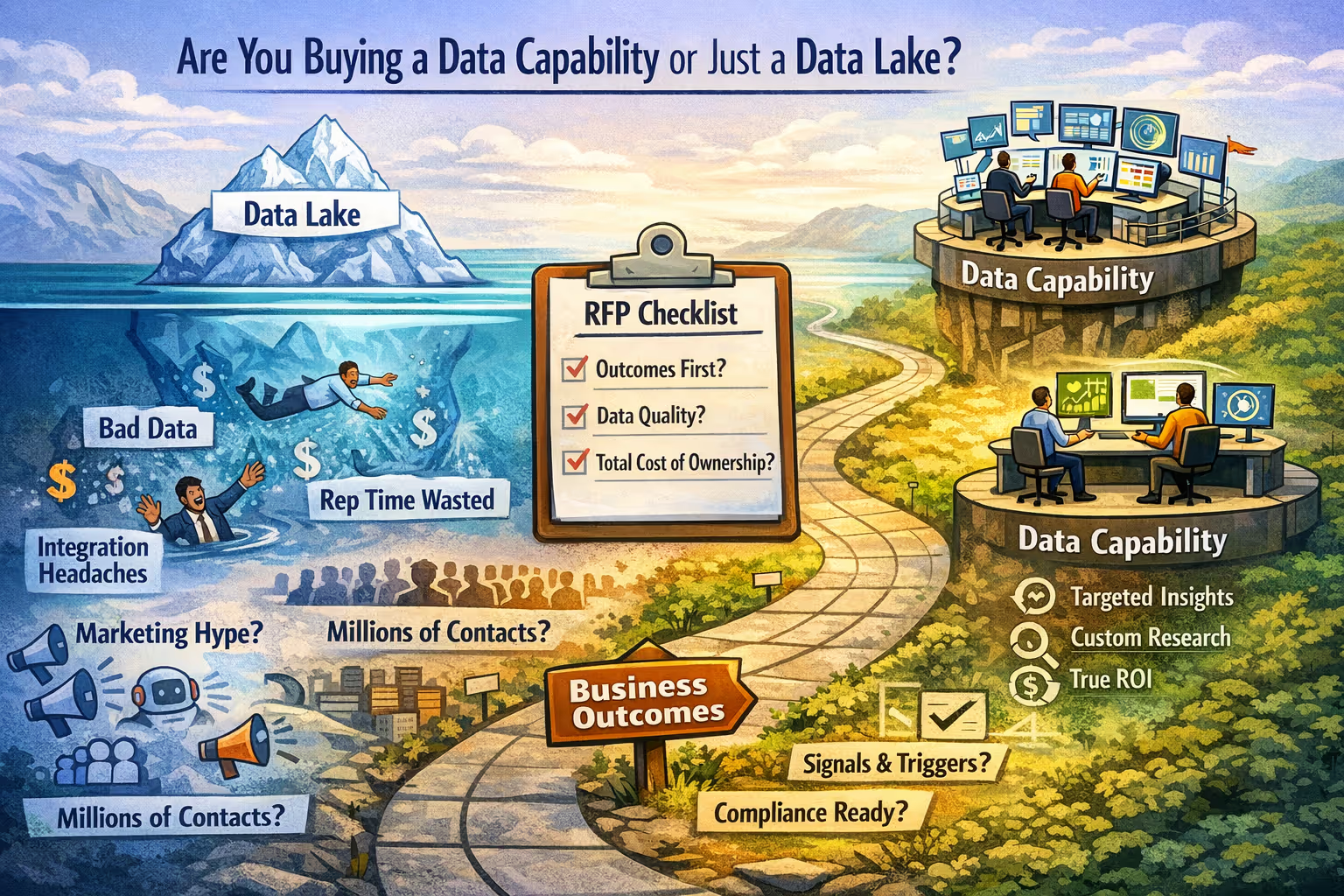
Here's a truth that hurts: most organizations think they know how to evaluate data providers—until they're six months into a contract and realize they bought a data lake, not a data capability.
If you're building an RFP for a data intelligence solution right now, you're probably facing a maze of vendors all claiming millions of contacts, AI-powered insights, and "verified" data. But how do you separate genuine capability from clever marketing?
This guide will show you exactly what to include in your RFP and how to evaluate vendor responses—including where traditional providers typically fall short and where modern data intelligence platforms pull ahead.
The Foundation: Outcomes Before Data Types
This is where most RFPs fail right out of the gate.
Before you list a single required field or data type, force internal alignment on what success actually looks like. Your RFP should lead with business outcomes, not technical specifications.
RFP Section: Business Outcomes & Use Cases
Ask vendors to respond to specific, measurable outcomes:
- Increase contact coverage per target account by X%
- Identify net-new ICP accounts not currently in your CRM
- Improve outbound connect rates in under-indexed regions (LATAM, APAC, EMEA)
- Reduce sales time wasted on bad or stale records
- Enable intent-based, signal-driven targeting across channels
Evaluation red flag: If a vendor responds with volume statistics instead of outcomes, you're looking at inventory, not intelligence.
Coverage Quality vs. Coverage Volume
Having millions of contacts means nothing if they're not the right contacts, recently validated, and actually usable.
RFP Section: Coverage by Market, Segment, and Region
Demand precision from vendors on:
Coverage breakdown by:
- Company size (SMB, mid-market, enterprise)
- Industry and vertical depth
- Geography (especially non-US markets)
Percentage of accounts with:
- Verified decision-makers
- Multiple buying-group contacts
- Recent validation (within the last 30–90 days)
What to look for: Do they admit where coverage is weak? Can they custom-build coverage where gaps exist? Or do they just hand-wave with "we have millions of records"?
Remember: prebuilt data lakes optimize for scale, not truth.
Data Freshness: The Non-Negotiable
Stale data is worse than no data—it wastes rep time and damages your brand.
RFP Section: Freshness, Verification & Decay Management
Require explicit answers on:
- How is data validated?
- What signals trigger re-verification?
- How often are records refreshed?
- What percentage of data is human-verified versus inferred?
- How do you handle role changes, layoffs, and company closures?
Evaluation benchmark: If the answer is "we refresh quarterly or monthly," you're looking at a static database. If the answer involves real-time validation, triggers, and feedback loops, you're looking at true intelligence.
Beyond Firmographics: Signals That Matter
This is where modern platforms separate themselves from legacy providers.
RFP Section: Signals & Contextual Intelligence
Ask vendors to detail their support for:
- New product or service launches
- Funding and ownership changes
- Hiring trends and strategic hires
- New locations and expansion signals
- Technology installations and removals
- E-commerce activity
- Supply chain relationships
- Positive and negative news
- Social signals (growth, engagement, brand momentum)
Critical follow-up questions:
- Are signals off-the-shelf or custom-defined?
- Can signals be tailored to your ICP, not a generic one?
Evaluation red flag: If signals are just "intent scores" you can't audit or customize, they're a black box. You want explainability and control.
Customization: The Future of Data Intelligence
Your ICP is unique. Your data solution should reflect that.
RFP Section: Custom Research & Data Build Capability
Force clear yes/no answers:
- Can you build datasets that don't already exist?
- Can you crawl, classify, and model data based on our specific ICP?
- Can you support niche roles, verticals, or partner ecosystems?
Examples of custom data needs:
- VARs and channel partners
- Franchise operators
- Managed service providers (MSPs)
- Vertical SaaS buyers
- Region-specific SMBs
Evaluation insight: If the vendor can't build outside their existing schema, you're buying their worldview—not yours.
Integration and Activation: Where Data Meets Workflow
Data unused is data wasted. Your data solution needs to live where your teams work.
RFP Section: Activation & Integration
Require details on:
- Native CRM integrations (Salesforce, HubSpot)
- Marketing automation platform integrations (Marketo, Pardot, Segment)
- Ad platform activation (Google, Meta, LinkedIn alternatives)
- APIs and webhooks
- Feedback loops (what happens when reps flag bad data?)
Evaluation focus: The best data providers obsess over where data breaks in the workflow, not just how it's delivered.
Compliance and Privacy: Non-Negotiable in 2025
Procurement will care about this. You should too—especially as regulations tighten globally.
RFP Section: Compliance & Data Governance
Require transparency on:
- GDPR, CCPA, LGPD, and regional compliance
- Consent versus legitimate interest frameworks
- Data sourcing transparency
- Right to audit
- Data ownership (leased versus exclusive)
Strategic consideration: Leased data equals shared risk. Bespoke, exclusive data equals strategic asset.
Accountability: Metrics and SLAs
If it can't be measured, it can't be trusted.
RFP Section: Performance Metrics & SLAs
Demand:
- Accuracy guarantees
- Replacement policies
- SLA on turnaround time
- Outcome-based KPIs (not just record counts)
Strong vendors will welcome this level of accountability. Weak ones will dodge it.
The Hidden Economics: Total Cost of Ownership
This is where most buying decisions go sideways—and where vendors count on you not asking the hard questions.
The sticker price is just the beginning. Many data intelligence platforms have deeply hidden costs that only surface after you've signed the contract and started implementation. Here's what actually drives your total cost of ownership:
The Visible Costs (What They'll Tell You About)
- Base platform fee or subscription cost
- Cost per contact/record/credit
- User seat licenses
- Annual contract value
The Hidden Costs (What They Won't Highlight)
Implementation & Integration Tax
- Custom API development when "native integrations" don't actually work
- Data normalization and cleanup before you can even use the data
- Middleware or iPaaS tools to make systems talk to each other
- IT/RevOps hours spent on setup, testing, and troubleshooting
Data Quality Burden
- Rep time validating and correcting bad data (multiply bad records by hourly sales cost)
- Opportunity cost of reps calling disconnected numbers or wrong contacts
- Database cleanup services to fix what the vendor broke
- CRM pollution cleanup costs
Operational Overhead
- Training costs for each team member
- Ongoing data hygiene and list management
- Manual enrichment when automated enrichment fails
- Admin time managing credits, downloads, and usage caps
Usage Limitations & Overages
- Per-export fees that weren't clear in initial pricing
- Credit systems that expire or don't roll over
- Regional coverage that costs extra
- Premium signals or features behind additional paywalls
The Abandonment Tax
- Unused credits or seats you paid for but never used
- Data that decays faster than you can activate it
- Features you bought but teams don't adopt
- Locked-in annual contracts when you realize it's not working
Replacement & Switching Costs
- Migration costs when you inevitably need to switch
- Lost productivity during transition
- Duplicate vendor costs during overlap period
- Institutional knowledge lost from the failed implementation
RFP Section: Commercial Model & True TCO
Don't just ask about pricing—demand transparency on the full economic picture:
Pricing Structure Questions:
- Cost per record versus cost per outcome achieved
- What happens to unused data, credits, or seats?
- Can pricing flex by region, segment, or use case?
- Are pilots supported before full commitment?
- What triggers pricing escalations or overages?
Hidden Cost Disclosure:
- What are typical implementation costs and timelines?
- What percentage of customers require custom development?
- What's the average time-to-value (when do teams actually start using it)?
- What ongoing maintenance or admin burden should we expect?
- What happens if data quality doesn't meet SLAs—do you credit back or just replace records?
Total Cost Benchmarking:
Ask vendors to provide a true TCO calculation that includes:
- Year 1: Platform costs + implementation + training + integration
- Year 2-3: Platform costs + maintenance + expected growth
- Hidden costs: Rep time waste, data cleanup, unused capacity
The Real ROI Formula:
True Cost of Ownership = Base Price + Implementation + Integration + Training +
Wasted Rep Time + Missed Opportunities + Data Cleanup +
Admin Overhead + Unused Capacity
Your Evaluation Framework
When scoring vendor responses, weight categories strategically:
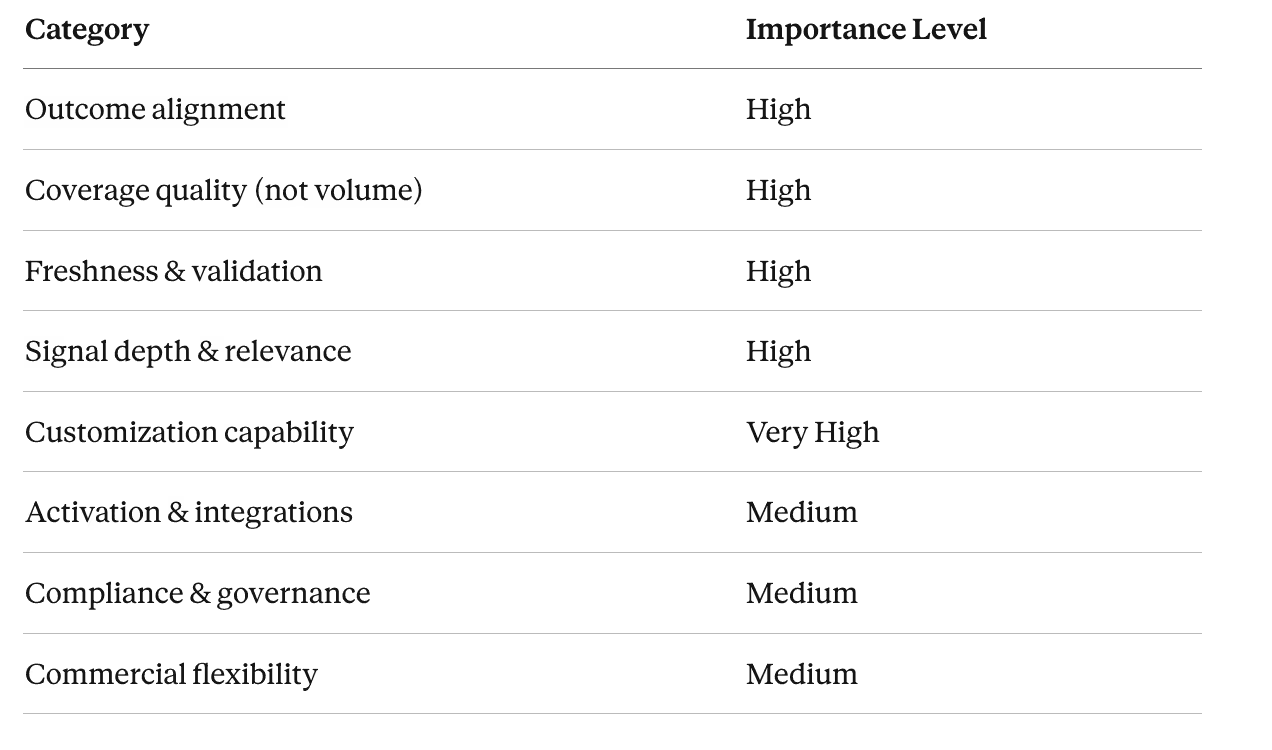
The final test: If a vendor wins on volume but loses on customization, freshness, and outcomes, they're a legacy provider pretending to be modern.
Moving Forward
Building an effective RFP for data intelligence isn't about finding the vendor with the most contacts or the lowest price per record. It's about finding a partner who understands that data is only valuable when it drives outcomes.
Your RFP should force vendors to prove they can deliver on your specific use cases, maintain data quality over time, and adapt as your needs evolve. Anything less is just buying a database—and databases don't drive revenue growth.
.avif)