HRIS Advertising Intelligence Report

The definitive map of where HRIS advertisers spend, what they say, and what they're getting wrong. Built on ad library data, technographic pixel audits, and competitive spend analysis.

Article
April 17, 2026
HRIS Advertising Intelligence Report | AdScope by AdGenius | LeadGenius
April 2026 Edition

HRIS Advertising Intelligence Report

The definitive map of where HRIS advertisers spend, what they say, and what they're getting wrong. 40 companies. 7 channels. 300,000+ creatives.

40 Companies Analyzed
7 Channels Mapped
38,000+ Creatives Reviewed
$15M+ Monthly Google Spend

Powered by AdScope by AdGenius | A LeadGenius Product

The $15 Million Blind Spot

The HRIS advertising market is one of the most heavily invested digital categories in B2B software. Across the 40 companies analyzed, estimated Google Ads spend alone exceeds $15 million per month. Annual category media spend likely exceeds $250 million.

And nearly all of it flows into the same two channels.

The Headline Finding

Of the 40 HRIS companies analyzed, 85% concentrate more than 80% of their paid media in Google Search and LinkedIn. Only 9 of 40 have an active TikTok pixel. Only 2 of 5 category leaders run Meta as a serious acquisition channel. Reddit, YouTube, and TikTok remain structurally uncontested. This is the single largest arbitrage opportunity in HRIS advertising.

85%
of companies are 80%+ concentrated on Google + LinkedIn
9 / 40
have an active TikTok conversion pixel
76%
have stale or missing Google Conversion Tracking
0 / 5
category leaders run vertical-specific SMB creative

The Category Spending Landscape

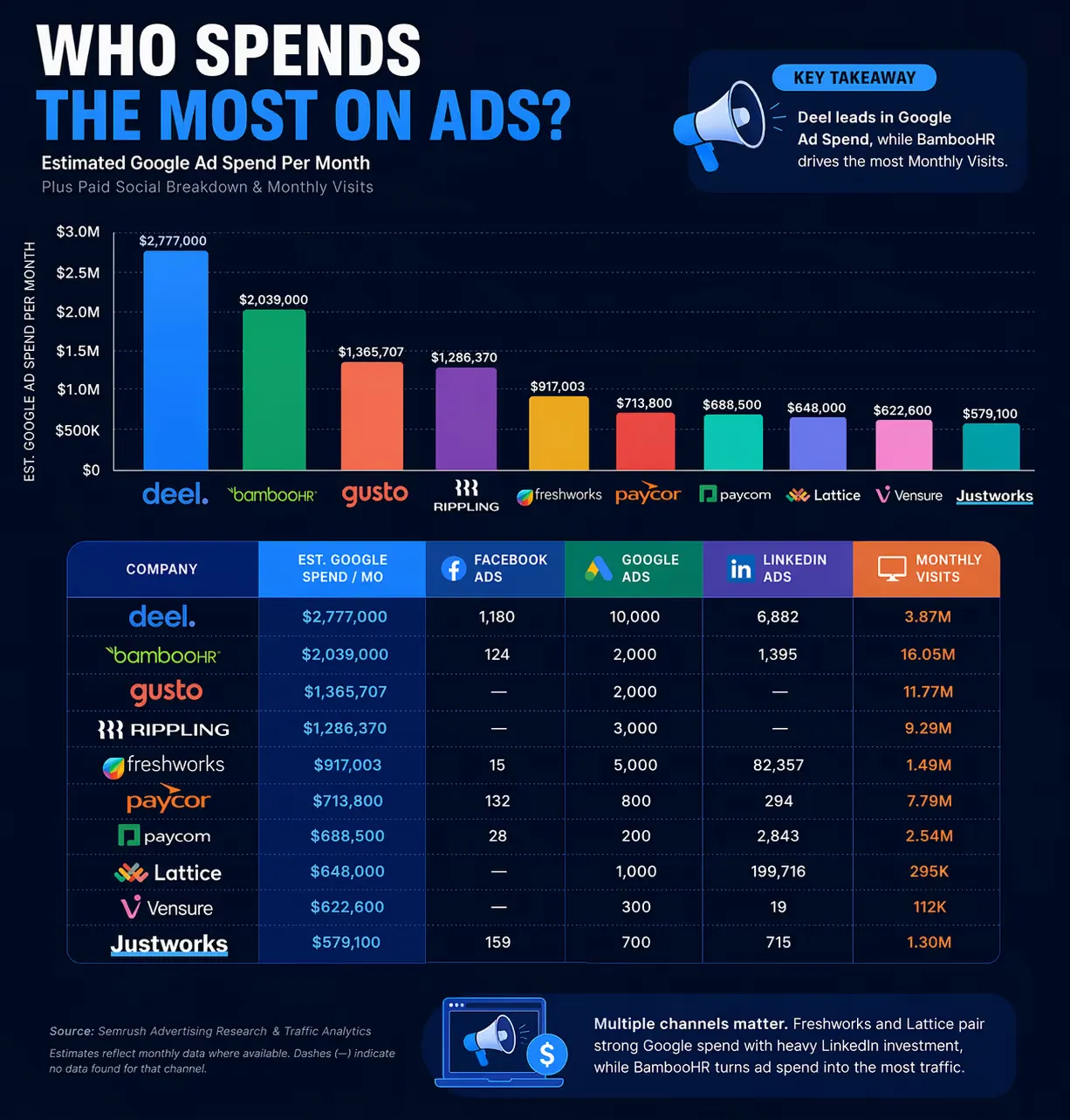
Four companies account for the overwhelming majority of estimated Google Ads spend: Deel ($2.78M/mo), BambooHR ($2.04M/mo), Gusto ($1.37M/mo), and Rippling ($1.29M/mo). Combined, these four represent roughly half of all estimated search spend in the category.

Company Est. Google Spend/Mo Facebook Ads Google Ads LinkedIn Ads Monthly Visits
Deel$2,777,0001,18010,0006,8823.87M
BambooHR$2,039,0001242,0001,39516.05M
Gusto$1,365,7072,00011.77M
Rippling$1,286,3703,0009.29M
Freshworks$917,003155,00082,3571.49M
Paycor$713,8001328002947.79M
Paycom$688,500282002,8432.54M
Lattice$648,0001,000199,716295K
Vensure$622,60030019112K
Justworks$579,1001597007151.30M

Top 10 HRIS companies by estimated monthly Google Ads spend. Source: SpyFu estimates, ad library data, AdScope analysis. Feb 2026.

The Concentration Problem

The most striking finding across all 40 companies is the degree of channel concentration. 35 of 40 companies (85%) place more than 80% of their visible creative inventory on Google Search and LinkedIn alone. This is not diversification. This is herd behavior at category scale.

Concentration TierCompanies% of TotalWhat It Means
>95% Google + LinkedIn2255%Effectively invisible outside search & LinkedIn
80–95% Google + LinkedIn1333%Token presence on one alt channel
60–80% Google + LinkedIn410%Emerging cross-channel diversification
<60% Google + LinkedIn12%True cross-channel (Deel)

The Pixel Gap

Ad creative tells you where a company is showing up. Tracking pixels tell you whether they're serious about it. The pixel data across 40 HRIS companies tells a story of strategic incompleteness even more dramatic than the creative data.

Tracking TechnologyActiveStale / InactiveNot InstalledActive %
Facebook Pixel2018349%
Facebook Conversion Tracking1818544%
LinkedIn Insights2611463%
Google Conversion Tracking1027424%
Google AdWords Conversion309273%
TikTok Conversion Pixel903222%
The Alarming Number

Only 24% of companies have active Google Conversion Tracking despite the category spending an estimated $15M+ per month on Google Ads. 76% are either running stale conversion tags or spending on search with no closed-loop measurement at all.

The TikTok Signal: Only 9 of 40

TikTok adoption in HRIS advertising is almost nonexistent. Only 9 companies out of 40 have an active TikTok conversion tracking pixel installed — and most of those deployments are recent. The remaining 32 companies have zero TikTok infrastructure. Not stale pixels. No installation at all.

CompanyTikTok PixelLast DetectedSegment
BambooHRActiveFeb 2026SMB
DeelActiveFeb 2026SMB
Employment HeroActiveFeb 2026Mid-Market
PaycomActiveFeb 2026Mid-Market
SHRMActiveFeb 2026Mid-Market
TeamSystemActiveFeb 2026SMB
ThryvActiveFeb 2026SMB
FingercheckActiveDec 2025SMB
JustworksActiveSep 2025SMB

The companies that have deployed TikTok pixels are disproportionately SMB-focused, which aligns with TikTok's audience composition: owner-operators, independent business builders, and early-career HR professionals already spending time on the platform.

The Facebook Pixel Graveyard

Nearly half of all companies (18 of 40) show a Facebook Pixel status of "Used" — meaning the pixel exists but is no longer firing. These are companies that had a Meta strategy, tested it, and abandoned it. The pixel remains as a digital artifact of an abandoned channel. For any advertiser willing to invest in Meta-native creative, these abandoned audiences are available at dramatically lower CPMs.

What the Pixel Data Tells a CRO

Your competitors are spending millions on Google Ads with stale conversion tracking. They abandoned Meta after a half-hearted test. They haven't even installed TikTok. This isn't just a creative opportunity — it's a measurement opportunity. The first HRIS advertiser to build a full-funnel, cross-channel measurement stack connecting ad engagement to CRM pipeline will have a structural advantage creative alone cannot replicate.

Want to see your own pixel gaps? We'll audit your tracking infrastructure and your competitors' — free, in 48 hours.

Book Your Audit

Creative Architecture & Competitive Messaging

Channel allocation tells you where competitors are visible. Tracking infrastructure tells you whether they're measuring. Creative architecture tells you what they're actually saying — and what they're not saying.

The Four-Layer Messaging Framework

Every B2B ad operates on one of four layers. Understanding which layers your competitors over-index reveals the specific positioning gaps available to challengers.

LayerFunctionCategory Observation
1 — IdentityCreates belonging and ambitionGusto leads (USA Luge, creator content). Rippling's Super Bowl. Massive gap for most.
2 — ProblemCreates urgency with specific painADP dominates (EU Pay Transparency, SECURE 2.0). Rippling's "Software Sprawl."
3 — ProofROI evidence, named customersDeel's case-study engine is the benchmark. G2 + customer counts elsewhere.
4 — ConversionDemo, pricing, incentive offersEveryone over-indexes. Rippling uses gift cards. Gusto is price-transparent.

The entire category over-indexes at Layer 4 (Conversion) and under-indexes at Layer 1 (Identity) and Layer 3 (Proof). The result is a landscape of interchangeable demo requests with very little emotional or competitive differentiation.

The Five Advertising Machines

Deel

The Proof Engine

The most prolific ad machine in the set: 940 Meta ads, 7,539 LinkedIn ads, and 10,000 Google ads. Deel has turned customer success stories into scalable performance media. Named-customer case studies run as ad creatives with quantified outcomes: $74K saved, onboarding cut from 3 months to 10 days, 120 hours of admin eliminated. Localization is exceptional — the same offer appears in four languages with region-specific landing pages.

Exploitable gap: Deel's ICP skews heavily toward global, venture-backed, tech-forward companies. The US domestic SMB payroll buyer — the restaurant owner, the logistics operator, the local services company — is almost entirely unaddressed.

Rippling

Category-Consolidation Machine

With 6,932 LinkedIn ads, 830 Meta ads, and an $8M Super Bowl debut, Rippling is advertising like a platform trying to feel inevitable. The "Software Sprawl" campaigns define the problem. The "Rule Your Business" Super Bowl series is their first serious Layer 1 (Identity) investment. Aggressive incentive strategy — Apple Watches, YETIs, Nike gift cards — likely inflates demo volume but introduces quality risk.

Exploitable gap: Zero Reddit presence. All-in-one promise creates migration anxiety. Incentive strategy creates pipeline noise. A precision challenger wins by being more exact and more verticalized.

ADP

Incumbent Fortress

ADP's footprint (4,822 LinkedIn ads, 2,000 Google ads, 247 Meta ads) is a market-coverage strategy, not a campaign strategy. Messaging is disciplined but broad: "Forward-thinking solutions," "Be ready for any what if." ADP Marketplace ads reinforce ecosystem gravity. This is an incumbent making sure no buyer escapes the category gravity field.

Exploitable gap: Messaging is broad to the point of abstraction. Dominates presence but not persuasion. A challenger doesn't need to outspend — it needs to out-specify.

Gusto

Full-Funnel Acquisition Engine

Always-on growth system: 422 Meta ads, 1,186 LinkedIn ads, 2,000 Google ads. USA Luge sponsorship and creator-led founder content give payroll software borrowed identity. Gusto's 79.96% direct traffic share — highest in the set — proves the brand strategy is working.

Exploitable gap: Broad SMB appeal leaves room for vertical specificity: restaurants with tipped wages, logistics with seasonal hiring, ecommerce with 1099 contractors. Reddit and community channels completely absent.

Namely

Maintenance Mode

Zero Meta ads, 16 LinkedIn ads, 62 Google ads (under parent Vensure). Diminished brand ownership. Creative is serviceable but not urgent or differentiated. The opportunity here isn't just stronger messaging — it's stronger conviction.
The Channel Arbitrage

When you overlay competitive density against channel cost structure, the arbitrage becomes stark. LinkedIn CPMs in B2B HR typically run $50–$80. Meta can deliver equivalent SMB reach at $8–$15 CPM, Reddit at $2–$6, and YouTube pre-roll at $8–$20. That's a 4–10x reach efficiency advantage against near-zero competition.

ChannelAvg. CPMCompetitors Active (of 40)SMB Buyer DensityOpportunity
LinkedIn$50–$8038 (95%)LowSaturated
Google Search$15–$45 CPC38 (95%)MediumDefended
Meta (FB/IG)$8–$15~15 active (38%)HighWide Open
YouTube$8–$20~5 (est.)HighUnder-Owned
TikTok$5–$129 w/ pixel (23%)Medium-HighWide Open
Reddit$2–$6<5 (est.)HighNear-Zero Competition

Rippling's $8 Million Super Bowl Bet

Nothing illustrates the channel allocation question more vividly than Rippling's Super Bowl LX debut. The 30-second spot cost approximately $8 million in airtime alone. Here's what that same budget buys across the channels most HRIS advertisers are ignoring:

$8M AllocationEst. ImpressionsTargetingDuration
Super Bowl (30 sec)~130M viewers, onceConsumer broadcast — single-digit B2B overlapOne night
TikTok ($5–12 CPM)800M–1.6BInterest + vertical targeting6–12 months
Reddit ($2–6 CPM)1.3B+r/smallbusiness, r/humanresources, vertical subs12+ months
Meta ($8–15 CPM)530M–1BBehavioral + lookalike audiences6–12 months
YouTube ($8–20 CPM)400M–1BCategory education keywords6–12 months

For the cost of 30 seconds of Super Bowl airtime, a challenger could fund an entire year of cross-channel paid media across Meta, YouTube, Reddit, and TikTok — with precision targeting and measurable pipeline attribution.

Running the same dual-channel playbook? Let us show you exactly where the arbitrage lives in your category — with real data, not theory.

Get Your Category Audit

The Category's White Space Map

Messaging Theme Matrix

The bottom row is the finding that matters most.

ThemeADPRipplingGustoDeelNamely
ComplianceDominantPresentModerateAI-specificModerate
Speed / AutomationModerateStrongStrongModerateModerate
Cost / PricingAbsentAbsentDominantAbsentAbsent
Global / InternationalStrong (EU)ModerateAbsentDominantAbsent
Identity / BrandAbsentDominantDominantFounder storyAbsent
Incentive OffersAbsentDominantAbsentAbsentAbsent
Social Proof / CasesLowModerateStrongDominantLow
Vertical SMBAbsentAbsentAbsentAbsentAbsent
The Category-Level Creative White Space

Not a single competitor is running vertical-specific SMB creative. The restaurant owner, the logistics operator, the ecommerce merchant, the home services manager — none see themselves in the current HRIS ad landscape. The highest-leverage creative type is "risk reversal by specificity." Generic claims don't reduce switching risk. Specific promises do: "Payroll built for restaurants with tipped wages," "1099 onboarding in 10 minutes," "SECURE 2.0 contributions handled automatically."

Five Exploitable Gaps Every HRIS Advertiser Should Own

  1. The Vertical Gap No competitor is producing industry-specific creative for restaurants, logistics, healthcare staffing, franchise models, field services, or ecommerce. This is the largest uncontested positioning territory in HRIS advertising.
  2. The Channel Gap Meta, TikTok, Reddit, and YouTube represent a 4–10x CPM advantage over LinkedIn with near-zero HRIS competition. 78% of the category hasn't even installed a TikTok pixel.
  3. The Measurement Gap 76% of companies have stale or missing Google Conversion Tracking despite spending millions on search. Cross-channel attribution to CRM pipeline is nearly nonexistent outside the top 3–4 spenders.
  4. The Proof Gap Only Deel has operationalized customer case studies as performance media at scale. Named-customer, quantified-outcome ads are the highest-converting B2B format — and almost nobody is running them.
  5. The Community Gap Reddit's r/smallbusiness (3.2M members), r/humanresources (226K), and industry-specific subreddits are where SMB buyers actively research. At $2–$6 CPM with near-zero competition, Reddit is the single highest-leverage net-new channel in the category.

What This Means for Your Strategy

For Digital Advertising Managers

If your HRIS paid media budget is more than 70% Google + LinkedIn, this is a wake-up call. You're competing in the most saturated, most expensive part of the funnel alongside the best-funded companies in the category. The marginal return on your next LinkedIn dollar is diminishing. The marginal return on your first Reddit, TikTok, or Meta dollar is enormous.

Start here: audit your pixel infrastructure. Active Facebook Conversion Tracking? Active TikTok pixel? Google conversion tags firing and passing data to your CRM? If any answer is "no," you have a measurement problem that precedes your channel allocation problem.

For CROs and Revenue Leaders

Pipeline growth over the next 24 months will disproportionately reward companies that diversify channels, invest in cross-channel measurement, and build creative that speaks to specific buyer verticals rather than generic "HR platform" positioning.

The companies that will win are not the ones that spend the most. They're the ones that connect signals — site behavior, CRM stage, persona, vertical, channel touchpoint — to creative sequencing across channels their competitors are ignoring. That's an infrastructure advantage.

Ready to see what your competitors are missing? 20-minute strategy walkthrough. Personalized to your category. No strings attached.

Schedule a Walkthrough

Get Your Own Competitive
Ad Intelligence Audit

This report covers HRIS. AdScope covers every B2B category. Get a personalized competitive ad intelligence audit for your market — delivered in 48 hours — plus a 20-minute strategy walkthrough.

Request Your Free Audit

Methodology

Based on ad library creative pulls (38,000+ creatives via AdScope), technographic pixel audits across 40 HRIS companies, and SpyFu spend estimates. Data reflects February–March 2026. Spend estimates are directional; actual multi-channel spend is likely 2–3x Google-only figures shown.

Our Resources

Learn From Our Resources

Discover expert insights, practical guides, and proven strategies to power your go-to-market success.

The Performance Blueprint: Your paid media decoded.

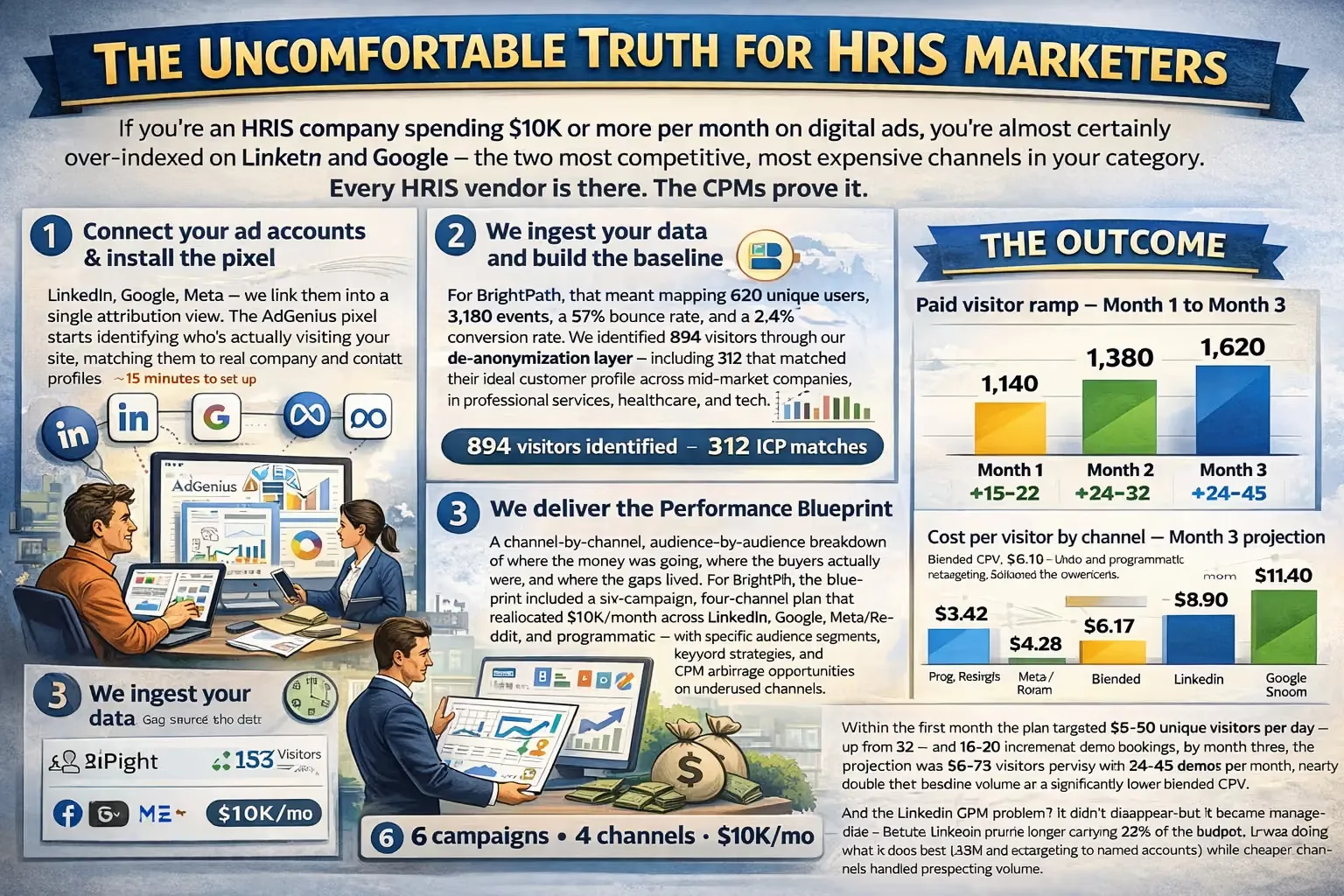
Most B2B companies spend thousands on digital ads every month and have no idea what's actually working. The AdGenius Performance Blueprint is a comprehensive, data-driven audit that strips away the guesswork—showing you exactly where your budget is producing results, where it's leaking, and what to do about it.

read more

Contact-Level Technographics: The Future of Precision Audience Building

Traditional B2B databases stop at account-level installs—useful logos, but little insight into who actually drives adoption. Contact-Level Technographics (CLT) goes deeper by mapping real practitioner behavior from GitHub, Stack Overflow, and other public-web signals back to verified business identities.

read more

Zoominfo Alternatives

Amidst growing dissatisfaction with ZoomInfo, businesses are turning to self-serve platforms & AI-driven, white-glove data services for accurate data solutions.

read more

Ready to Find the
Contacts That Matter?

Get precise, compliant, and on-demand contact data—tailored to your business needs.