
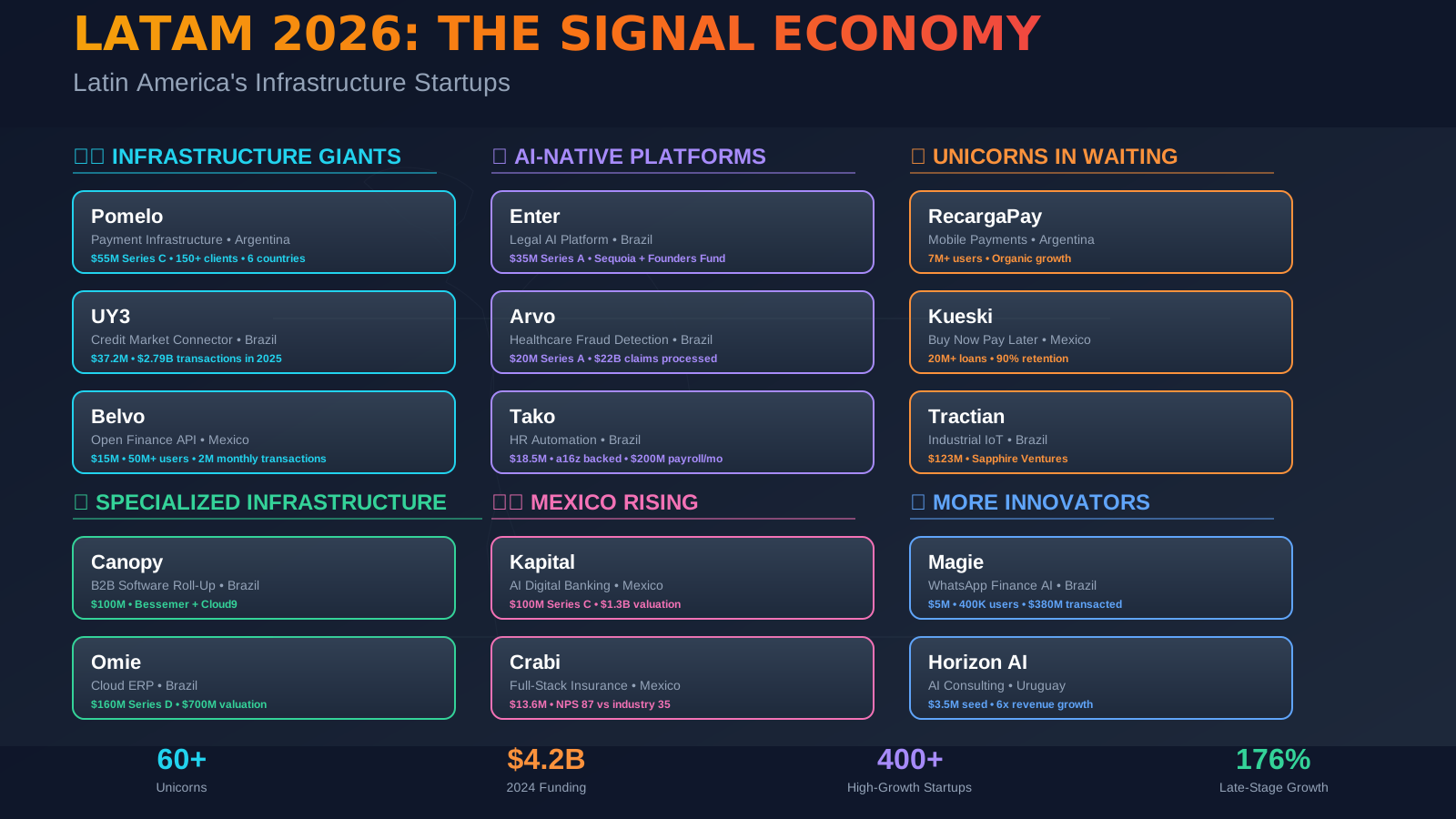
Latin America isn't just minting unicorns anymore—it's building the financial rails, AI platforms, and B2B infrastructure that the entire digital economy depends on. What's changed since the Nubank and Rappi era isn't just the number of billion-dollar companies (now over 60 across the region), but the fundamental shift in how founders build. Capital is more sophisticated. Startups launch with global ambitions from day one. And the most compelling companies aren't chasing consumer hype—they're constructing the invisible infrastructure that powers everything else.
After analyzing 400+ high-growth companies across Brazil, Mexico, Colombia, Chile, and Argentina—tracking funding velocity, executive movement, hiring patterns, infrastructure expansion, and B2B traction—we've identified a clear pattern: 2026 belongs to the infrastructure builders, the AI-native platforms, and the companies solving the hardest problems in financial services, logistics, and enterprise software.
Here are the startups defining Latin America's next chapter.
The Infrastructure Giants: Financial Rails for the Next Decade
Pomelo (Argentina) - The Payment Infrastructure Powerhouse

What they do: Cloud-native infrastructure for credit, debit, and prepaid card issuance and managementWhy they matter: Just raised $55 million in Series C (January 2026) co-led by Kaszek and Insight Partners, serving 150+ clients including BBVA, Santander, Bancolombia, PayJoy, Binance, and Western Union. Operating across six countries, Pomelo provides the BIN sponsorship and regulatory compliance infrastructure that enables any company—from banks to fintechs to crypto platforms—to issue cards at scale.The signal: When global giants like Western Union and Binance choose your infrastructure over building their own, you're not just a vendor—you're essential plumbing.
UY3 (Brazil) - The Credit Market Connector
What they do: Digital infrastructure linking fintechs, banking correspondents, and loan originators to Brazil's capital marketsWhy they matter: Secured $37.2 million (January 2026) after processing $2.79 billion in transactions in 2025 alone. UY3 handles the entire credit lifecycle—from loan registration to funding—making Brazil's fragmented credit ecosystem actually work together.The signal: In a market where credit access remains the biggest barrier to growth, building the pipes that connect lenders to capital is a $100 billion opportunity.
Belvo (Mexico) - Open Finance Infrastructure
What they do: Leading open finance API platform connecting users' accounts to financial applicationsWhy they matter: Raised $15 million led by Quona Capital in 2025, now processing nearly 2 million account-to-account transactions monthly with 50+ million connected users. BBVA, Mercado Libre, and Creditas all depend on Belvo's infrastructure.The signal: As Brazil's "Brazil Stack" (Gov.br digital identity, Pix instant payments, Open Finance) sets the regional standard, Belvo is building the connective tissue that makes it all interoperable across borders.
The AI-Native Wave: Enterprise Intelligence Built From Scratch
Enter (Brazil) - Legal AI That Actually Works
%20-%20Legal%20AI%20That%20Actually%20Works.svg)
What they do: AI-powered legal drafting platform providing auditable, reliable document creationWhy they matter: Founded in 2023, already raised $35 million Series A co-led by Founders Fund and Sequoia at a $350 million valuation. Processing 250,000 legal cases annually, Enter is solving one of enterprise software's hardest problems: AI that lawyers trust.The signal: When Sequoia and Founders Fund co-lead a Series A just months after launch, they're betting on category creation, not incremental improvement.
Arvo (Brazil) - Healthcare's Fraud Fighter
What they do: AI platform securing financial transactions in healthcare by analyzing billing and insurance claimsWhy they matter: $20 million Series A led by Kaszek and Base10 Partners, processing over $22 billion in medical claims while quadrupling revenue in 12 months. Reducing review times from 15 minutes to 30 seconds means Arvo isn't just faster—it's fundamentally changing healthcare economics.The signal: Healthcare fraud costs Brazil an estimated $5 billion annually. AI that can catch it at scale isn't a nice-to-have—it's infrastructure.
Tako (Brazil) - HR Automation for Everyone
What they do: AI-driven payroll and HR automation platformWhy they matter: $18.5 million Series A led by Ribbit Capital with participation from a16z, processing over $200 million in monthly payroll. In a region where SME back-office operations remain stuck in the spreadsheet era, Tako is automating the entire stack.The signal: When a16z backs HR infrastructure in Brazil, they're betting on a playbook that worked with Gusto and Rippling in the US—but at LatAm margins and scale.
Magie (Brazil) - WhatsApp-Native Financial Assistant
What they do: AI-powered financial assistant for Pix payments, balance checks, and bill payments via WhatsAppWhy they matter: Founded in 2024, raised $5 million led by Lux Capital (January 2026), already has 400,000+ users and processed $380 million in transactions. Pivoting from consumer to B2B conversational finance infrastructure on WhatsApp—where 90%+ of Brazilians already are.The signal: Chat-based finance isn't the future in LatAm—it's already here. Magie is building the conversational layer that sits on top of Pix, Open Finance, and Brazil's financial infrastructure.
Horizon AI (Uruguay) - The AI Consulting Platform
What they do: AI-driven consulting and automation platform for enterprise clientsWhy they matter: Raised $3.5 million seed led by NXTP (January 2026) after growing revenue sixfold in 2025. Serving Mercado Libre, Itaú, and PwC, expanding across LatAm and into the US.The signal: Uruguay is producing AI companies that serve the region's largest enterprises—proving that geographic arbitrage plus technical talent is a winning formula.
The Nearly-There: Unicorns in Waiting
RecargaPay (Argentina) - Mobile Payments, Organically Grown
%20-%20Mobile%20Payments%2C%20Organically%20Grown.avif)
What they do: Mobile payment platform for credit recharges, bill payments, and transportationWhy they matter: 7+ million users acquired almost entirely through organic growth. When you can build a payments platform without burning through VC dollars on customer acquisition, you've cracked something fundamental.
Kueski (Mexico) - Buy Now, Pay Later for LatAm
What they do: Digital lending platform offering instant credit and BNPL optionsWhy they matter: 20+ million loans granted, 90% user retention, present in 25% of Mexico's top 150 retailers. Kueski is addressing Latin America's credit gap with a model that actually works at scale.
Tractian (Brazil) - Industrial IoT for Predictive Maintenance
What they do: Industrial monitoring through intelligent sensors and AI-driven predictive maintenanceWhy they matter: Raised $123 million from Sapphire Ventures in 2024. In a region where industrial downtime costs billions, Tractian's AI sensors prevent failures before they happen.
Stark Bank (Brazil) - Banking Infrastructure for Developers
What they do: Developer-first banking platform backed by Bezos ExpeditionsWhy they matter: Jeff Bezos doesn't invest in many Brazilian startups. When he does, it's because the infrastructure play is undeniable.
Omie (Brazil) - Cloud ERP for SMEs
What they do: Cloud-based management software for small and medium enterprisesWhy they matter: $160 million Series D (September 2025) at $700 million valuation. Brazilian SMEs are finally digitizing their back offices, and Omie owns the category.
The Specialized Infrastructure Plays
CashU (Brazil) - B2B Supply Chain Credit
What they do: AI-based credit for SMBs using supply chain data instead of traditional financialsWhy they matter: Raised $23 million FIDC (January 2026), analyzing purchase frequency, transaction volume, and supplier relationships to set credit terms. This is what "alternative data" for credit actually looks like when it works.
Canopy (Brazil) - The B2B Software Roll-Up
What they do: Tech holding company acquiring and scaling B2B software providersWhy they matter: Founded in 2025, already raised $100 million co-led by Bessemer and Cloud9 Capital. First acquisition: Solus, a Brazilian healthcare software provider. Canopy is betting that LatAm's fragmented B2B software landscape is ripe for consolidation.
PX (Brazil) - Logistics Intelligence for Fleets
What they do: Big data and AI for fleet logistics optimizationWhy they matter: Reducing logistics expenses by 20-30% now, targeting 50% reductions. Supporting 500+ vehicle fleets and launching first US operation in 2026. When Mercado Livre invests $5.8 billion in Brazilian logistics infrastructure, companies like PX become critical.
Strike (Brazil) - AI-Powered Offensive Security
What they do: Continuous, AI-driven penetration testing with automated agentsWhy they matter: $13.5 million Series A, AI systems achieving 60-80% of senior pentester effectiveness at 10x the speed. Half the customer base adopting the hybrid AI model by end of 2025, projecting 200 enterprise clients in 2026.
Mexico's Infrastructure Surge
Kapital (Mexico) - AI-Driven Digital Banking

What they do: Digital bank with AI-powered financial servicesWhy they matter: $100 million Series C (2025) led by Pelion Venture Partners and Tribe Capital, pushing valuation to $1.3 billion. Mexico's digital banking infrastructure is maturing fast.
Nufi (Mexico) - The Identity Verification Layer
What they do: Platform verifying any person or business in Mexico in under five minutesWhy they matter: Uses 130+ data sources, serves 330+ B2B companies including major banks, fintechs, and government agencies. Raised $1.5 million seed led by Magma Partners. In a market where LatAm leads global credit card fraud, identity infrastructure isn't optional.
Crabi (Mexico) - Insurance Built Right
What they do: Full-stack auto insurance carrier controlling the entire value chainWhy they matter: First new full insurance license in Mexico in 30 years. NPS of 87 vs. 35 for traditional insurers. Raised $13.6 million led by Kaszek and Ignia, tripling year-over-year growth for three consecutive years.
What This All Means
The 2026 LATAM startup landscape reveals three undeniable truths:
1. Infrastructure is the new consumer. The biggest funding rounds, the smartest capital, and the fastest-growing companies are all building B2B infrastructure. The Nubank playbook worked brilliantly—for Nubank. Everyone else learned that sustainable businesses come from owning critical infrastructure, not chasing consumer market share.
2. AI is eating everything, but selectively. The AI winners aren't using LLMs as chatbots—they're applying machine learning to specific, high-value problems where reducing human time by 10x or 100x creates massive economic value. Legal drafting, healthcare fraud detection, credit underwriting, industrial maintenance—these aren't "AI features." They're AI-native businesses.
3. Brazil's regulatory leadership created a moat. The "Brazil Stack"—digital identity (Gov.br), instant payments (Pix), and Open Finance—isn't just good policy. It's created a regulatory environment where fintech infrastructure companies can build once and scale across the region. Countries copying this playbook (Colombia's Bre-B, Argentina's QR codes) will see their own infrastructure booms.
4. The nearshoring wave is real. Mexico's historic milestone—surpassing Brazil in quarterly VC funding for the first time since 2012—isn't random. It's nearshoring, US proximity, and a maturing ecosystem all hitting at once. The $9.89 billion raised over the past decade is starting to compound.
5. Capital efficiency is the new growth at all costs. RecargaPay's 7 million organic users, Kueski's 90% retention, Crabi's NPS of 87—these aren't accidents. The companies building for 2030 understand that sustainable unit economics and capital efficiency matter more than vanity metrics.
The Bottom Line
Latin America's startup ecosystem raised $4.2 billion in 2024 (up 27% YoY) and is projected to see similar levels in 2026, with late-stage funding up 176% year-over-year in Q3 2025. Brazil recorded $1.25 billion in investments in H1 2025 alone, already exceeding half of 2024's total.
But the money tells only part of the story. The real narrative is about what founders are building: financial infrastructure that banks depend on, AI systems that replace manual processes entirely, logistics networks that make e-commerce viable in markets where it wasn't before, and identity verification that enables trust at scale.
The Nubank and Rappi era was about proving LatAm could produce unicorns. The 2026 era is about proving it can produce indispensable infrastructure. These aren't companies that might get acquired—they're companies that everything else depends on.
That's not hype. That's just the signal economy taking over.
Data sources: Crunchbase, TechLoy, LatamList, Distrito Platform, Wayra, Cuantico VP, LAVCA, January 2026
.avif)