
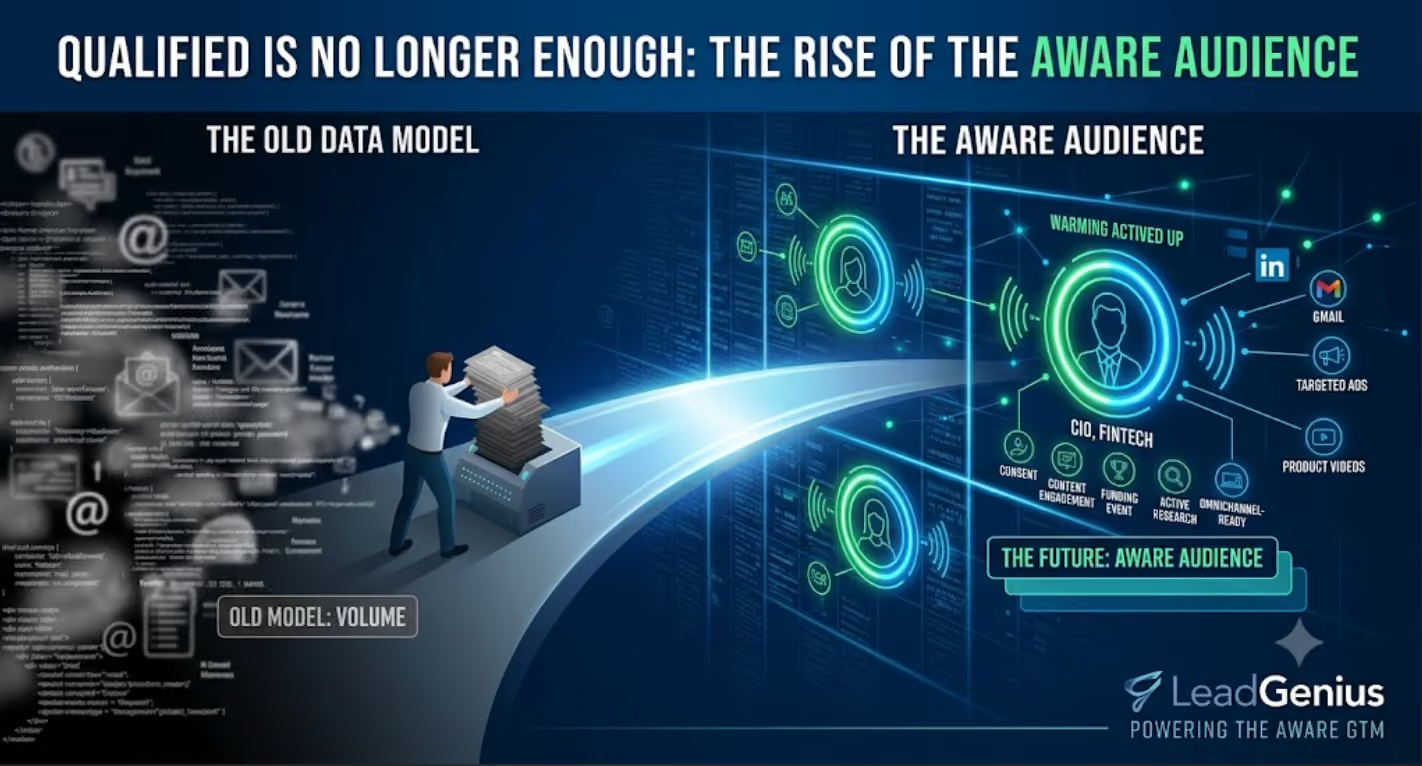
For a long time, the B2B data market was built around a very simple promise: give sales teams more names, more emails, more phone numbers, and more companies to work. That made sense in the predictable revenue era.
The model was straightforward. Build a clean list. Load it into a sequencer. Run a high-volume outbound cadence. Track opens, replies, meetings, and pipeline. If performance dipped, add more volume. More accounts. More contacts. More touches.
That system worked when inboxes were less saturated, buyers were more willing to engage with cold outreach, and the main constraint on pipeline creation was access to contact data.
That world is gone.
Today, the problem is not that revenue teams lack names. The problem is that they lack context. They lack timing. They lack compliant, channel-ready audience data that tells them who is actually worth engaging, why now, and how that audience should be warmed up before sales ever asks for a meeting.
The future of B2B data is not the static list. It is the aware audience.
The old data model was built for volume
The predictable revenue playbook was built around a clean division of labor. Marketing generated demand. Sales developed accounts. SDRs worked lists. Data vendors supplied the raw material.
The buyer record did not need to be particularly nuanced. It needed to be deliverable, reasonably accurate, and matched to a title or persona. If you were selling to VP Sales, VP Marketing, CIO, Head of RevOps, or Procurement, the assumption was that the right title at the right company was enough to justify outbound.
That created an entire category of data providers optimized around breadth: large prebuilt databases, standardized firmographics, basic contact records, and generic intent signals. For a while, that was enough.
But as every GTM team adopted the same playbook, the advantage disappeared. Everyone bought the same data. Everyone filtered by the same titles. Everyone used the same firmographic fields. Everyone automated the same "personalized" outbound. Buyers noticed. And inboxes became war zones.
The result is obvious to anyone running pipeline today: a clean list is useful, but it is no longer sufficient.
The new buyer journey requires aware audiences
Modern buyers are not sitting around waiting for an SDR email to explain their problem to them. They are researching anonymously. They are asking peers. They are watching videos. They are reading comparison pages. They are using AI tools to summarize vendors. They are consuming content across LinkedIn, Google, Reddit, YouTube, communities, review sites, newsletters, and search results long before they ever fill out a form.
That matters because it changes what "lead generation" actually means. A lead is no longer just a person who matches an ICP. A good lead is someone who is qualified, reachable, compliant to engage, and aware enough to understand why the conversation matters.
That awareness may come from several places. It may come from permission-passed data where the buyer has already raised their hand in a compliant context. It may come from real-time authentication, where the record has been validated against current signals rather than stale database assumptions. It may come from content engagement, event participation, product research, hiring activity, technology adoption, funding, expansion, or other account-level signals. It may even come from an intentional awareness campaign that moves a cold but qualified audience into a warmer stage before sales outreach begins.
The best GTM teams are no longer just sourcing leads. They are manufacturing audience readiness.
Compliance is now a growth requirement
Compliance used to be treated like a legal checkpoint. Today, it is a growth requirement. That does not mean every buyer engagement needs to come from a form fill. It means revenue teams need to understand the origin, permission context, geographic constraints, and activation rules for every audience they use.
This is especially important as GTM teams expand globally. A U.S.-centric contact acquisition strategy does not automatically translate into Europe, LATAM, APAC, or other international markets. Different regions require different standards around lawful basis, consent, legitimate interest, phone outreach, email usage, data retention, and opt-out handling.
The companies that win are not going to be the ones that simply buy the biggest file. They will be the ones that can answer better questions:
- Where did this data come from?
- When was it last verified?
- What signal makes this account relevant right now?
- Can this audience be used for email, ads, phone, direct mail, or only certain channels?
- Has this buyer shown awareness, research behavior, or account-level movement?
- Is this audience ready for sales, or does it need to be warmed up first?
That is a very different standard than "Can you give me 50,000 contacts by Friday?"
Email alone can no longer carry the pipeline number
Outbound email is not dead. But the idea that email alone can carry modern pipeline creation is dead. The economics have changed. Deliverability is harder. Buyers are overwhelmed. AI-generated outreach has made bad personalization cheaper and more common. Every inbox is full of messages that sound vaguely relevant but feel completely detached from the buyer's real priorities.
The market is not short on outreach. It is short on relevance.
This is why audience data now needs to be built for activation across multiple channels. The same ICP should be usable for outbound email, LinkedIn, Google, Meta, programmatic, direct mail, event promotion, content syndication, website personalization, and retargeting.
It gives marketing the ability to warm up the account before sales calls. It gives sales the context to speak to current business conditions. It gives RevOps the structure to route, score, suppress, segment, and measure engagement. It gives paid media teams a more precise audience than broad platform targeting. It gives leadership a better view of which accounts are not just in the TAM, but actually moving.
The goal is not just to find the right companies. The goal is to create a system where the right companies see the right message in the right places before the rep ever lands in the inbox.
From SEO to AEO: why buyer discovery is changing again
There is another major shift underneath all of this: the move from SEO to AEO. For years, B2B marketers optimized for search engines. The job was to rank, win clicks, capture traffic, and convert visitors. But buyer discovery is becoming more answer-driven. Prospects are increasingly asking AI systems and search assistants to summarize markets, compare vendors, explain categories, recommend solutions, and narrow their options.
That means visibility is no longer just about ranking on a search results page. It is about being understood, trusted, cited, and included in the answers buyers see.
If buyers are asking AI tools what vendors matter, what category language to use, what problems to prioritize, and what solutions to consider, then the "lead" may be shaped before they ever visit your website. That changes demand generation.
Your content strategy, audience strategy, and data strategy now need to work together. You need to know which companies are in-market, which companies should be in-market, what they are likely researching, what language they use, what channels influence them, and what messages can move them from unaware to problem-aware to solution-aware to sales-ready.
In the SEO era: "How do we capture demand when someone searches?" In the AEO era: "How do we make sure the right buyers understand the problem, trust our point of view, and encounter our brand before they make the shortlist?"
That is not just a content problem. That is a data problem.
The rise of the awareness-qualified lead
Most companies still think about lead quality in narrow terms. Is the company in the ICP? Is the contact the right title? Is the email valid? Is the account large enough? Is there a technology match?
Those are still important. But they do not answer the most important question: is this buyer ready to care? That is why the next evolution of lead scoring will focus less on static fit and more on awareness.
An awareness-qualified lead is not necessarily someone who filled out a form. It is a buyer or account that has enough context, exposure, signal strength, or demonstrated behavior to justify higher-priority engagement — an account that recently launched a new product, opened a new location, raised funding, changed ownership, hired into a strategic function, adopted a relevant technology, expanded e-commerce operations, showed supply chain movement, increased social traction, or engaged with content around a specific problem. It could also include accounts intentionally warmed through a targeted awareness campaign before being routed to SDRs.
This is where the best GTM teams are going: not just lead generation, but lead preparation.
Instead of asking sales to turn completely cold records into pipeline through brute-force outbound, marketing and RevOps can build audience systems that move the right accounts into a higher-awareness state first. That is better for the buyer. It is better for the rep. And it is better for conversion.
Where LeadGenius fits
LeadGenius was built for this new reality.
Because most companies are no longer struggling to describe a generic ICP. They are struggling to find the messy, specific, high-propensity audiences that standard databases miss.
They need to know which companies are expanding internationally. Which accounts just launched a new product. Which brands are growing their e-commerce footprint. Which companies are hiring for roles that suggest budget movement. Which businesses are using specific onsite technologies. Which accounts show social growth, supply chain activity, marketplace presence, funding events, location expansion, or other real-world signals.
They need to find buyers in countries where traditional data coverage is thin. They need to suppress existing customers, de-dupe against CRM, validate contactability, and package the output for sales, marketing, and advertising. And increasingly, they need to understand whether those audiences are cold, aware, engaged, or ready for direct outreach.
That is the shift LeadGenius supports: from static records to custom, compliant, signal-rich audiences that can be activated across the full GTM motion.
The new GTM data standard
The future of B2B data will not be defined by who has the largest database. It will be defined by who can produce the most useful audience.
Useful means compliant. Useful means current. Useful means tied to real business signals. Useful means activated across channels. Useful means mapped to the actual buyer journey. Useful means helping revenue teams understand not just who to contact, but why that company matters now and what kind of engagement should come next.
The predictable revenue era rewarded teams that could scale outbound activity. The next era will reward teams that can scale relevance. That is a very different game.
Because the question is no longer: "Can you give me more leads?"
The better question is: can you help me find the right buyers, understand what they care about, warm them up across the right channels, and engage them when they are actually ready to listen?
That is where modern pipeline is going. And that is where LeadGenius is built to help.
.avif)