Rippling did not climb to the top of the HRIS conversation by acting like an HRIS company. It climbed there by refusing the category's most comfortable assumptions. And its advertising tells you exactly how.
On paper, Parker Conrad should have had a harder road the second time around. His first company, Zenefits, became one of Silicon Valley's most notorious cautionary tales. Conrad resigned in 2016 amid regulatory trouble tied to broker licensing issues, and the company became equally infamous for its culture stories—including reports about memos telling employees to stop drinking and having sex in office stairwells. Whether every retelling was fair is almost beside the point. The market's conclusion was brutal: growth had outrun governance.
What makes Rippling interesting is that Conrad's second act did not retreat into caution and blandness. It learned a different lesson entirely.
Rippling reached a $13.5 billion valuation in 2024, then jumped to $16.8 billion in 2025 after a $450 million Series G with investors including Goldman Sachs Growth, Baillie Gifford, and GIC. Revenue had been doubling year over year in the period leading up to that round, with annual recurring revenue reported above $570 million. That kind of velocity buys a lot of freedom to spend aggressively on product, expansion, and brand.
And Rippling has hardly become controversy-averse. In 2025, a former Rippling employee admitted to spying for rival Deel under directions from Deel's CEO, turning the rivalry into one of the nastiest public feuds in SaaS. Conrad didn't shy away from it. He told CNBC that some companies actually started talking to Rippling because of the lawsuit. In other words, Rippling did not become less combative in its second life. It became more operationally disciplined about where that aggression goes: into product breadth, category framing, and market control.
The Operating Thesis: Selling a Category, Not a Feature Set
The first key to Rippling's go-to-market strategy is that it does not sell a feature set. It sells an operating thesis. Rippling positions itself as the unified system for HR, IT, finance, and more—built on a single source of truth for employee data, with 500+ integrations. That may sound like normal platform language, but it is actually a deliberate escape from the trap that swallows a lot of HR tech vendors: becoming "just another payroll tool," "just another HRIS," or "just another admin layer."
The second key is that Rippling has been willing to create the problem, not just answer it. Its recent brand work does not start with "here are our modules." It starts with "your software stack is broken."
"Business software is failing modern businesses and the people who use it. It's out of date, there's too much of it, and it slows everything down."
Nick Wiesner, VP of Brand, RipplingThat is classic Challenger-style market making. Rippling is not merely asking buyers to prefer its product. It is teaching them to dislike the architecture they already have. If the market starts to believe fragmentation itself is the enemy, then Rippling doesn't have to win every feature comparison. It only has to look like the cleanest escape route. That is a much better game than arguing over who has slightly better payroll workflows.
The Advertising Machine: Three Levels at Once
Rippling's advertising tells you everything about how this company thinks about growth. It operates on three levels simultaneously: narrative, identity, and conversion. Most SaaS companies pick one lane—brand or demand capture. Rippling is doing both, and doing both loudly.
Level 1: Category Narrative
Rippling's February 2025 "Because HR Deserves Better" campaign framed HR leaders as being stuck in bad relationships with outdated software. Produced by SLMBR PRTY and directed by Abby Horton, the campaign featured real HR leaders from companies like Forterra, Therabody, and Faherty Brand who had made the switch. The message was blunt: your frustration isn't your fault. It's your software.
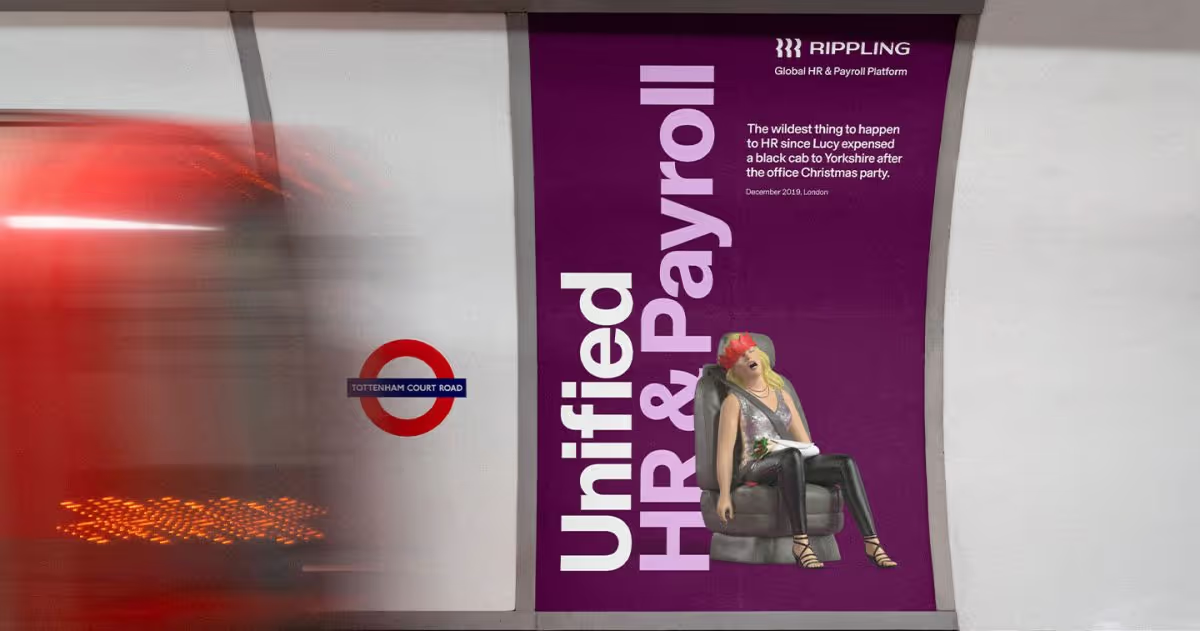
Then in April 2026, Rippling launched its first UK brand campaign through Stink Studios: "The Juiciest Thing to Happen to HR and Payroll." The campaign flipped the traditional narrative around workplace gossip—using character-led stories inspired by real workplace incidents and miniature scene recreations deployed across London OOH, including a takeover at Liverpool Street station, taxi wraps, radio, digital, and social channels. The creative premise: while HR is often seen as the keeper of office drama, the real thing worth talking about is that a platform like Rippling exists and actually delivers.
Level 2: Identity Investment
Rippling's 2026 Super Bowl debut pushed the same architectural argument to a mass audience. The "Rule Your Business" campaign starred Tim Robinson as a diabolical corporate mastermind whose grand plans are repeatedly undone by clunky, fragmented business software. Created with Tombras (Ad Age's 2025 Agency of the Year), the 30-second spot aired during the third quarter of Super Bowl LX, with additional placements on Peacock during the Olympics.
The spot ran nationally with targeted linear buys in San Francisco, San Diego, Atlanta, and Minneapolis. Five total Robinson spots are planned to roll out across the year. As Adweek reported, the campaign marked a shift from performance-led marketing to mass awareness—while still tying the story back to onboarding, finance, IT, and benefits failures caused by disconnected systems.
Level 3: The Demo Machine
Here is where it gets interesting. For all the brand ambition, Rippling has not abandoned hard-nosed direct response. Our April 16 AdScope snapshot surfaced active Rippling presence across Google Search, X, TikTok, YouTube, and LinkedIn—with demo creative offering a $150 Lululemon or Nike gift card, AirPods, and $100 Amazon gift cards for booking a demo.
So the public picture right now is not "Rippling has transcended performance marketing." It is "Rippling is layering major brand ambition on top of a still-very-aggressive demo machine." That combination can be powerful, but it also creates tension if incentives start pulling in curiosity rather than urgency.
The Channel Footprint: Where Rippling Is—and Isn't
The AdScope data from April 16, 2026 paints a detailed picture of Rippling's channel strategy. Google Search remains the heaviest investment by far, with 3,000 ads running under the "People Center, Inc." advertiser name—predominantly text ads for search capture targeting payroll, PEO, benefits, and HRIS queries. LinkedIn carries the incentivized demo offers and thought-leadership-style sponsored posts. X and TikTok carry a mix of video creative and brand messaging. YouTube shows 15 ads tracked.
| Channel | Status | Active Ads | Last 30 Days | Primary Use |
|---|---|---|---|---|
| Google Search | Active | 3,000 | 30 | Demand capture, PEO/payroll terms |
| X (Twitter) | Active | 25 | 20 | Video, gift-card demo CTAs |
| YouTube | Active | 15 | 10 | Brand awareness, video |
| TikTok | Active | 11 | 11 | Creator/influencer-style content |
| Active | 22+ | 4 | Incentivized demos, thought leadership | |
| None | 0 | 0 | — | |
| Meta (FB/IG) | None | 0 | 0 | — |
What is notable is what is missing. No active Reddit ads. No active Meta ads in the April scrape. For a company running a Super Bowl spot and London OOH takeovers, the absence of Meta and Reddit is a strategic gap, not a resource limitation. These are channels where CPMs run substantially lower than LinkedIn, where HR tech communities actively discuss tooling decisions, and where vertical-specific creative could differentiate Rippling from peers who also cluster around Google and LinkedIn.
On LinkedIn, the creative mix is revealing. Rippling runs a dual-track approach: company-branded ads pushing the "all-in-one" platform message alongside thought-leadership posts promoted from individual profiles—people leaders at companies like Chess.com, OneSignal, and Imagine AI (YC F25). Several of these are clearly part of a customer advocacy program, featuring testimonials about Rippling AI's impact on performance review cycles, headcount planning, and global payroll. This is smart social proof engineering: the platform message comes from Rippling, but the validation comes from named practitioners with titles and companies that mid-market buyers can pattern-match against.
The Traps Rippling Has Avoided
To understand why Rippling's rise feels different from the typical HRIS growth story, it helps to name the traps that most competitors fall into—and that Rippling has systematically sidestepped.
The Point-Solution Trap
Most HRIS companies start with one thing—payroll, onboarding, benefits—and get stuck there in the buyer's mind. Rippling expanded the frame early. It doesn't sell HR. It sells workforce operations: HR, IT, and finance on a single employee data model. That is a meaningfully different positioning because it changes the competitive set. You aren't comparing Rippling to Gusto on payroll; you're comparing it to the entire cobbled-together stack.
The Timid-Brand Trap
B2B SaaS companies, particularly in HR tech, default to safe, forgettable brand work—stock photography, compliance-speak, a safe shade of blue. Rippling went the other way. A Super Bowl ad starring Tim Robinson. Purple OOH takeovers across London featuring miniature characters inspired by real HR horror stories. The "Because HR Deserves Better" campaign that essentially told buyers their current software was a bad relationship they needed to leave. This is brand work that creates opinion, not just awareness.
The Feature-Dump Trap
With 24+ products spanning payroll, benefits, SSO, identity management, bill pay, and corporate cards, Rippling could easily overwhelm buyers with feature taxonomy. Instead, it made "bad software" and "fragmentation" the villain. When you make the category architecture the problem, you don't have to win feature-by-feature. You just have to look like the most coherent alternative.
The US-Only Product Trap
Rippling invested in international footprint alongside product expansion: Dublin as EU headquarters, Sydney for APAC, Bengaluru as a growing engineering center. The UK campaign launch in April 2026 is a natural extension of that physical expansion—it is not a company testing international creative from San Francisco. It is a company building market-specific narrative with a local agency (Stink Studios) and local media strategy (OneScreen, StackAdapt).
The Traps That Still Remain
Rippling's rise may contain the seeds of its next set of challenges. These aren't fatal flaws. They're the kind of strategic tensions that emerge precisely because the company is operating at such an ambitious scale.
Channel Gravity
Despite being more channel-diverse than most HRIS peers, Rippling still clusters heavily around Google and LinkedIn—the same two channels every competitor defaults to. The April AdScope snapshot found no active Reddit and no active Meta presence. YouTube and TikTok are active but lightly invested relative to Google's 3,000 ads. For a company that has clearly mastered narrative and creative, the under-investment in lower-CPM channels where HR tech buyers actually discuss tooling decisions (Reddit, niche Facebook groups, programmatic Meta) represents real white space.
Incentive Pollution
Gift-card demos, AirPods offers, and gadget-led calls to action may boost response rates, but they can also muddy pipeline quality. The April snapshot surfaced $150 Lululemon cards, AirPods, and $100 Amazon cards as live incentives. That does not mean Rippling is wrong to use them. It means Rippling is doing what many elite GTM machines do: borrowing efficiency from a tactic that gets weaker as more people notice it. The danger isn't that incentives fail. The danger is that teams start mistaking booked volume for durable buying intent.
Over-Broadness
Rippling's all-in-one promise is one of its superpowers, but it also creates a natural line of attack. Some buyers—particularly in SMB and lower mid-market segments—hear "one platform for HR, IT, finance, and more" and think "operational lock-in," "big migration," or "broad but shallow." The biggest white space in HRIS advertising remains vertical SMB creative: industry-specific messaging that addresses the specific compliance, staffing, and workflow problems of restaurants, healthcare, construction, professional services. Not a single major HRIS player is really owning it. Rippling has built the narrative engine. It hasn't fully built the vertical engine yet.
What This Tells You About Where HRIS Is Going
Rippling did not become the hottest name in HRIS because it stayed clean, quiet, and category-correct. It became hot because it built a product thesis big enough to matter, a narrative sharp enough to reframe the market, and an advertising system willing to do both brand theater and conversion warfare at the same time.
The company has treated go-to-market as an extension of product architecture: one integrated system, multiple surfaces, constant pressure. The controversy gets headlines. The operating discipline is what built the business.
Zenefits became a symbol of what happens when hypergrowth outruns control. Rippling, for all its noise and all its sharp edges, looks much more like a company trying to make control itself into the product—and then turn that same discipline into a market story everyone else is forced to respond to.
That may be the clearest lesson in Rippling's rise. And for anyone competing in this category—or any category where a well-funded challenger is rewriting the rules—the advertising data tells you everything you need to know about where the punches are coming from.
See the Full Competitive Picture
AdScope tracks ad creative, channel strategy, and messaging patterns across 7 channels for any company in your competitive set. Free to use.
Try AdScope Free →
Ripplings Super Bowl Ad
.avif)