Most "ZoomInfo alternatives" lists rank tools by feature parity, which misses the point. Almost nobody leaves ZoomInfo because they want the same thing for less money. They leave because their team needs something ZoomInfo structurally can't deliver — accurate data in EMEA, contacts in niche roles like procurement-tech buyers in pharma, or research-grade verification on accounts where a wrong dial wastes a quarter.
This list is organized by the actual reason teams switch. Each alternative is positioned by what it's best at — not how it stacks up across an arbitrary 47-row comparison matrix. If you're mid-renewal, mid-frustration, or planning international expansion, the right answer is rarely "the cheapest version of the same thing."
I.The four reasons teams actually leave
Before evaluating alternatives, it's worth being honest about the trigger. The reason matters more than the tool, because it determines what "better" even means.
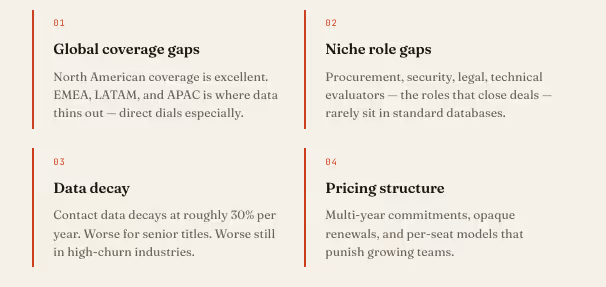
01
Global coverage gaps
North American coverage is excellent. EMEA, LATAM, and APAC is where data thins out — direct dials especially.
02
Niche role gaps
Procurement, security, legal, technical evaluators — the roles that close deals — rarely sit in standard databases.
03
Data decay
Contact data decays at roughly 30% per year. Worse for senior titles. Worse still in high-churn industries.
04
Pricing structure
Multi-year commitments, opaque renewals, and per-seat models that punish growing teams.
Match the trigger to the alternative. A team leaving over EMEA coverage shouldn't pick the platform that's best at North American mid-market — even if it's cheaper. A team leaving over pricing shouldn't pick the most expensive premium alternative, no matter how much better the data is.
❦
II.Best for global coverage (EMEA, LATAM, APAC)
LeadGenius
Custom Research · Human-Verified
Best for
Enterprise teams expanding into EMEA, LATAM, or APAC. Niche roles the databases miss. Buying committee mapping.
Approach
AI + human researchers source contact data on demand against your ICP — not from a pre-built static database.
Strengths
Strong EMEA, LATAM, APAC coverage. GDPR, CCPA, LGPD compliant by design. Finds procurement, security, and technical buyers other tools miss. Contact monitoring for job-change signals.
Weaknesses
Not self-serve. Project timelines run days to weeks, not seconds. Wrong fit for high-velocity, low-value outbound where volume matters more than precision.
Pricing
Custom; reported contracts start around $18K/year with enterprise scoping up to $80K+. December 2025 update introduced a cents-per-record campaign model.
III.Best for European compliance and accuracy
Cognism
Premium EMEA Database
Best for
Mid-market and enterprise teams selling into Europe where phone-verified mobile numbers and GDPR compliance are non-negotiable.
Strengths
Roughly 25 million heavily-verified Platinum contacts. Strong DNC compliance across EU markets. Manual verification on senior titles. License-based pricing removes credit anxiety.
Weaknesses
No published pricing. Reported platform fees start around $15K with annual commitments. Smaller total database than ZoomInfo or Apollo.
Pricing
Benchmarks put a 5-user Grow contract near $22,500/year. Enterprise scales from there.
IV.Best for self-serve volume at low cost
Apollo.io
All-In-One Prospecting
Best for
Small teams and individual reps doing high-velocity outbound in North America who want sequencing, dialer, and data in one place.
Strengths
Free tier for evaluation. Annual pricing from roughly $49–$119 per user per month. Built-in sequencing and engagement tools. Fast self-serve onboarding.
Weaknesses
Data accuracy is inconsistent — particularly on senior titles and non-US contacts. Enterprise teams often pair it with a second, more accurate source.
Pricing
Free, then $49–$119/user/month annual; $59–$149 monthly.
V.Best for custom enrichment workflows
Clay
Programmable Data Stack
Best for
RevOps teams who want to compose enrichment workflows from 100+ data providers and run custom logic across them.
Strengths
Aggregates multiple data sources in one workspace. Powerful for AI-driven research and personalization at scale. Active community and template library.
Weaknesses
Not a data provider itself — it routes to others. Steep learning curve. Costs compound across the providers you call.
Pricing
Credit-based plans starting around $149/month. Real cost depends on which providers you connect through it.
VI.Best free / freemium option
HubSpot Breeze Intelligence
Bundled With HubSpot
Best for
Teams already deeply in HubSpot who want enrichment without adding another vendor contract.
Strengths
Native to HubSpot. No new integration overhead. Reasonable coverage for North American mid-market. Credits often bundled with existing plans.
Weaknesses
Weak coverage outside North America. Limited depth on niche roles. Locks you further into the HubSpot ecosystem.
Pricing
Credit-based, bundled into Sales Hub Professional and above. Add-on credits available.
VII.Best for outbound velocity with built-in sequencing
Lusha
Fast Lookups · Self-Serve
Best for
Individual reps and small teams in the US doing email-first outbound who want self-serve pricing and a Chrome extension.
Strengths
Published pricing from around $52/user/month. ~280M contacts globally. Fast LinkedIn workflow via extension. Quick to deploy.
Weaknesses
Credit limits per user create scarcity at scale. Accuracy uneven outside North America. Mobile coverage thinner than premium alternatives.
Pricing
From around $52.45/user/month annual. Credit caps per user; enterprise quoted separately.
VIII.Best for intent-only use cases
Bombora
Intent Signals · Co-Op
Best for
Teams that already have a contact data source and need to layer in intent — what accounts are researching, when, and on which topics.
Strengths
The largest B2B intent data co-op. Granular topic coverage. Integrates with most major ABM and outbound platforms.
Weaknesses
Not a contact database. You still need a contact data provider underneath. Signal quality requires sound topic strategy to be useful.
Pricing
Custom; typically licensed annually based on topic count and seat count.
The teams that get this decision right don't pick the best vendor. They pick the right vendor for the specific gap they're trying to close.
— LeadGenius Field Notes
IX.A three-question decision framework
Most evaluations collapse into months of demos. They don't have to. Three questions, answered honestly, route you toward the right alternative faster than any feature matrix.
01.
Where do your next 50 deals live?
North America? Apollo or Lusha will cover you. Europe? Cognism. Mix of EMEA, LATAM, and APAC? LeadGenius. The geography answer is usually the only one that matters.
02.
Are you prospecting roles the databases already know?
Standard sales and marketing titles? Any volume database works. Procurement, security, legal, niche operations roles? Custom research outperforms every database. This is the question most teams skip.
03.
Is your problem data, or is it activation?
If your bounce rates are low and your reach is high but conversion is poor, switching data vendors won't fix it. Look at sequencing, messaging, and sales follow-through first.
X.The hybrid stack most enterprise teams actually run
Here's what almost no vendor will tell you: most enterprise GTM teams don't pick one. They run a hybrid stack because each tool solves a different shape of problem.
A common composition looks like this. Apollo or Lusha for high-velocity outbound on standard ICP — cheap data, fast workflow, acceptable accuracy at volume. Cognism layered in for European motion where compliance and connect rates matter more than cost per record. LeadGenius reserved for the top tier of accounts — the ones where buying committee depth, niche-role coverage, and global precision justify research-grade pricing. Bombora sitting underneath all of it, providing intent signals that prioritize who gets which level of treatment.
This isn't redundancy. It's segmentation. The mistake teams make is paying premium prices for volume work, or paying volume prices for premium work. Get the segmentation right and total spend often drops while pipeline quality rises.
If you've made it this far in a ZoomInfo evaluation, you probably already sense which alternative fits your specific gap. Start there. Run a 30-day data quality test against your most important account list. Measure bounce rates, dial connect rates, and role accuracy. The right answer reveals itself fast when you stop comparing decks and start comparing data.
See data quality for yourself.
Send us your hardest 50 accounts — global, niche roles, the ones your current vendor can't crack. We'll run them through human-verified research and show you the difference.
Connect with a Strategist →

.avif)