Article
Clari + Salesloft: Consolidation Without Reinvention
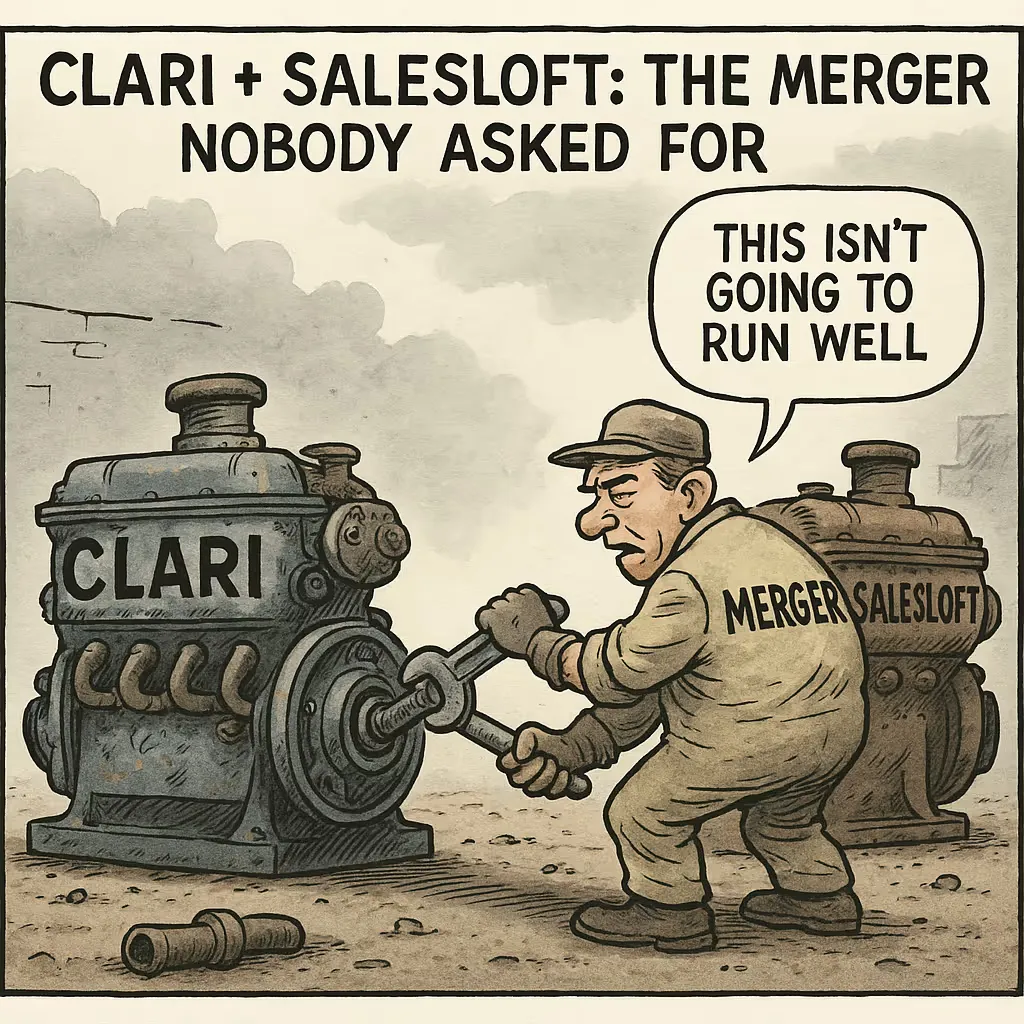
Clari’s merger with Salesloft feels less like the birth of a “revenue AI powerhouse” and more like bolting two struggling engines together and calling it a Tesla.
How the Clari + Salesloft + 1mind stack exposes what happens when private equity tries to merge its way to product-market fit—and why nimble startups are eating the old guard’s lunch.
Two years ago, we wrote about the Salesloft-Drift acquisition as a harbinger of a broader consolidation wave. We called it a “necessity for survival” driven by commoditized categories, plummeting valuations, and the PE imperative to justify lofty acquisition multiples. We warned that as larger entities absorbed smaller, niche players, the diversity of tools and approaches might diminish, potentially stifling innovation.
We were right about the consolidation. We underestimated how badly it would go.
On March 6, 2026, Clari + Salesloft officially announced the sunset of Drift and an exclusive partnership with 1mind to replace it. Existing Drift customers are being referred—not migrated, referred—to a startup most of them have never heard of. Their tool is going away. Their data is in limbo. And the product they were told two years ago would see “continued innovation” is being quietly euthanized.
This is how a $3.3 billion consolidation experiment ends. Not with a bang, but with a sunset notice and a partner press release.
Let’s reconstruct the financial logic, because it matters.
In 2021, Vista Equity Partners acquired a majority stake in Drift at a reported $1 billion valuation—roughly 17x revenue. In December 2021, Vista took a majority stake in Salesloft at a $2.3 billion valuation, a 23x revenue multiple. Both deals were struck at the peak of SaaS exuberance, when public SaaS multiples sat around 15–18x and private growth-stage companies regularly commanded even higher premiums.
By the time Vista merged the two companies in February 2024, the market had cratered. Public SaaS multiples had compressed by more than 60%, settling around 6–8x revenue. Private valuations followed. Vista was sitting on $3.3 billion in combined acquisition cost for two companies whose standalone market value had likely shrunk to a fraction of what was paid.
The merger wasn’t a product strategy. It was financial triage. Combine the revenue lines, cross-sell the customer bases, cut redundant headcount, and pray that the combined entity could grow into the valuation before the fund needed to exit. The thesis was simple: 1 + 1 + 1 = 4. Salesloft’s sales engagement. Drift’s conversational marketing. Clari’s revenue intelligence. Together, an unbeatable “Revenue Orchestration” platform.
But in SaaS, stitching together three products built on different architectures, for different buyers, with different technical debt doesn’t create a platform. It creates a Frankenstein—held together by brand messaging and press releases instead of shared infrastructure.
Then in August 2025, Clari acquired Salesloft (which by then included Drift). Clari itself had raised $496 million at a $2.6 billion valuation. The combined entity inherited every unresolved integration problem, every technical debt burden, and every customer who was already growing restless from the Salesloft-Drift merger. The leadership carousel told the story: Salesloft had cycled through multiple CEOs in two years, and by December 2025 the merged company named Steve Cox—a professional PE-backed turnaround operator—as CEO.
When your SaaS company needs a turnaround CEO three months after closing a merger, the math was always wrong.
Drift’s story arc is worth pausing on because it illustrates something important about what happens when innovation stops but the brand keeps trading on its reputation.
Drift genuinely created a category. Conversational marketing was a real concept that changed how B2B companies thought about their websites. The idea that you shouldn’t gate everything behind a form, that you should engage visitors in real-time, that buyer experience on the website matters—Drift popularized all of that. At its peak, Drift was on tens of thousands of websites. The blue chat bubble became as recognizable in B2B as Salesforce’s cloud logo.
But the product never evolved past its original premise: qualify a visitor, book a meeting, route to a rep. That’s where it ended. The AI capabilities Drift marketed were really pattern-matching chatbots with decision trees. The “conversational” experience was conditional logic wearing a chat interface. And the platform lived entirely on the website—it knew nothing about what happened after a prospect signed up, moved into a trial, or entered an evaluation.
The hardest revenue problem in B2B SaaS with a self-serve motion isn’t getting someone to sign up. It’s what happens in the 48 hours after they do. A visitor tells your chatbot exactly what they care about, then creates an account and your product treats them like a total stranger. All that context vanishes. Trial-to-paid conversion doesn’t die on the website. It dies inside the product.
Drift never solved for that. Neither did the companies trying to replace it.
Then came September 2025. Attackers compromised Salesloft’s GitHub environment, pivoted into Drift’s AWS infrastructure, and stole OAuth tokens tied to customer integrations with Salesforce, Google Workspace, AWS, Azure, and OpenAI. More than 700 organizations were affected, including Cloudflare, Palo Alto Networks, and Zscaler. Drift was taken offline. The chatbot that thousands of companies relied on for lead qualification went dark.
For many customers, this was the moment the implicit contract broke. They’d been patient through the Vista acquisition, patient through the Salesloft merger, patient through declining support quality and revolving CSMs. But having your customer data exposed because your vendor’s vendor couldn’t secure its token store? That’s a trust event that doesn’t recover.
Six months later, Drift is being sunset. The timing is not a coincidence.
The March 2026 announcement frames the Drift sunset as a strategic evolution—“transitioning to a new era.” Drift customers will be referred to 1mind under an “exclusive agreement.” The press release is packed with the usual buzzwords: “Superhumans,” “agentic AI,” “revenue orchestration.”
Strip away the language and here is what is actually happening: Clari + Salesloft is admitting it cannot maintain the Drift product. Rather than invest in rebuilding it—which would require significant engineering resources the company needs elsewhere—they’re outsourcing conversational AI to a startup and calling it innovation.
For Drift customers, this is a forced migration to a vendor they didn’t choose, with a product they haven’t evaluated, from a company that was marketing “continued innovation” to the Drift platform as recently as eighteen months ago. The integration promises—that 1mind’s signals will feed into Clari’s forecast, that every interaction will become a “structured signal”—are aspirational at best. These are two companies that just entered a partnership. Deep product integration takes years, not quarters.
When a vendor “refers” your account to another company, that’s not a partnership. That’s an admission that the product you paid for no longer has a future.
The Clari + Salesloft + Drift saga is not an isolated failure. It’s the clearest case study yet of a broader pattern breaking across the SaaS landscape: the private equity roll-up thesis applied to software companies.
The playbook goes like this. Acquire multiple companies in adjacent categories at peak valuations. Merge them under a single brand. Cut costs—headcount, R&D, customer success. Cross-sell aggressively. Grow the combined revenue line enough to justify the combined valuation. Exit to a strategic buyer or take public.
The problem is that this playbook was designed for industrial businesses where merging operations creates genuine scale efficiencies. In software, the opposite often happens. Each acquired product brings its own architecture, its own data model, its own technical debt, and its own customer base that was sold a specific product vision. Merging those products is not like merging warehouses. It requires sustained engineering investment that PE cost-cutting actively works against.
The result is a predictable death spiral. Cost-cutting degrades the product. Product degradation increases churn. Increased churn hurts the growth metrics needed to justify the valuation. So you cut more costs to maintain margins, which further degrades the product. The cycle accelerates until you’re sunsetting products you paid a billion dollars for and referring customers to startups.
This dynamic is not unique to SaaS. It’s playing out in real time in the entertainment industry with the Paramount-Warner Bros. Discovery saga, and the parallel is instructive.
When Discovery acquired WarnerMedia from AT&T in 2022, the combined entity inherited over $43 billion in debt. The thesis was the same: combine two subscale media companies, extract synergies, and grow into the debt. Instead, the linear TV business kept declining, the streaming wars burned cash, and Warner Bros. Discovery spent three years cutting its way to viability—gutting content libraries, shelving completed films, and degrading the brands it paid to acquire.
By early 2026, the Paramount offer to acquire WBD would create a combined company carrying roughly $79–90 billion in debt. Analysts immediately flagged the obvious: this is the same situation that led AT&T to sell WarnerMedia, which is the same situation that led to the Discovery merger. Each consolidation creates more debt, not less. Each time, the acquirer insists that “synergies” will solve the math. Each time, those synergies are either smaller than projected or arrive too late to service the interest payments.
Replace “debt” with “technical debt” and “synergies” with “platform integration,” and you have the Clari + Salesloft + Drift story. Same logic. Same outcome. Same spiral.
In media, the debt merger creates a bigger ship that’s harder to steer and more expensive to maintain. In SaaS, the PE roll-up creates a bigger codebase that’s harder to innovate on and more expensive to support. The physics are identical.
While the incumbents are busy merging, integrating, cutting, and sunsetting, a new generation of companies is doing something the old guard structurally cannot: shipping fast.
This is the central asymmetry that consolidation creates. Every merger adds organizational complexity, integration projects, migration dependencies, and product debt. The newly combined company can’t just build—it has to reconcile three different data models, maintain backward compatibility for three different customer bases, and navigate the politics of which legacy features to preserve. Product velocity—the one thing that actually determines long-term competitive advantage in software—drops off a cliff.
Meanwhile, startups are building purpose-built solutions on modern architectures with zero legacy burden. They don’t need to maintain a Salesforce integration designed in 2016 or support a chatbot framework built before large language models existed. They can start from first principles: what does the buyer experience actually need to look like in 2026?
The emerging competitive landscape looks nothing like the one that existed when Vista acquired Drift. Tools like Warmly, Qualified, Koala, and dozens of others are building conversational and intent-based engagement without the weight of a legacy sales engagement platform bolted on top. Customer data platforms are enabling teams to stitch together CRM data, product usage signals, and website interactions so that onboarding can continue the conversation a prospect already started. Workflow automation tools are connecting marketing, product, and sales signals in ways that monolithic platforms promised but never delivered.
The common thread: these companies are lean, product-obsessed, and unencumbered by the baggage that PE consolidation creates. They don’t have three different customer success models to reconcile or four different billing systems to maintain. They can focus entirely on advancing the product.
The old guard’s response to this threat has been to add more features through acquisition rather than through engineering. But adding features through acquisition and adding features through engineering produce fundamentally different outcomes. One gives you a bundle. The other gives you a platform. Customers can tell the difference.
The Drift sunset sends a clear signal to the market about what PE-backed SaaS roll-ups are actually worth.
Public SaaS multiples have settled into a “new normal” of roughly 6–7x revenue, down from the 15–18x peak of 2021. B2B SaaS multiples specifically sat at 5.9x entering 2026, down from 6.7x the prior year. Private equity, once the biggest buyer in SaaS M&A—setting a record of 73 PE-led enterprise SaaS deals in Q1 2025 alone—is now pricing deals more carefully. The premium that once attached to “platform” positioning and “category leadership” is eroding, replaced by hard scrutiny of retention, margin, and the Rule of 40.
The implication for future acquisitions is sobering. When Vista paid 23x revenue for Salesloft and 17x for Drift, the implicit assumption was that growth would continue at rates high enough to bring effective multiples down over time. Instead, median SaaS growth rates have fallen from 20–25% to around 12%, and the companies saddled with integration overhead are growing even slower than that. The gap between what was paid and what the assets are worth has only widened.
The core valuation fallacy in PE-driven SaaS consolidation is the belief that combining adjacent products creates multiplicative value. The math assumes that cross-sell rates will be high, churn will be lower in a bundled offering, and the combined company will command a “platform premium” that exceeds the sum of the standalone values.
What actually happens: cross-sell rates are modest because the buyer personas for each product are different. Churn increases during integration as product quality slips and customers feel neglected. And the platform premium never materializes because the integration is superficial—the products share a brand and a login page, not an architecture.
1 + 1 + 1 does not equal 4. In most PE SaaS roll-ups, 1 + 1 + 1 equals about 2.5—after accounting for integration costs, customer attrition, the talent exodus that follows every acquisition, and the opportunity cost of spending two years on migration projects instead of product innovation.
Future acquirers, whether PE or strategic, are going to internalize this lesson. Expect due diligence to go deeper on technical integration feasibility, longer earnouts tied to retention, and lower headline multiples for companies with unclear product-architecture fit. The era of buying revenue lines and assuming they’ll grow together is ending.
If you’re a demand generation leader who just lost your Drift instance—or if you’re watching this happen from the sidelines and wondering whether your vendor is next—the takeaway is not “swap in another chat widget.” The takeaway is that the entire category of website-only engagement tools is being exposed as insufficient.
The future of B2B engagement is not a smarter chatbot on your homepage. It’s systems that maintain context across the entire buyer journey—from the first ad impression to the website visit to the product trial to the sales conversation. It’s infrastructure that connects what marketing knows, what the product observes, and what sales needs, so that no handoff creates a cold start.
That’s what we’re building at LeadGenius. Not a replacement for Drift. A fundamentally different approach to how demand generation teams see, reach, and engage their buyers across every channel and every stage.
The big ships are taking on water. The nimble ones are already past them.
Use this moment to rethink the whole approach. Your buyers don’t live on your website. They move across LinkedIn, Google, Meta, YouTube, TikTok, Reddit, and a dozen other channels before they ever fill out a form. The question isn’t which chat tool to use. It’s whether you can see, reach, and engage your best accounts wherever they actually are.
LeadGenius and AdGenius give demand gen leaders cross-channel visibility and engagement across every paid platform—not just the website. See the whole picture.
Article
Clari’s merger with Salesloft feels less like the birth of a “revenue AI powerhouse” and more like bolting two struggling engines together and calling it a Tesla.

Article
The Drift–Salesloft hack shows how consolidation of GTM platforms into “revenue operating systems” concentrates risk, turning a single weak link into a billion-record breach that threatens the trust—and future—of the entire sales technology stack.

Article
Despite Clay's impressive growth and partnerships, its $1.25B valuation on $30M ARR raises serious doubts about sustainability, drawing parallels to past overhyped tech valuations like Hopin.

Get precise, compliant, and on-demand contact data—tailored to your business needs.