
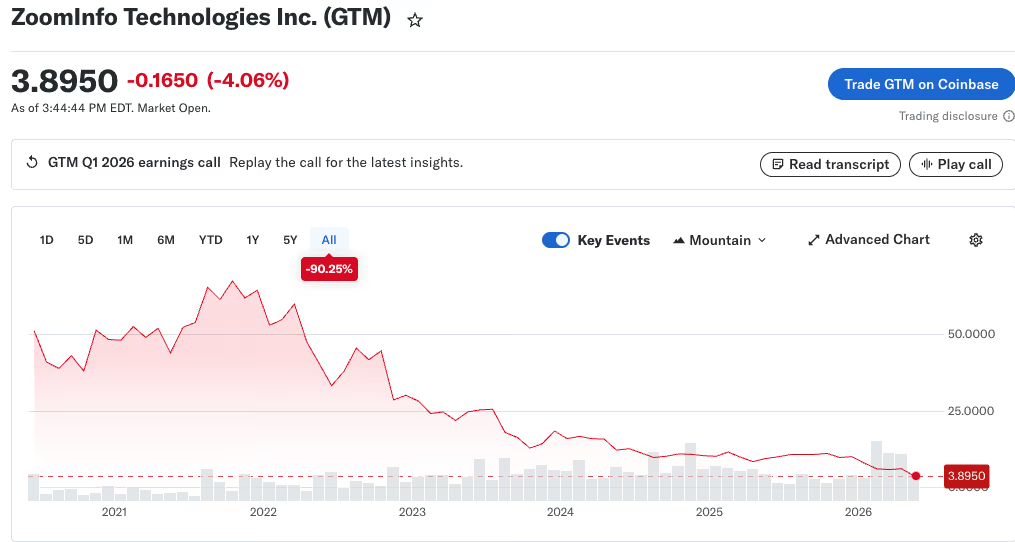
There is something almost uncomfortable about watching ZoomInfo right now. Not because the company failed — in many ways, it didn't. That's the unsettling part.
Six years after going public, ZoomInfo is still expected to generate roughly $1.2 billion in annual revenue. It still has tens of thousands of customers. It still owns one of the most recognized brands in B2B go-to-market software. It integrated AI into workflows, launched copilots, added MCP support, leaned into agentic search, and partnered aggressively across the emerging AI stack. By the standards of operational execution, this is not a company asleep at the wheel.
And yet the market has almost completely repriced its existence.
The company that once commanded a valuation north of $13 billion is now hovering near roughly one-tenth of that. That is not a normal SaaS correction. That is the market trying to answer a much bigger question: What happens when the thing you sell becomes infinitely reproducible?
The Real Force at Work
AI isn't just competing with data vendors. It's collapsing their pricing logic.
The easiest way to misread ZoomInfo's decline is to frame it as a story about guidance misses, operational missteps, or even head-to-head competition. It's bigger than that.
ZoomInfo is running headfirst into the structural force now reshaping the entire SaaS economy: AI is compressing the value of aggregation.
For two decades, B2B data companies operated on a simple premise. Information was hard to collect, hard to structure, hard to validate, and expensive to operationalize. Whoever assembled the largest proprietary database won. That logic made perfect sense in 2014. It makes dramatically less sense in 2026.
The moat was never really the data. The moat was the cost of assembling the data. AI shattered that cost curve.
Once LLMs become capable of reasoning across messy public web data, the scarcity premium attached to pre-built databases begins to collapse. Not disappear entirely — but collapse gradually, painfully, and unevenly. And a reasonably capable growth team can now combine open-web crawling, LLM-based entity resolution, enrichment APIs, GitHub signals, job postings, funding data, and social graphs into something shockingly close to "good enough."
Not perfect. But good enough destroys pricing power. That is the key economic distinction the market is reacting to.
Two Models
What the old world assumed vs. what the new world rewards
- Crawl the web for years
- Structure and normalize data
- Attach contacts and taxonomies
- Wrap a UI around it
- Rent access at high margin
- Call the database the product
- Orchestrate signals in real time
- Enrich with first-party context
- Resolve identity dynamically
- Interpret intent, not just store it
- Integrate at the execution layer
- Build proprietary feedback loops
The Difficult Part
ZoomInfo actually did many of the "right" things.
And that's what makes this situation so unsettling for the rest of the data industry.
The company saw AI coming. It invested. It repositioned. It integrated copilots. It shifted toward workflow enablement. It moved toward consumption pricing. It tried to become infrastructure instead of inventory. The market is effectively saying: that may not matter.
Because when the underlying asset is being commoditized, product innovation starts to look defensive rather than expansive. That is the terrifying dynamic spreading across the broader GTM ecosystem right now.
Platforms built on 6sense, intent vendors, enrichment companies, waterfall providers — all of them are being forced to answer the same existential question: what part of your product remains defensible when AI can synthesize buyer intelligence dynamically?
The Broader Shift
Buyers used to want certainty. Now they want adaptability.
That sounds subtle. It changes everything.
The old model assumed the database itself was the value. The new model suggests the value may live instead in orchestration, context, workflow integration, identity resolution, timing, proprietary first-party feedback loops, and execution.
The future may belong less to companies that store information and more to companies that continuously interpret it. That distinction is devastating for legacy database economics.
Especially because SaaS is already under pressure from three converging forces that hit simultaneously: interest rates rising and instantly punishing growth multiples; companies realizing they overbought software during the zero-rate era; and AI starting to collapse labor requirements across knowledge work. Every CFO is now asking the same question: why are we paying millions for software designed to organize human workflows if AI reduces the number of humans required?
That question is especially brutal inside sales and marketing software. Because sales itself is changing. Outbound is changing. Prospecting is changing. Intent is changing. Even the concept of a "lead" is changing.
AI agents don't care about your seat model. They don't care about your taxonomy. They don't care about your static segmentation logic. They care about access. That is why the market is rewarding platforms closest to execution layers and punishing platforms closest to static inventory layers.
The LeadGenius View
What this means for how you build your data strategy now
ZoomInfo may ultimately survive this transition better than many smaller competitors. Scale still matters. Distribution still matters. Brand still matters. Workflow integration still matters. A company generating $1.2 billion in revenue has options that smaller vendors do not.
But the valuation collapse signals something much larger than one company's struggles. It signals the end of a specific era in B2B software: the era where proprietary accumulation alone guaranteed durable value.
At LeadGenius, this is exactly the transition we've been building for. Our model was never "biggest database wins." It's always been about precision over volume — targeted, human-verified, continuously enriched intelligence built around the accounts you actually care about. Not a static archive. A living data layer that works the way AI-native GTM teams operate.
The companies that will come out of this transition strongest are not the ones who owned the most data in 2020. They're the ones who can get the right intelligence, to the right workflow, at the right moment in 2026. That's a different problem. And it requires a different kind of partner.
.avif)