
There is a quiet fiction sitting underneath modern go-to-market strategy.
It’s the idea that a “contact” is a real thing.
A row in Salesforce.
A person with a title.
An email attached to an account.
A record purchased from a vendor and refreshed every 90 days.
The entire B2B data industry is built on this fiction.
And it is collapsing.
Not gradually.
Not theoretically.
Structurally.
Because the way companies buy technology has changed — but the way revenue teams identify buyers has not.
The Most Expensive Lie In B2B
Revenue teams are told a story:
If you know the company, the title, and the email — you know the buyer.
This was barely true ten years ago.
It is objectively false now.
Titles don’t map to work.
Work doesn’t map to influence.
Influence doesn’t map to buying power.
An “Engineer” could be:
- Writing core infrastructure
- Running experiments
- Evaluating vendors
- Ignoring tools leadership already bought
Traditional datasets flatten all of this into a single column: Job Title.
Which means most GTM strategy is built on abstraction, not reality.
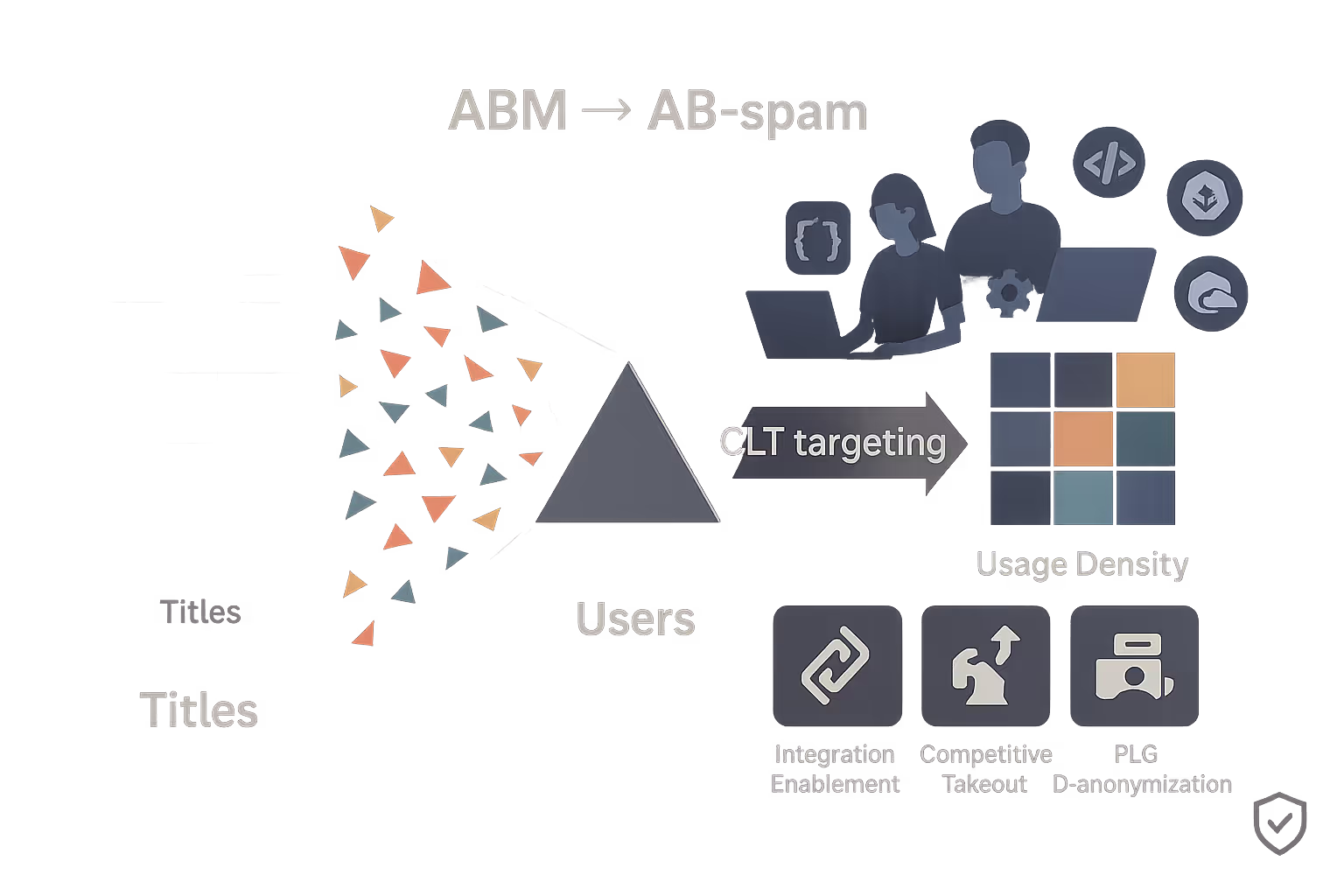
Your own CLT framework makes the uncomfortable truth explicit: what actually matters lives outside LinkedIn — in repositories, contributions, tool usage, and practitioner behavior.
Contact Level Technographics (CLT)
In other words:
The buyer is not a person.
The buyer is behavior.
Static Data Is Not Just Inefficient — It’s Conceptually Wrong
The industry debate still frames this as:
Better accuracy
More coverage
Faster refresh cycles
But that debate misses the real shift.
Static data assumes identity is stable.
Modern buying assumes identity is dynamic.
Someone can:
Evaluate Databricks this quarter
Migrate away next quarter
Influence a purchase without holding budget
Drive adoption without ever appearing in a buying committee slide
A static record cannot capture motion.
And buying is motion.
Which means the core architecture of the legacy data model is misaligned with how decisions actually happen.
Contact-Level Technographics Is Not A Feature. It’s A Different Ontology.
Most people interpret CLT as:
“Better targeting for technical audiences.”
That framing is too small.
CLT is a shift from identity-based GTM to behavior-based GTM.
It replaces:
Who they are → What they do
Persona → Practice
Org chart → Usage density
Decision maker → Adoption network
This is the real disruption.
Because once you see buying as a network of practitioners interacting with tools, the entire concept of “find the decision maker first” starts to look primitive.
The deal doesn’t start at the top anymore.
It emerges from the inside.
The Collapse Of Persona-Based Marketing
Persona marketing was built for a world where:
Information flowed top-down
Vendors controlled education
Executives defined tools
That world is gone.
Today:
Practitioners discover tools
Practitioners test tools
Practitioners shape internal narratives
Practitioners create momentum leadership later approves
Which means persona marketing is often targeting the wrong moment in the buying cycle.
It’s messaging to authority instead of momentum.
CLT surfaces momentum.
That’s the difference.
The Real Reason Conversion Improves
People often attribute CLT performance to:
Better personalization
Better segmentation
Better lists
Those are downstream effects.
The real reason performance improves is epistemic.
You know something real.
Not inferred interest.
Not modeled intent.
Not assumed persona fit.
Observed behavior.
And observed behavior changes how teams operate:
Messaging shifts from generic outcomes → real problems
Sales conversations start inside the work
Multi-threading becomes natural, not forced
Account scoring reflects depth, not logo value
This is why usage density is such a powerful concept.
It transforms account qualification from “should we sell here” to “how embedded are we already.”
That is a fundamentally different question.
Why This Is Deeply Threatening To The Data Industry
Because if behavior becomes the primitive, three uncomfortable things happen.
- The value of massive prebuilt databases declines
- Refresh cycles become irrelevant
- Data vendors must become signal infrastructure
That last one is the real shift.
CLT is not a dataset.
It is sensing.
And sensing doesn’t scale the same way static databases scale.
It requires continuous discovery, stitching, identity resolution, and context modeling.
In other words: bespoke becomes the default.
Which explains why the industry narrative keeps trying to reduce this category to “enrichment.”
Enrichment sounds incremental.
This is architectural.
The Future Of GTM Is Not “Better Lists.” It’s Buyer Visibility.
The teams winning the next decade will not have:
More contacts
More intent scores
More titles
They will have visibility into:
Who is touching a technology
Where usage is expanding
Which teams rely on it
What problems practitioners are actively solving
That visibility changes:
Segmentation
Timing
Messaging
Forecasting
Deal strategy
It moves GTM from probabilistic to observational.
And once that shift happens, it’s hard to go back.
The Controversial Conclusion
The contact record is becoming the least interesting object in B2B data.
Not useless.
But insufficient.
The atomic unit of GTM is shifting from person → activity.
Contact-Level Technographics is one expression of that shift.
But the bigger idea is this:
Revenue teams will stop asking “Who should we target?”
They will start asking “Where is work happening?”
And when that becomes the primary question, the entire data category reorganizes around it.
Static vendors will call this enrichment.
Forward teams will recognize it as infrastructure.
The difference will define pipeline outcomes for the next decade.
.avif)