
Every B2B marketer is staring at the same broken dashboard. Email open rates that mean nothing. LinkedIn requests that get archived on sight. Reply rates measured in fractions of a percent. The two channels that built modern pipeline are saturated to the point of being background noise — and the flood of AI SDRs and cheap automated research only accelerated the collapse. When anyone can generate a "personalized" opener for free, personalization stops signaling anything at all.
So instead of pouring another quarter's budget into AI SDR seats or email deliverability infrastructure that gets you incrementally closer to an inbox nobody reads, the smarter move is to pick a precision audience and reach it with something physical. The case for thoughtful direct mail is no longer a nostalgic hunch. It's in the numbers.
The channel gap is enormous, and it's measurable
Start with raw attention. The average person gets 16.8 mail pieces a week, compared to 600+ emails. The physical mailbox is the one channel that isn't oversaturated, which is exactly why it works. According to the USPS Mail Moments Review, approximately 90% of households open direct mail they receive, and 42% read or scan each piece.
vs. email (4.4% / 0.12%)
the mail they receive
vs. digital
That attention converts into response rates digital can't touch. The DMA Response Rate Report 2024 puts B2C house-list response rates at 9% on average and B2B at 4.4%, far above the roughly 1% average for email marketing. Looked at against today's email reality, the gap is even starker: B2B direct mail generates a 4.4% response rate compared to email's 0.12% — a 36x advantage that compounds when you're targeting high-value accounts with long sales cycles.
And the median economics hold up across industries. Direct mail delivers a median ROI of around 29%, with high-performing campaigns exceeding 1,000%, and neuroscience shows physical mail requires 21% less cognitive effort while driving 70% higher brand recall. The momentum isn't theoretical — 82% of marketers planned to increase direct mail spending in 2025.
The case studies: what "good" actually looks like
Aggregate benchmarks are useful, but the published campaign results are what make the play credible.
The canonical dimensional-mail story. Intronis ran a multi-channel campaign centered on a dimensional mailer — the incentive was an Atari game console replicator — sending two pieces to high-value prospects to drive a 30-minute sales call. The outcome: a 35% conversion rate and 700% ROI. Of the initial 50 prospects, 50% scheduled the call and 22% converted. The campaign delivered over 10% of Intronis' bookings that year — the math that justifies spending more per touch when deals are large.
A reminder that the creative carries the play. After researching the client's prospects, SOMAmetrics led with a white paper on the challenges CEOs face, followed with a nurturing sequence of personalized vlogs, blogs, and case studies, then targeted CEOs with a sales series and a direct ask for a meeting — earning 278% ROI in new accounts in 60 days.
Ten of the targeted accounts responded within the first week, and the campaign earned an ROI of 13:1, with more expected as competitors' contracts ran out.
Direct response doesn't have to mean tiny lists. DocuSign segmented over 450 enterprise accounts by buying stage and ran stage-specific messaging, resulting in a 22% increase in their sales pipeline.
Mail performs best woven into the funnel. A B2B software firm mailed oversized letters with QR codes, then followed up with LinkedIn ads, achieving a 35% increase in lead-to-opportunity conversion vs. email-only. More broadly, brands see 27–118% lifts in response when campaigns pair mail with digital follow-ups.
Why gifting scales the play upmarket
For high-value accounts, the dimensional mailer evolves into strategic gifting — and the engagement data is what makes it a board-defensible line item. When done well, ABM campaigns that include gifting see 49% engagement from executive sponsors, a 447% increase in opportunities generated, and 70% of recipients taking an online action after receiving a gift.
A $20 gift that shows you understand someone's world beats a $200 generic gift basket every time.
The discipline that separates winners from swag-wasters is fit over cost. The tactical version: a roughly $30 coffee bundle sent to a CMO before a pitch meeting can lift demo attendance by around 18%, and a personalized book sent to a VP of Sales after a first call keeps you top of mind when they're ready to decide.
Practitioner results reinforce it. A Sprout Social field marketer reported that gifting in her sales process directly impacted $250K of closed-won revenue — a 100x ROI — by building stronger champions and closing bigger deals faster. And the channel scales: EvenUp Law turned gifting into a pipeline engine and saw 3x growth from direct mail.
Enterprise buying has too many humans for email
This isn't only about channel fatigue — the structure of enterprise deals demands it. A B2B direct mail campaign targets a buying committee, and enterprise purchases typically involve 6 to 10 decision-makers across departments. The goal of any single piece isn't a direct conversion but a meeting, a demo request, or staying top-of-mind through a 3-to-12-month cycle. Email alone simply cannot move a buying group of that size and seniority.
The economics follow from deal size. Because B2B deals are often $10,000 to $500,000+, it makes sense to spend $3 to $15 per mail piece if it improves your odds of closing. And the format should scale to the stakes: for ABM and C-suite outreach, dimensional mailers — a branded box with a relevant book or product sample — justify their cost by commanding attention flat mail can't.
Where AI actually earns its keep
Here's the irony worth sitting with: the same technology that ruined email is what makes modern direct mail viable at scale.
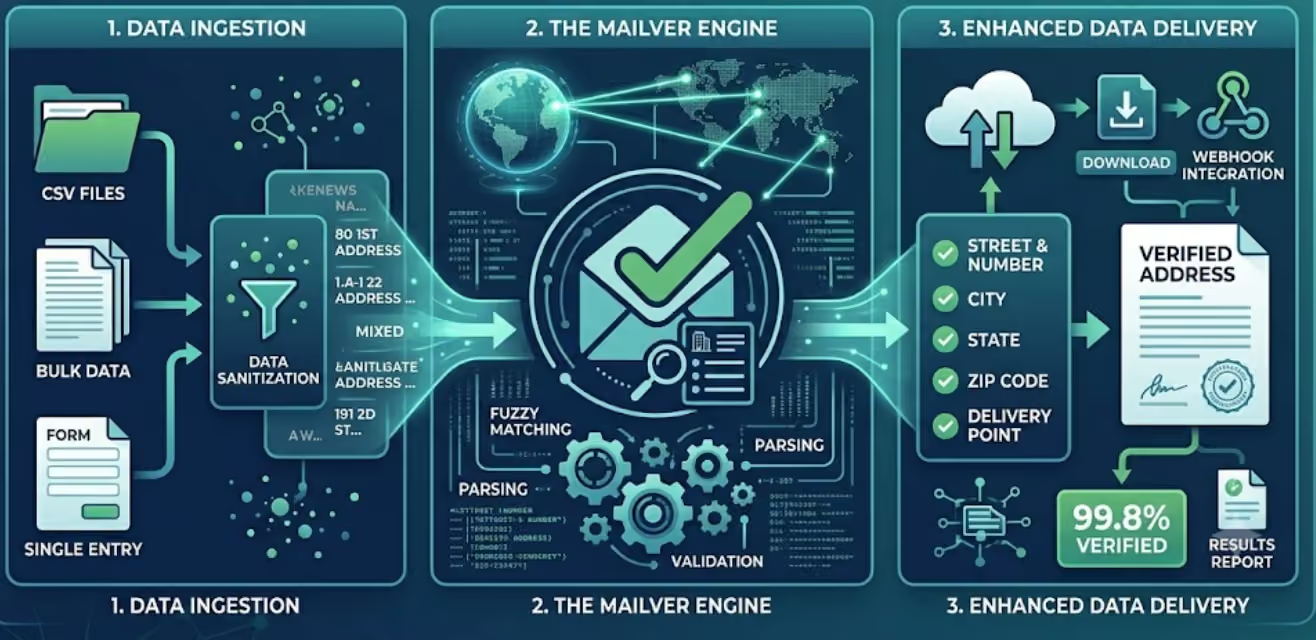
Use AI for the parts of this play that are pure research and routing — cleanly mapping the buying center of each critical account, verifying and authenticating the best physical addresses so a gift lands where it'll actually be opened, and matching the gift to the individual rather than blasting a generic box. AI-driven recipient research is exactly how you surface "what does this person's world look like" at scale.
That frees your marketing team to spend its time on the only thing that moves the needle: the creative and the collateral. The book. The hardware. The reason this specific object matters to this specific person. AI does the targeting; humans do the thing worth noticing.
The reallocation
The argument is not "do more outreach." It's "stop funding channels with a structural reason to fail." In 2025, successful direct mail isn't about mass outreach — it's about precision. Take the budget that's currently buying AI SDR volume the market has learned to ignore, or email infrastructure that inches you toward an unread inbox, and redirect it. Pick the handful of accounts and the specific humans inside them who actually matter. Reach them with something real, tracked with a QR code or unique URL so you can prove the pipeline it touched.
A smaller list. A higher cost per touch. A dramatically higher rate of touches that land — and a stack of published case studies showing 13:1, 278%, 700%, and 100x when it's done with care.
The mailbox is empty.
That's exactly why it works.
Precision starts with reaching the right desk. Verify and authenticate the best physical addresses for your target accounts with LeadGenius Address Verify — then build the play around it.
Connect with a strategist →Sources & Notes
DMA Response Rate Report 2024 and ANA research (via Mailpro, BirdseyePost); USPS Mail Moments Review; MarketingSherpa (Intronis); Uviaus (SOMAmetrics, O2, DocuSign); LettrLabs; Reachdesk and Sendoso published customer results. Vendor-published figures (Reachdesk, Sendoso) reflect their own customers and should be read as directional rather than independently audited.
.avif)