
If you run demand gen or RevOps at Paycor, Gusto, BambooHR, Rippling, ADP Workforce Now, Workday, or any HRIS/PEO/payroll platform targeting small-to-mid-market employers, you've watched this movie before. Your ICP is "businesses with 10–250 employees." Your CRM says you're working a list of 400,000 accounts that match. Your sales team books meetings with a third of them and half turn out to be the wrong size — 4 employees, not 40; 780 employees, not 78. The SDR burns their day re-qualifying. The AE burns the meeting. The marketing team never finds out, because the account stays in the CRM forever, marked "fit."
That's the headcount problem. And in a category where your entire pricing model, compliance surface, feature gating, and sales motion hinges on getting employee count right, it's not a minor data hygiene issue. It's an existential go-to-market problem that every HRIS vendor has been quietly absorbing as the cost of doing business.
It doesn't have to be.
Why Headcount Data Is Broken for SMB Employers
There are roughly 6.3 million U.S. employer firms, per the Census Bureau and SBA. Of those, over 99% are SMBs. The HR software market serving them was valued at $20.9 billion in 2024 and is growing around 4–11% annually depending on which segment you read. This is the largest, most contested, most fragmented B2B SaaS market in existence — and the data infrastructure every vendor uses to target it was built for a very different kind of company.
Here's what actually happens when a typical HRIS vendor pulls an ICP list of "businesses with 25–100 employees":
- The employee count comes from LinkedIn. Almost universally. ZoomInfo, Apollo, Cognism, Clearbit, 6sense — the headcount field in each is predominantly a LinkedIn-derived estimate, sometimes layered with web scrape validation. For SMBs with 25–100 employees, LinkedIn penetration is radically incomplete. Most line staff at a 40-person HVAC company, dental office, accounting firm, or restaurant group are not on LinkedIn. The platform counts the owner, the bookkeeper, and maybe three managers. The CRM records them as a 4-employee company.
- The count is months old. LinkedIn company size buckets update infrequently. A company that was 80 people in Q1 and 140 people in Q3 often still shows as "51–200" (same bucket) or worse, still reads as the old count altogether. For an HRIS vendor with tier-gated pricing at 50 or 100 employees, missing a bucket transition means leaving revenue on the table for 6–12 months.
- The count is a range, not a number. "51–200 employees" is not a headcount. It's a shrug. A 52-person company and a 198-person company have entirely different HRIS needs, benefits complexity, compliance surface, and willingness to pay. Treating them as the same account tier is the category's most expensive category error.
- The count can't tell you direction. A 60-person company that's been 60 people for three years is a different sale than a 60-person company that was 30 a year ago. One is a stable customer for a mid-tier SKU. The other is about to outgrow you. Neither signal exists in the data most HRIS vendors are targeting against.
What "stale and imprecise" actually costs
Illustrative: The Same SMB Employer, Three Data Sources
Illustrative examples based on observed variance patterns between LinkedIn-derived firmographics and primary-source employment data for SMB employers in services, healthcare, and skilled-trades verticals.
The second example — Delta Dental Group at 78 employees across four locations — is the classic HRIS sweet spot. Benefits complexity, multi-state compliance, PTO administration across shift schedules, payroll across hourly and salaried. Priced correctly, it's a $25K+ ACV customer. On a LinkedIn-sourced list, it looks like a 7-person practice that doesn't need you. Your SDR never calls.
What Modern Employment-Signal Data Actually Looks Like
The category term for this is employment-signal triangulation, and it's the reason a handful of HRIS vendors are quietly pulling ahead in SMB prospecting efficiency while everyone else is burning SDR cycles on bad lists. The idea is simple: stop relying on any single source for headcount and instead reconcile several authoritative signals into a single, fresh, precise number.
SMB Headcount Data: The Legacy Stack
- LinkedIn profile count, sometimes bucketed, usually stale
- Self-reported company size from web forms (optional field, always skipped)
- Web scrape of "About Us" pages — "We're a team of 50" written in 2019
- D&B/Experian employee bands based on tax filings, often 12–36 months old
- No delta data — can't tell hiring from stable from contracting
- No industry context — a 60-person warehouse is the same as a 60-person law firm
- No relationship graph — multi-location SMBs look like separate 5-person shops
SMB Headcount Data: Triangulated & Fresh
- Secretary of State filings establish entity truth, incorporation date, registered agent
- Primary-source employment signals (job postings, career page activity, licensing data)
- Officer and director filings expose real operating team depth
- Branch and subsidiary resolution unifies multi-location operators into one account
- Hiring velocity: monthly delta on open reqs, posting-to-fill cadence, growth rate
- Industry risk scoring: turnover benchmarks, compliance exposure, wage-and-hour profile
- Weekly refresh cadence, confidence-scored, activation-ready across ad platforms
The Three Signals That Actually Predict Who's Ready to Buy HRIS
1. Precise Headcount (Not a Range)
A real number, not a bucket. For SMB employers, the difference between 45 and 51 employees is the difference between "we manage on a spreadsheet" and "we need real software this quarter." Modern triangulated data sources reconcile Secretary of State filings, employment signals, officer graphs, and proprietary enrichment to produce a specific headcount figure with a confidence score — not a LinkedIn bucket. The practical implication for HRIS sales is direct: tier-gated campaigns finally work. Compliance-surface messaging (ACA thresholds, EEO-1 reporting, state-specific triggers like California's 100-employee rule) can be targeted precisely instead of broadcast to "anyone who might be close."
2. Hiring Velocity
Headcount at a point in time tells you what a company is. Hiring velocity tells you what it's about to become. A 40-person company that has posted 8 new roles in the last 60 days is a different sale than a 40-person company with no recent job postings. One is growing into your next pricing tier, feeling the pain of manual onboarding, and urgently in-market. The other is stable and two years from a serious conversation. The category terms every HRIS buyer actually wants to filter on — growing fast, hiring aggressively, expanding multi-state — are all velocity signals, not static counts.
Open Req Delta (30/60/90-day)
Raw count of job postings currently active vs. prior period. Most predictive when normalized as a percentage of current headcount — a 50-person company posting 6 roles is hiring at a very different intensity than a 500-person company posting 6.
Posting-to-Fill Cadence
How fast a company is actually closing requisitions. Short cycles indicate operational muscle (and active HR workflows). Long cycles indicate either scale problems or lack of dedicated HR resource — both are relevant HRIS buying signals, but they inform different pitches.
Multi-State Expansion
Derived from Secretary of State foreign-qualification filings. A business registering to operate in a new state is hitting multi-state compliance for the first time — payroll tax, workers' comp, state-specific leave. High-intent moment for any HRIS/PEO conversation.
Officer/Executive Turnover
Pulled from Secretary of State officer filings. A new CFO, COO, or Director of People Ops inside an SMB typically triggers a 90-day system review. Platforms that catch this signal early win the replacement cycle; platforms that don't find out after the RFP has been written.
3. Industry Risk Profile
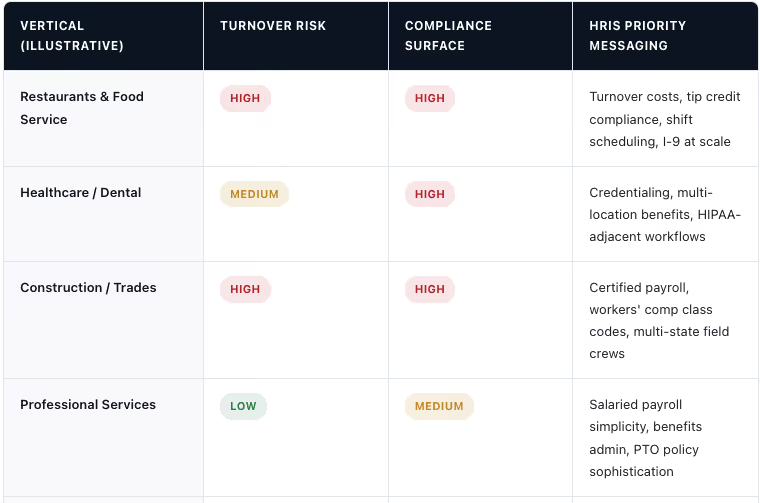
Not all SMB employers are created equal, and HRIS pricing tiers reflect that — but most vendor targeting doesn't. A 75-person restaurant group and a 75-person law firm have radically different HR needs. The restaurant has 180% annual turnover, tipped-wage complexity, I-9 exposure across transient staff, and overtime rules that are a lawsuit waiting to happen. The law firm has 8% turnover, salaried staff, and a relatively clean compliance surface. They should not be marketed to the same way, priced the same way, or closed by the same rep — but in most HRIS CRMs, they're both just "professional services, 50–200."
Modern data makes industry risk bandable. Industry codes, DOL wage-and-hour enforcement history by NAICS, turnover benchmarks, and workers' comp class codes can be layered onto the firmographic record to produce a risk profile that actually changes the pitch.
Priced correctly, a restaurant group is a more expensive HRIS customer than a law firm of identical size — and it should be. The platform that prices and pitches accordingly wins the deal and the renewal. The platform that treats both as "50–200 professional services" either underprices the restaurant and carries the risk, or overprices the law firm and loses the sale.
From Raw Signal to Activatable Audience: The Modern HRIS Data Stack
Employment Signal Triangulation Flow
Establish the Entity
Primary-source ingestion from all 50 Secretaries of State. Legal name, jurisdiction, incorporation date, entity type, registered agent, officer filings, foreign qualifications, multi-state branches. This is the ground truth layer — the one thing no B2B data tool built on LinkedIn can match.
Resolve Multi-Location Structure
Relationship graph data (subsidiaries, branches, control statements) unifies multi-location operators. A 4-location restaurant group or 3-office medical practice shows up as one HRIS-relevant account with the correct total headcount — not four separate 15-person pings in your CRM.
Triangulate Headcount
Reconcile Secretary of State officer counts, primary-source employment signals, industry licensing data, and verified enrichment to produce a specific, confidence-scored headcount figure. Not a bucket. A number with a margin of error.
Attach Velocity
Layer in hiring velocity: open requisition counts, month-over-month delta, posting-to-fill cadence, multi-state expansion events, officer turnover. These are the signals that separate "stable account" from "in-market right now."
Score Industry Risk
Append NAICS-level turnover benchmarks, wage-and-hour enforcement history, workers' comp class codes, and multi-state compliance exposure. Build bands that inform pricing tier, messaging track, and routing to vertical-specialized AEs.
Activate
Push directly into CRM, MAP, ad platforms (Meta, LinkedIn, Google, TikTok, YouTube, CTV), and outbound sequencers. Suppress existing customers. Segment by tier + velocity + vertical. Refresh weekly. The same data feeds sales routing, pricing, ad audiences, and personalization simultaneously.
What HRIS, PEO, and Payroll Vendors Are Actually Doing With This
| Use Case | Signals Used | Activation | Why It Works |
|---|---|---|---|
| Tier-transition targeting | Precise headcount + hiring velocity | Outbound Meta | Catch SMBs crossing the 50-employee ACA threshold or the 100-employee EEO-1 line — they need HRIS that week, not next year |
| Multi-state expansion signal | SoS foreign qualification filings | Outbound Meta Direct Mail | First-time multi-state compliance is the #1 trigger event for PEO/HRIS replacement. Catch it the week of filing. |
| High-turnover vertical plays | Industry risk + precise headcount | Meta TikTok YouTube | Restaurants, trades, logistics: turnover pain hits at specific headcount bands. Target vertical-specific creative at the inflection point. |
| Competitive displacement | Officer/CFO turnover + velocity | ABM Meta | New finance or people leader in the first 90 days = 68%+ likelihood of reviewing the HRIS stack. Aggressive, time-bounded plays land here. |
| Fast-grower upmarket motion | Hiring velocity + headcount delta | ABM LinkedIn | Gusto → Rippling, BambooHR → Workday Medium, Paychex → Paycor — all powered by catching SMBs at the inflection point of scale |
| Newly-incorporated capture | SoS filings, sub-12-month entities | Outbound Meta | First-year employers — especially those crossing into their first W-2 hires — are wide-open targets for Gusto-tier platforms |
Why This Matters More in HRIS Than Anywhere Else
There's a reason the HRIS, PEO, and payroll category is particularly vulnerable to headcount data problems — and it's structural. Unlike nearly every other B2B SaaS category, this one has:
- Headcount-based pricing. Most HRIS platforms charge per employee per month. Mis-sizing a target account isn't a messaging error — it's a revenue math error. If your CRM says "30 employees" and the company actually has 90, your entire ACV assumption is off by 3x.
- Hard regulatory thresholds. 50 employees triggers ACA employer mandate. 100 employees triggers EEO-1 filing. 20 triggers ADEA. 15 triggers Title VII. State-level thresholds are even more varied. Every one of these is a sales trigger — and every one requires precise headcount, not a range.
- High churn cost. HRIS implementations are painful. A misfit sold into a 200-employee account sized as 50 churns loudly in year two, taking the margin with it and poisoning the reference list. The acquisition math only works when the targeting was right in the first place.
- Brutal ad competition. Per recent HRIS ad-landscape analysis, the category's top advertisers — ADP, Rippling, Gusto, Paycor, Paychex, Deel, Namely — are concentrating aggressively on Google Search and LinkedIn. CPMs are among the highest in B2B SaaS. Running those channels against imprecise headcount data is expensive cruft. Running them against precise, velocity-scored, risk-banded audiences is the actual path to competitive displacement.
What to Demand From an SMB Employer Data Partner
If you're running prospecting, lifecycle, or paid media at an HRIS/PEO/payroll vendor and you're reliant on a general-purpose B2B data tool for your headcount, you already know the pain. A few questions to pressure-test any potential upgrade:
- Is headcount a number or a range? If your vendor returns buckets ("11–50," "51–200"), they're giving you LinkedIn-derived data with a fresh coat of paint. Insist on a specific integer with a confidence score.
- What's the primary source for employment signal? If the answer is "web scrape + LinkedIn + some proprietary magic," that's the legacy stack. Modern partners triangulate Secretary of State officer filings, primary-source job posting data, and verified enrichment.
- Can they deliver hiring velocity? 30/60/90-day open req deltas, posting-to-fill cadence, and multi-state expansion events. If a partner can't give you velocity, they can't tell you who's in-market — they can only tell you who exists.
- How is multi-location structure resolved? If a 4-location dental practice shows up as 4 separate accounts, you're prospecting the same buyer four times and missing the real total-employer headcount. The relationship graph has to be there.
- Refresh cadence? Monthly is table stakes. Weekly is the bar for activation. Anything less is an answer to the question everyone stopped asking a year ago.
- International coverage? If the roadmap includes Canada, UK, or EU expansion — as it does for every major HRIS and EOR platform — the same data discipline has to extend to 130+ jurisdictions. Ask for the list.
A Few Things HRIS Teams Ask About Most
Our ICP is nominally 25–250 employees. When we audited, almost 40% of our list was actually outside that range once we got real headcount numbers. Cleaning that up was the highest-ROI project demand gen ran last year.
Hiring velocity is the only firmographic signal we've found that reliably predicts meeting conversion. Not revenue, not industry, not tech stack. Whether they're posting jobs this month.
We split-tested the same outbound sequence — one list scored on LinkedIn headcount, one scored on triangulated headcount plus velocity. Reply rate on the second list was 2.3x. Same reps, same copy, same week.
The Takeaway
Every HRIS, PEO, and payroll SaaS has the same targeting infrastructure as every other B2B SaaS — and that infrastructure was not built for a category whose pricing, messaging, compliance surface, and entire sales motion depend on being correct about headcount. For twenty years, the answer was "LinkedIn plus a vibe." For the last three, there's been a better answer.
The HRIS companies gaining share right now aren't outspending their competitors. Many are spending less. They're winning because their prospecting universe is actually the size they think it is, their tier-gated campaigns hit the right companies, their hiring-velocity scoring catches in-market accounts a quarter before anyone else, and their creative lands against vertical-specific risk profiles instead of generic "SMB" messaging.
That's what precise headcount, hiring velocity, and industry risk unlock when they're built on a foundation of Secretary of State filings, officer graphs, and primary-source employment signals — rather than on whatever LinkedIn is willing to estimate this quarter.
For HRIS, the headcount problem has been the single biggest tax on go-to-market efficiency for a decade. It doesn't have to be.
Build your HRIS prospecting universe on signal, not guesswork.
LeadGenius works with HR tech, PEO, and payroll platforms to build precise, velocity-scored, risk-banded employer datasets — grounded in Secretary of State filings, officer graphs, and primary-source employment data. Talk to a strategist about your ICP, your current headcount accuracy, and what precise SMB employer data could unlock for your pipeline.
Connect with a Strategist →LeadGenius · B2B Data & Audience Intelligence for Go-to-Market Teams
.avif)