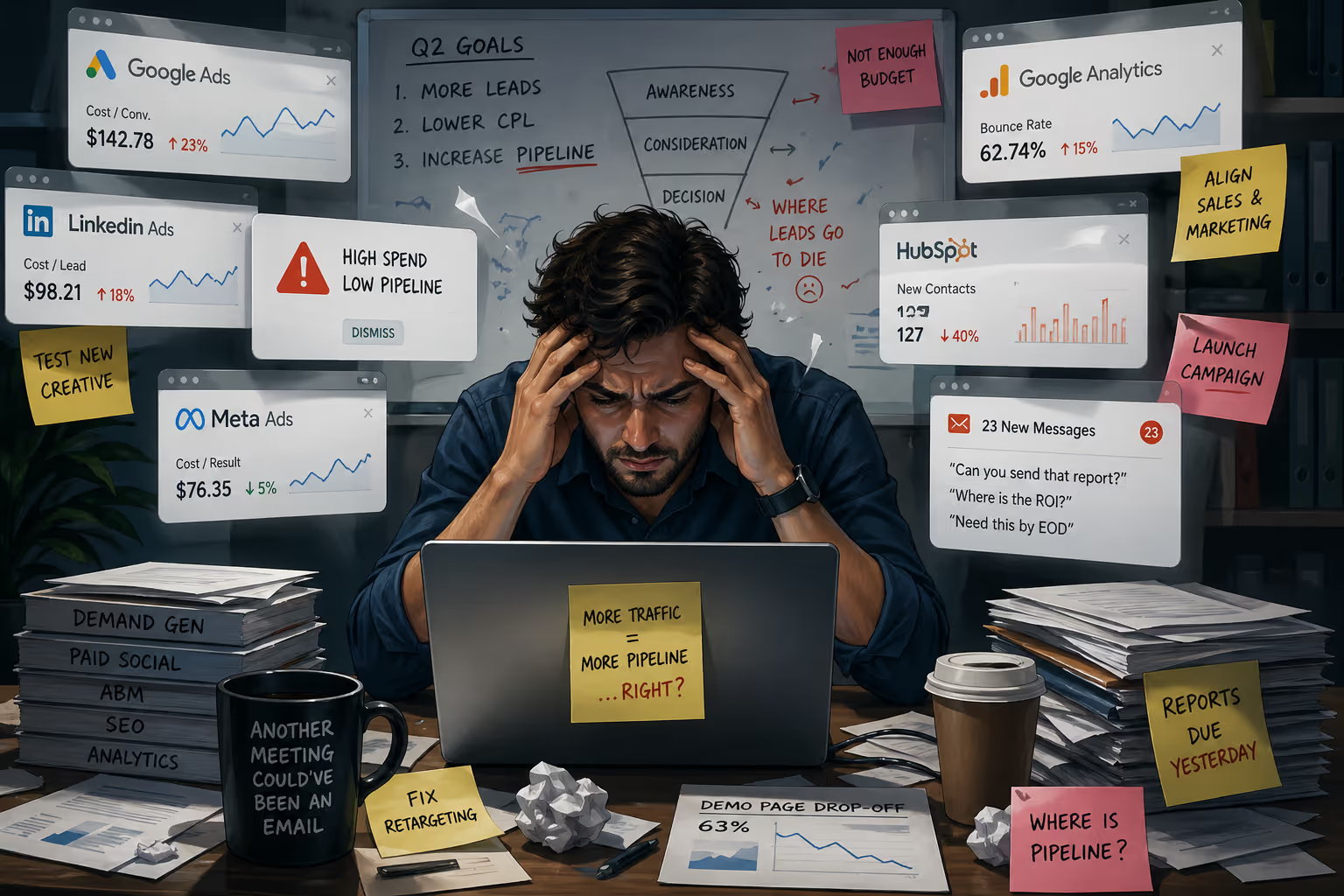

Hospitality SaaS is a $6 billion market growing at nearly 12% annually. There are over 100 companies competing across restaurant POS, hotel property management, vacation rentals, labor scheduling, and food safety. Almost all of them are running paid media on LinkedIn. And almost all of them are wasting money doing it.
That is not an exaggeration. It is a structural problem with how B2B SaaS marketing teams think about hospitality buyers — and it is costing this vertical millions of dollars in misallocated ad spend every year.
The issue is simple: the people who buy hospitality SaaS do not behave like typical B2B buyers. And the channels that work for selling HRIS, CRM, or DevOps tools to corporate buyers are precisely the wrong channels for reaching a restaurant owner in Austin, a boutique hotel GM in Asheville, or a vacation rental operator managing 15 properties on the Gulf Coast.
The hospitality SaaS landscape is broader than most people realize
When we mapped the hospitality SaaS market for AdGenius targeting, we identified 108 companies across 11 distinct sub-verticals. The market is not just "restaurant POS." It spans the full operational stack of how hospitality businesses run.
Every one of these companies is fighting for the attention of hospitality decision makers. And the overwhelming default channel for B2B SaaS advertising is LinkedIn. That is where the mismatch starts.
The fundamental problem: your buyer is not on LinkedIn
Think about who actually makes purchasing decisions in hospitality. These are not Fortune 500 VP-level executives reviewing enterprise software over quarterly planning cycles. These are operators.
The pattern is clear. The smaller the operation, the further the buyer is from LinkedIn. And hospitality SaaS overwhelmingly sells to small and mid-market operators — independent restaurants, boutique hotels, vacation rental hosts. These people run their businesses from their phones. They discover software on Instagram, evaluate it on YouTube, ask about it in Facebook Groups, and buy it after a Google search.
Yet hospitality SaaS companies keep pouring 60–80% of their paid media budgets into LinkedIn because that is what B2B SaaS companies are "supposed" to do.
The CPM math makes the case even clearer
When you are paying $95 per thousand impressions on LinkedIn to reach a restaurant owner who checks LinkedIn once a month, and that same person is scrolling Instagram and Facebook daily at $11–$14 CPMs, the math is not subtle. You are paying 7–8x more to reach someone on a channel where they are barely present.
For hospitality SaaS companies spending $10K or more per month on paid media, that gap represents tens of thousands of dollars in wasted reach every quarter.
The hospitality SaaS paid media paradox
You are selling to operators who live on Instagram, Facebook, and YouTube. But you are advertising to them on LinkedIn because your marketing team learned B2B media buying from companies that sell to corporate buyers. The channel strategy was inherited from a different industry with a different buyer profile — and nobody stopped to check whether it still applied.
Diversification is not optional. It is a competitive lever.
This is not just about saving money on CPMs. It is about finding your buyers in the places where they are actually making decisions.
A restaurant owner researching a new POS system is watching Toast and SpotOn demo videos on YouTube. They are scrolling past Instagram ads from Popmenu and BentoBox. They are reading Reddit threads in r/restaurantowners about which scheduling tool actually works. They are in Facebook Groups asking other operators what reservation platform they use.
If your paid media strategy is 70% LinkedIn and 25% Google Search, you are absent from every one of those moments. Your competitors who figure out channel diversification first will own those touchpoints at a fraction of the cost.
The structural advantage is significant. A hospitality SaaS company that shifts even 40% of its LinkedIn prospecting budget to Meta, YouTube, and programmatic retargeting can typically expect to see 3–5x more impressions per dollar on prospecting audiences, lower blended CPL as cheaper channels supplement LinkedIn's high-value but expensive retargeting, better frequency management since the buyer encounters the brand across multiple channels instead of seeing the same LinkedIn ad 15 times, and improved retargeting economics when programmatic display picks up site visitors at $8–12 CPMs instead of relying solely on LinkedIn retargeting at $90+.
What this means for hospitality SaaS marketers right now
The hospitality SaaS market is growing fast — from $6.1 billion in 2026 toward $12 billion by 2032. Competition is intensifying across every sub-vertical. Toast, SpotOn, Cloudbeds, Guesty, 7shifts, and dozens of others are all accelerating paid media investment to capture SMB operators during a generational shift to cloud-based tools.
The companies that win will not be the ones with the biggest LinkedIn budgets. They will be the ones that build multi-channel acquisition systems matched to where their specific buyers actually spend time — and measure performance across all of those channels in a unified view.
That is what a Performance Blueprint is designed to do. We connect your ad accounts and pixel, identify where your site traffic is actually coming from, reveal which audience segments are showing purchase intent, and build a channel-by-channel plan that puts your budget where your buyers are — not where B2B convention says they should be.
For hospitality SaaS companies, that almost always means less LinkedIn, more Meta, more YouTube, more programmatic — and a dramatically better cost per demo as a result.
Your hospitality buyers aren't where you think they are.
The Performance Blueprint shows you exactly where they are — and how to reach them for a fraction of what you're spending now.
Book a Performance Blueprint.avif)