
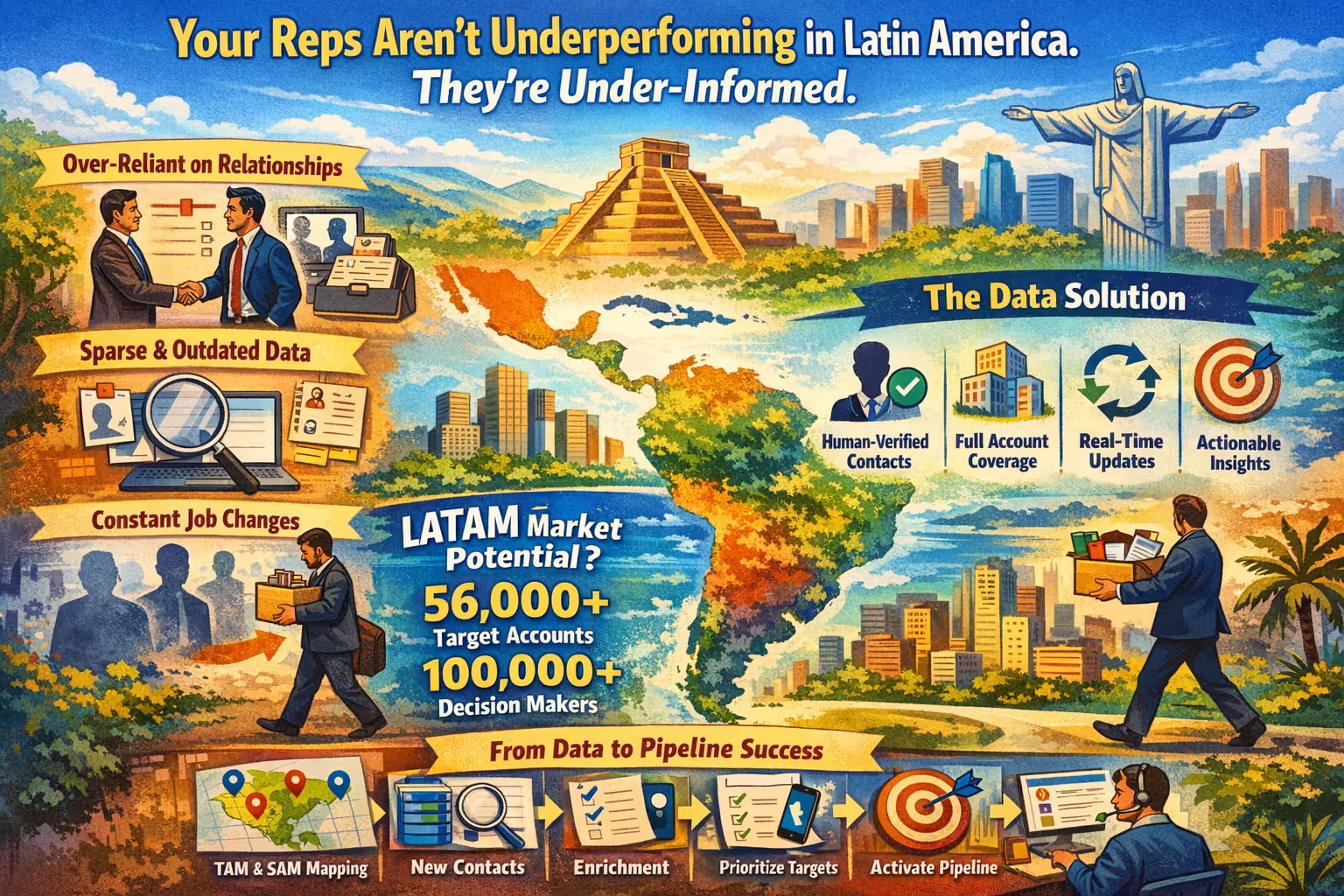
Your reps aren't underperforming in Latin America. They're under-informed.
If you sell into financial services, insurance, banking, or government across Latin America, you've heard the same refrain from your go-to-market team: "LATAM is relationship-driven." And that's true — but it's become a convenient excuse for something much more fixable.
The real issue? Most B2B organizations attempting to build pipeline south of the U.S. border are working with contact databases that were never designed for the region. They're stitching together ZoomInfo exports, stale LinkedIn scrapes, and the occasional warm intro — and wondering why conversion rates look anemic compared to North America or EMEA.
Let's talk about what's actually broken, and what a purpose-built data strategy looks like when you're serious about LATAM revenue.
Three Problems Hiding Behind "LATAM Is Just Different"
1. You're dependent on relationships to build pipeline — and that doesn't scale.
Relationship-driven selling is a feature of LATAM markets, not a bug. But when your entire pipeline generation strategy depends on who your reps already know, you've capped your growth at the size of their Rolodex. Every new territory, every new vertical, every rep who leaves — you're starting from scratch.
2. Your contact coverage at target accounts is embarrassingly thin.
In North America, your average enterprise account might have 15–30 mapped contacts across IT, operations, procurement, and the C-suite. In LATAM? You're lucky to have two. And one of them changed jobs six months ago. The major data vendors treat the region as an afterthought — coverage gaps are the norm, not the exception.
3. People change roles constantly, and your CRM doesn't keep up.
Job mobility in Latin American financial services and government is real, and it's accelerating. A VP of Technology at a Brazilian bank in Q1 might be a CIO at a Colombian fintech by Q3. If your data isn't refreshed continuously, you're sending outreach to ghosts.
The Actual Size of the Opportunity
Here's what most teams don't realize: the addressable market in LATAM financial services alone is massive — and massively underworked.
A recent LeadGenius TAM analysis across banking, insurance, investment management, financial services, fintech, and government administration in the region identified over 56,000 target accounts spanning every company size from startups to enterprises. That's not a niche. That's a continent-sized pipeline waiting to be built.
The contact universe is equally substantial. Across the ICP departments that matter most — operations, IT, procurement, product management, and customer success — the analysis surfaced nearly 100,000 decision-makers at the director level and above. That includes roughly 2,400 C-level executives and 2,200 VPs sitting inside organizations that match ideal customer profiles.
And here's the kicker: the largest concentration of accounts (over 32,000) sits in the 1–10 employee range — the fintech and financial startup ecosystem that's exploding across Brazil, Colombia, Mexico, and Chile. If your ICP includes emerging players alongside enterprise banks, you need a data partner that can map both ends of that spectrum with equal rigor.
Why Your Current Data Vendor Can't Solve This
Let's be direct: ZoomInfo, Apollo, Lusha, and the rest of the prebuilt database providers are optimized for North America and Western Europe. Their LATAM data is:
- Sparse: Coverage drops off a cliff once you leave major metros like São Paulo and Mexico City.
- Stale: Contact records in the region go stale 2–3x faster than in the U.S. due to higher job mobility and less consistent digital footprints.
- Anglicized: Job titles, company names, and departmental structures don't map cleanly to U.S. conventions. A "Vicepresidente de Tecnología de la Información" doesn't always show up when you search "VP of IT."
- Unverified: Email deliverability and phone connectivity in LATAM require human verification — not just algorithmic guessing.
The fundamental problem is architectural. Static databases are built by crawling the same public sources everyone else crawls. That works when you're prospecting into Salesforce's customer base in San Francisco. It fails spectacularly when you're trying to reach the CTO of a 200-person fintech in Bogotá or the Head of Procurement at a retail chain in Santiago.
What Purpose-Built LATAM Data Actually Looks Like
The difference between "we have LATAM data" and "we have data that actually converts in LATAM" comes down to four things:
Human-verified contacts, not algorithmic guesses. When LeadGenius maps a target account in Latin America, the output isn't a probabilistic email pattern and a scraped LinkedIn title. It's a verified contact record — name, title (in the original language and normalized), confirmed email, direct phone, LinkedIn profile, department, and seniority — validated by human intelligence analysts who understand local business structures. The sample data from a recent LATAM engagement included contacts like CISOs in Lima, CTOs in Bogotá, COOs in Rio de Janeiro, and purchasing managers in Santiago — each with direct dial numbers and verified email addresses.
Account coverage across the full spectrum. From a 10-person fintech in the Dominican Republic to a 10,000-employee retail conglomerate in Peru, the account universe needs to reflect reality — not just the companies that happen to have English-language websites. The TAM analysis approach maps accounts by industry, company size, and geography simultaneously, so you can segment and prioritize with precision.
Contact mapping by department and seniority. Selling enterprise software into LATAM financial services means reaching operations leaders, IT decision-makers, procurement teams, product managers, and customer success executives — often at the same account. A proper engagement maps all of these personas, at every seniority level from manager to C-suite, across the full account universe.
Continuous refresh, not annual snapshots. Champion monitoring and account monitoring mean that when your target contact moves from Banco Santander Peru to a fintech in Chile, you know about it — and you have their new contact details before your competitor does.
From Data to Pipeline: The Playbook
Good data isn't the finish line. It's the starting line. Here's how the best LATAM go-to-market teams turn a LeadGenius engagement into real pipeline:
Phase 1: TAM & SAM Definition. Map the full addressable market by industry, company size, geography, and department. Understand where the density is — and where the whitespace lives. In the LATAM financial services example, that meant identifying 56,125 accounts and nearly 100,000 contacts as the total addressable universe, then segmenting down to the highest-priority tiers.
Phase 2: Net-New Contact Acquisition. Fill the gaps your CRM can't. For most organizations entering or expanding in LATAM, this means adding thousands of verified contacts that simply don't exist in any prebuilt database. Focus on multi-threading — you need three to five contacts per account across different departments and seniority levels to run a modern ABM play.
Phase 3: Enrichment & Hygiene. Clean up what you already have. Normalize titles, update company hierarchies, verify emails, append direct dials. The cost of sending outreach to bad data isn't just wasted sends — it's burned credibility in a market where trust takes longer to build.
Phase 4: Signal-Driven Prioritization. Layer technographic, firmographic, and behavioral signals on top of your contact data to prioritize outreach. Who just adopted a new core banking platform? Which accounts are showing expansion signals? Where are your champions moving?
Phase 5: Activation. This is where data meets motion. Whether you're running multichannel ABM through a platform like AdGenius, executing outbound sequences, or feeding qualified leads into your SDR team, the quality of your pipeline is determined by the quality of the data underneath it.

The Bottom Line
Latin America isn't a "nice-to-have" market anymore for financial services technology companies. It's a growth imperative. But the go-to-market infrastructure most organizations are running in the region — relationship-dependent, data-starved, manually maintained — can't support the growth targets the board is setting.
The companies that will win LATAM pipeline over the next 24 months aren't the ones with the biggest sales teams or the flashiest brand presence. They're the ones with the best data — purpose-built, human-verified, continuously refreshed, and structured for the way the region actually works.
That's what LeadGenius builds. Not resold data scraped from the same sources your competitors are using. On-demand intelligence, built for you, mapped to your ICP, verified by human analysts, and delivered at the scale your pipeline requires.
56,000+ accounts. 100,000 decision-makers. One region your competitors are still fumbling.
Your move.
.avif)