If you sell to small and mid-sized businesses — and you're in HR tech, accounting, back-office ops, POS, payroll, insurance, or any of the verticals built on the backs of America's 33 million SMBs — you already know the quiet trade-off that defines your market.
Enterprise data is clean, expensive, and fought over by eight vendors and a coalition of intent platforms. SMB data is cheap, messy, and treated like a commodity. You can get a list of 500 Fortune 1000 CMOs in twelve seconds. You cannot, historically, get a clean list of every independent dental practice in Maricopa County that registered in the last 90 days, with a verified owner email and a current LinkedIn. Not without a three-month enrichment project and a tolerance for 40% bounce rates.
That gap — between what enterprise GTM teams can do with data and what SMB-focused GTM teams can do — has been the single biggest unaddressed handicap in B2B marketing for twenty years.
It's closing. Fast. And the teams that understand what's actually changed are already running circles around the ones still buying lists by state.
Why SMB data has always been impossible
Before we get to what's new, it's worth being honest about why the problem was real. SMB data isn't hard because data vendors are lazy. It's hard because the underlying entities are adversarial to structure.
A small business in 2020 might have three names, four addresses, two phones, one shared email for everything from payroll to spam, no LinkedIn page, a Facebook page the owner's nephew set up in 2014, and a legal entity registered in Delaware despite the business operating entirely out of a strip mall in Tempe. The owner is also the CFO, the head of HR, the marketing department, and the person who approves your invoice. Their title on LinkedIn is "Founder." Their title on the incorporation filing is "Registered Agent." Their title in real life is "exhausted."
This is why the big B2B data providers historically concentrated on companies with 200+ employees. Match rates were defensible. Firmographic signals were rich. Org charts were legible. SMB — especially the long tail of sole proprietorships, emerging businesses, and newly registered agents — was left to list brokers, scrapers, and the brave souls who'd built regional sales teams around local knowledge.
"SMB data has always been the ugly stepchild of B2B. Everyone talks about the market opportunity. Nobody wants to actually do the work to make the data usable." — Industry analyst, B2B data category, 2024
What actually changed
Three things, in roughly this order: public registry digitization, AI-powered entity resolution, and privacy-compliant audience activation. Together they've inverted the economics of the long tail.
Then vs. now
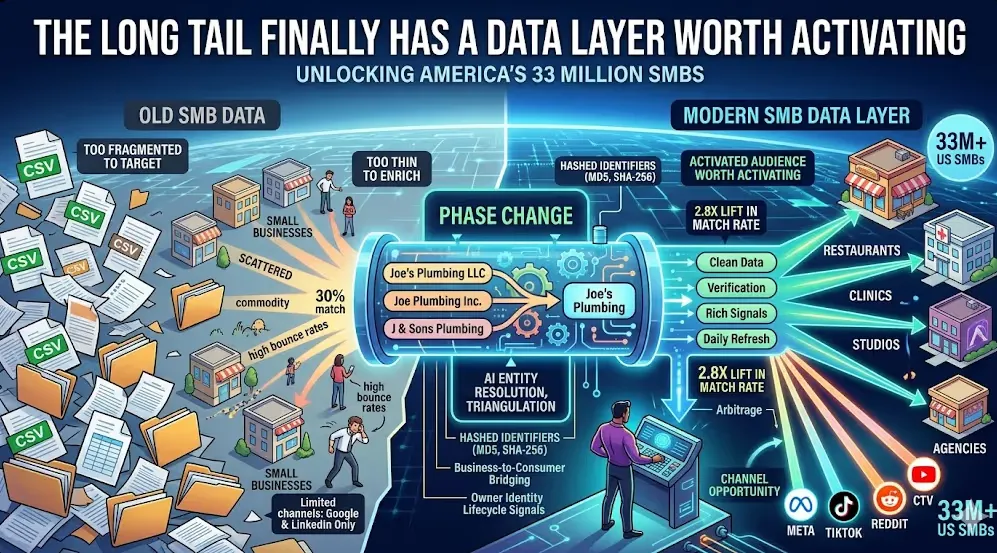
SMB data, c. 2018
- List vendors selling the same scraped file, refreshed quarterly
- Contact-level match rates of 25–35% against any enrichment source
- Email validation handled by a VA in the Philippines and a prayer
- Audience activation meant "upload CSV to LinkedIn, hope for 18% match"
- Entity resolution done manually: "Is this the same Joe's Plumbing or a different Joe's Plumbing?"
- Channel options: LinkedIn, Google Search. That was the stack.
SMB data, today
- Daily-refreshed state filings, cross-referenced against 30+ signals
- Contact-level match rates of 65–85% with verified business emails
- AI entity resolution that reconciles "Joe's Plumbing LLC," "Joe Plumbing Inc.," and "J & Sons Plumbing" to a single canonical entity
- Hashed-identifier audience layers (MD5, SHA-256) that activate on Meta, TikTok, Reddit, YouTube, CTV
- Business-to-consumer bridging: the SMB owner's personal profile, not just the business filing
- Channel options: the entire open web, not just the two places everyone else is already bidding
The shift isn't incremental. It's a phase change. And it means the teams that built their SMB motions around the old constraints — LinkedIn outbound, a list of 50,000 prospects refreshed every quarter, a 12% bounce rate they learned to tolerate — are now getting lapped by teams that treat the SMB universe as a fully-addressable, fully-activatable audience.
How the new enrichment actually works
To understand why match rates have jumped, you have to understand what's happening between the moment a business is formed and the moment a marketer can target its owner on Meta. It's a pipeline — and ten years ago most of the stages simply didn't exist.
The magic is in stages two and three. Entity resolution used to be a manual process — you'd pay analysts to look at two records and decide if they were the same business. Today, models trained on tens of millions of reconciled entities can do it faster, more consistently, and at a scale no human team could touch.
Triangulation is the second unlock. A Secretary of State filing alone tells you a company exists. It doesn't tell you whether the owner is active on TikTok, what zip code they actually work from, or whether the business phone in the filing is still connected. Triangulation — the practice of validating a single entity against multiple independent sources — is what turns a dead list into a live audience.
"The companies winning in SMB right now aren't the ones with the biggest list. They're the ones whose list actually matches when you upload it." — Head of growth, vertical SaaS (quoted in trade press)
The channel arbitrage almost nobody is pricing in
Here's the part that matters most for marketing and RevOps leaders: once you have a real, activation-ready SMB audience, you have something that is genuinely rare in B2B — cheap inventory on channels your competitors aren't using.
Look at where B2B SaaS advertisers targeting SMBs actually spend today. Almost all of it concentrates on two channels: Google Search (where CPCs in HR tech, accounting, and ops have more than doubled in five years) and LinkedIn (where SMB decision-makers are a minority of the user base and CPMs have climbed accordingly).
Meanwhile, the places SMB owners actually live online — Meta, TikTok, Reddit, YouTube, CTV, programmatic display — are dramatically under-bid by competitors with the same ICP. This isn't because those channels don't work. It's because legacy B2B data providers couldn't activate audiences on them. When your data lives in a CSV of unhashed emails with 30% bounce rates, your only options are your CRM and LinkedIn.
The arbitrage doesn't last forever. It never does. The teams who move first — who take their SMB audience layer and activate it on Meta, TikTok, Reddit, YouTube, and CTV while the rest of their category is still stuck in the LinkedIn/Google duopoly — are the ones who will pay 2026 prices while their competitors pay 2029 prices for the same inventory.
What a modern SMB data layer actually contains
The difference between a list and an audience layer is the difference between a snapshot and a living system. A modern SMB data infrastructure isn't one file — it's a connected set of datasets that together let you find, verify, enrich, and activate any SMB segment you can describe.
| Layer | What's in it | What it unlocks |
|---|---|---|
| Registered Entity | Legal name, jurisdiction, company type, formation date, status, registered address, industry codes, previous names | Newly formed business triggers, status change alerts, total addressable market sizing |
| Officers & Agents | Named officers, positions, start/end dates, titles, nationality, partial DOB, residence country, hashed officer emails, officer phones | Owner-level targeting for sole proprietorships; buying-committee resolution for SMB |
| Addresses & Filings | Registered, mailing, and alternative addresses; full filing history with dates, IDs, descriptions, and document URLs | Geographic precision; change-of-address signals; compliance intent; filing-triggered outreach |
| Relationships | Branches, subsidiaries, control statements, share parcels, ownership percentages, date ranges | Parent-child resolution; franchise vs. independent; multi-location SMB accounts |
| Consumer Bridge | Persistent individual + household + address IDs, demographics, financial segment, geographic codes (CBSA, census tract, block group), carrier route | Bridging the SMB owner's professional identity to their consumer identity for cross-channel activation |
| Consumer Attributes | 16 categories spanning automotive, behavioral, interests, lifestyle, political, real estate, transactional, EAGLES segmentation, occupations | Audience segmentation that actually models human behavior, not just firmographics |
| Activation Identifiers | MD5 + SHA-256 hashed emails, NANP 10-digit validated phones, address hashes | Privacy-compliant audience uploads to every major ad platform |
This is the architecture that makes the long tail addressable. It's also what separates a real SMB data partner from a list vendor with a fancier wrapper.
Who this matters for (and why)
The teams getting the most out of modern SMB data infrastructure tend to share a few characteristics. They sell into verticals where the buyer is the owner, where the deal is measured in thousands not millions, and where volume and velocity matter more than a six-month enterprise sales cycle.
HR tech & payroll
Selling payroll, benefits, or HRIS into businesses with 1–50 employees means your ICP is defined less by industry code than by lifecycle stage. Businesses that incorporated 60–180 days ago are in-market in ways that would be invisible to traditional firmographic targeting. Filing data is the trigger; owner enrichment is the conversion.
Accounting, tax & back-office SaaS
Every new LLC is a prospect for bookkeeping, tax prep, and back-office automation. The challenge has never been identifying the opportunity — every state publishes the filings. The challenge has been turning 847 Tuesday-morning filings in California into a clean, deduped, contact-enriched, channel-activatable audience by Wednesday morning.
Restaurant, retail & local service SaaS
POS, scheduling, inventory, and local marketing tools live or die on SMB acquisition cost. Traditional firmographic targeting is useless here — a 10-person restaurant doesn't look like a 10-person SaaS company, and the owner's buying behavior is more consumer than corporate. Consumer-graph bridging is the only way to activate meaningfully on Meta and TikTok, where restaurant owners actually spend their time.
Insurance, lending & financial services for SMBs
Every newly registered business is a potential buyer of commercial insurance, a business line of credit, or a merchant account. Lifecycle-triggered outreach — powered by daily Secretary of State refresh and enrichment — is the difference between being first in the inbox and fourth.
Vertical SaaS across the long tail
Clinics, studios, agencies, trades, franchises — anywhere the vertical SaaS wave is still rolling, SMB audience data is the underlying enabler. The vertical SaaS market is projected to cross $150 billion in the next few years, and the winners will be the teams that treat SMB acquisition as an audience problem, not a list problem.
"Vertical SaaS won the last decade by building better software for specific industries. It'll win the next decade by building better audience infrastructure for those industries. Product depth without data depth gets expensive fast." — GTM strategist, vertical SaaS category
The international dimension
Most US-based marketers assume SMB data is a domestic problem. That assumption costs them real pipeline. The mechanics of registry data — publicly filed, jurisdiction-coded, increasingly digitized — work the same way in the UK, Australia, Canada, across the EU, and in most of LATAM and APAC. The difference is that very few data providers have built infrastructure to harmonize across jurisdictions.
A company that sells HR tech to US restaurants almost always has a Canadian and UK TAM that looks identical. An accounting SaaS targeting US LLCs has a mirror opportunity in Australian Pty Ltd formations. The teams with international SMB audience infrastructure are quietly building multi-region pipelines while their single-market competitors are still hand-cleaning state-level CSVs.
What to ask your data provider (a short checklist)
- What's the refresh cadence on your Secretary of State coverage, and do you cover all 50 states + international jurisdictions?
- How do you resolve entities across branches, subsidiaries, alternative names, and previous names?
- Can you deliver hashed identifiers (MD5, SHA-256) for audience activation on Meta, TikTok, Reddit, YouTube, and CTV — not just LinkedIn?
- What's your match rate against the major consumer graphs for owner and officer records?
- How do you handle the bridge between a business entity and the personal identity of its owner or officer?
- What filing-triggered signals do you support (formation, status change, address change, new officer, dissolution)?
- What's your approach to data triangulation — specifically, how many independent sources validate a single contact record?
- Can you deliver custom SMB audience segments, or do you sell the same file everyone else is buying?
The answers to those eight questions will tell you in about fifteen minutes whether you're working with a list vendor or a modern SMB data partner.
The bottom line
For twenty years, SMB was the part of the B2B market where marketers made peace with bad data. You took the 30% bounce rate. You bought the stale list. You ran LinkedIn outbound because it was the only channel where the data actually matched. You told your board the TAM was huge and you'd get to it eventually, once the data caught up.
The data has caught up. Secretary of State digitization, AI entity resolution, and privacy-compliant audience activation have collectively turned the long tail into the most interesting addressable market in B2B — the one with the most owners, the most velocity, the most buying activity, and the least advertiser saturation across the channels that matter.
The question isn't whether your SMB motion needs an upgrade. It's whether you're going to build it now, while the arbitrage is still open, or wait until your competitors have already compressed it.
LeadGenius has been building SMB data infrastructure for the smartest GTM teams in the world for over a decade. We cover every US jurisdiction and dozens internationally. We run daily refresh pipelines against Secretary of State filings. We built AI entity resolution before it had a market category. And we deliver the hashed identifier layers that let you activate SMB audiences on every channel, not just the two your competitors are fighting over.
If you've spent any part of the last year fighting with a list that doesn't match, a channel mix that doesn't scale, or a pipeline that doesn't convert — we should probably talk.
Stop buying lists. Start building audiences.
See how LeadGenius turns Secretary of State filings, consumer graph data, and cross-channel activation into pipeline your competitors can't match.
Connect With a Strategist →