
If your team is expanding globally, your biggest hidden risk isn’t bad targeting.
It’s bad compliance.
Most revenue organizations assume their primary obstacle is coverage:
- “Do we have enough contacts in EMEA?”
- “Can we scale APAC?”
- “Are we missing LATAM pipeline?”
But coverage is rarely the true constraint.
The real risk sits beneath the surface — in how that data was sourced, documented, validated, and activated.
Because once you move beyond a single domestic market, the rules change.
And they change fast.
The Reality Most Revenue Teams Underestimate
Global expansion introduces operational complexity that most go-to-market engines were not built to handle.
Each country has:
- Different consent standards.
- Different lawful basis expectations.
- Different data transparency requirements.
- Different “Do Not Contact” registry frameworks.
- Different documentation standards.
- Different enforcement posture.
And enforcement is increasing — not decreasing.
What may be considered compliant outbound engagement in one region could trigger penalties, brand damage, or regulatory scrutiny in another.
The uncomfortable truth?
Most global campaigns are deployed on data infrastructure that was designed for scale — not for jurisdictional nuance.
The Static Database Illusion
Traditional data providers operate on a static inventory model:
- Pre-collected contact records.
- Broad compliance assumptions.
- Periodic refresh cycles.
- Generic lawful basis explanations.
- Minimal country-specific documentation.
That model works — until it doesn’t.
Because compliance isn’t static.
It is:
- Country-specific.
- Channel-specific.
- Use-case specific.
- Continuously evolving.
A database built for volume cannot dynamically adjust to:
- Changing registry requirements.
- New privacy legislation.
- Sector-based enforcement differences.
- Signal-driven shifts in company behavior.
- Region-specific consent thresholds.
The result?
Revenue teams scale risk at the same rate they scale outreach.
The Hidden Cost of “Good Enough”
When compliance is treated as a checkbox rather than infrastructure, several downstream risks emerge:
- Increased complaint rates.
- Suppression failures.
- CRM contamination.
- Legal review slowdowns.
- Marketing ops bottlenecks.
- Reputational damage.
- Sales team productivity drag.
- Regional campaign shutdowns.
And perhaps most costly of all:
Hesitation.
When legal, compliance, and RevOps lack confidence in data sourcing, global campaigns slow down or stall entirely.
Speed dies.
And pipeline follows.
A Different Way to Think About Global Data
The companies that win internationally are not the ones with the largest databases.
They are the ones with:
- Clear lawful basis documentation.
- Country-level compliance mapping.
- Integrated suppression and registry automation.
- Real-time signal validation.
- Audit-ready sourcing workflows.
- Campaign-specific data construction.
In other words:
They treat compliance as a competitive advantage — not a constraint.
When data is purpose-built to campaign intent and mapped to regional requirements, three things happen:
- Risk decreases.
- Relevance increases.
- Confidence accelerates execution.
That is the shift.
What This Guide Will Help You Do
This guide provides a structured framework to help revenue leaders:
- Understand global consent models.
- Identify regulatory exposure before launch.
- Operationalize registry and suppression hygiene.
- Demand stronger documentation from vendors.
- Move from static inventory to signal-driven sourcing.
- Build global pipeline without compromising compliance posture.
This is not a legal manual.
It is a revenue infrastructure blueprint.
Because the future of global expansion isn’t more contacts.
It’s compliant, signal-driven, campaign-specific data — built dynamically, activated intelligently, and documented rigorously.
Part 1: The 4 Global Consent Models You Must Understand
When revenue teams expand internationally, they often think in terms of market size, language, and demand.
They should be thinking in terms of consent architecture.
Based on global country mapping analysis, most markets fall into four dominant regulatory patterns. Understanding which model applies before launching outreach is the difference between scalable pipeline and scalable exposure.
This isn’t a legal nuance.
It’s a revenue infrastructure decision.
I. Transparency + Opt-Out Framework
In these markets, data usage is permitted under a transparency model — provided specific notification and opt-out standards are met.
Example countries include:
- Argentina
- Peru
- Chile
How These Markets Work
Organizations can process and use business contact data when:
- The individual has been properly notified.
- The purpose of processing is clearly defined.
- An accessible opt-out mechanism is provided.
- Suppression requests are honored promptly.
The burden here is operational — not necessarily prohibitive.
The mistake revenue teams make is assuming that opt-out compliance is automatic.
It isn’t.
Without synchronized suppression workflows, opt-out logic can break between:
- CRM
- Marketing automation
- Sales engagement platforms
- External enrichment tools
That fragmentation is where risk enters.
Revenue Risk in This Model
- Opt-out requests not syncing across systems
- Old records reactivated after refresh
- DNC registries not incorporated
- Campaign-level transparency gaps
At small scale, this may go unnoticed.
At global scale, it becomes visible.
Operational Best Practices
In transparency + opt-out markets:
- Maintain auditable opt-out workflows across every activation system.
- Integrate DNC registry checks prior to campaign deployment.
- Implement automated suppression syncing between CRM, MAP, and outbound tools.
- Log suppression activity with timestamp documentation.
- Conduct quarterly suppression hygiene audits.
Compliance here is a systems design issue — not a sourcing issue.
II. Dual Consent / Explicit Opt-In Environments
These environments require a materially higher standard of proof.
Example:
- Brazil
In these markets, it is not sufficient to rely on assumed business interest.
You must demonstrate lawful basis and, in many cases, explicit opt-in.
How These Markets Work
Requirements often include:
- Clear documentation of consent capture.
- Defined lawful basis for processing.
- Vendor-level sourcing transparency.
- Evidence of opt-in where required by channel.
Inherited database consent becomes highly risky here.
A vendor saying “this is compliant” is not documentation.
Revenue leaders should ask:
- When was consent obtained?
- Under what mechanism?
- For what purpose?
- Is the consent transferable?
- Is it channel-specific?
If those answers are vague, your exposure is high.
Revenue Risk in This Model
- Reliance on historical consent not tied to your use case
- No documentation trail at contact level
- Channel misalignment (email vs phone vs ads)
- Legal review bottlenecks delaying launch
- Campaign suspension due to insufficient proof
This is where static inventory databases struggle most.
Because consent isn’t universal.
It’s contextual.
Operational Best Practices
In dual consent environments:
- Never rely on inherited or generalized consent.
- Source data in real time tied to a defined campaign use case.
- Document lawful basis per contact.
- Maintain consent evidence in an auditable format.
- Align legal and RevOps before activation.
The shift here is philosophical:
Move from “Do we have data?”
To “Can we defend how we sourced this data?”
III. Strict Regulatory & Registry-Heavy Markets
These markets combine comprehensive privacy regulation with strong enforcement posture and active registry infrastructure.
Example:
- Germany
These regions often have:
- Detailed privacy legislation
- Cultural sensitivity to data usage
- Active enforcement authorities
- Mandatory or strongly expected registry checks
- Clear expectations around documentation
How These Markets Work
In these markets, compliance is not just technical.
It is reputational.
Registry validation, lawful basis confirmation, and documentation expectations are high.
Even minor process failures can escalate quickly.
Revenue leaders should assume:
- Enforcement bodies are active.
- Complaints are taken seriously.
- Documentation requests can occur.
- Public exposure risk is real.
Revenue Risk in This Model
- Registry suppression gaps
- Channel misinterpretation of lawful basis
- Messaging that fails local standards
- Inability to produce sourcing documentation
- Sales reps activating data outside approved workflows
The risk here is not just fines.
It’s brand damage in high-value markets.
Operational Best Practices
In strict regulatory markets:
- Validate lawful basis per outreach channel (email ≠ phone ≠ ads).
- Ensure DNC suppression is integrated into enrichment workflows.
- Conduct localized compliance reviews of messaging.
- Restrict rep-level manual uploads of unvalidated contacts.
- Store audit-ready sourcing documentation.
If your compliance logic lives in a PDF policy document instead of in your workflow automation, you are exposed.
IV. Hybrid / Sector-Based Enforcement Models
Some countries enforce privacy rules based on industry, communication channel, or state-level frameworks rather than a single unified national standard.
Examples:
- United States
- Japan
These markets are often misunderstood.
Because they feel “flexible.”
But flexibility creates complexity.
How These Markets Work
In hybrid environments:
- Enforcement may vary by state or region.
- Different industries face different standards.
- Phone and SMS outreach may carry higher scrutiny.
- B2B vs B2C distinctions matter significantly.
- Registry compliance is often critical for telephonic outreach.
For example:
A B2B email may be acceptable.
A phone campaign into the same audience may trigger registry violations.
Channel matters.
Sector matters.
Purpose matters.
Revenue Risk in This Model
- Assuming national uniformity where it doesn’t exist
- Failing to distinguish B2B and B2C logic
- Ignoring phone registry suppression
- Cross-channel compliance drift
- Sales teams activating data outside approved frameworks
The danger here is complacency.
Because the market feels familiar.
Operational Best Practices
In hybrid environments:
- Separate B2B and B2C targeting logic.
- Maintain distinct consent standards by channel.
- Integrate phone registry validation before dial campaigns.
- Align enrichment logic to channel-specific activation plans.
- Create a compliance review trigger when expanding into new states or sectors.
Hybrid models require segmentation discipline.
The Strategic Takeaway
Every global campaign should begin with one question:
Which consent model applies?
Before:
- You build the audience.
- You enrich contacts.
- You activate outreach.
- You sync to CRM.
- You brief SDRs.
Compliance classification should be the first operational step — not the last legal check.
Because once outreach begins, your compliance posture becomes visible.
And in a world where enforcement is increasing and brand trust is fragile, the most competitive revenue engines are not the most aggressive.
They are the most intentional.
Part 2: Why Static Databases Fail Globally
Most traditional data providers were architected for a different era.
They rely on:
- Massive pre-collected data lakes
- Quarterly or biannual refresh cycles
- Scraped and appended records at scale
- Broad, one-size-fits-all compliance interpretations
- Static enrichment layers applied universally
That model worked when outbound was primarily volume-based and regulation was relatively predictable.
It breaks down today.
Here’s why.
I. Regulation Is No Longer Global — It’s Hyper-Local
Privacy law isn’t a single framework.
It’s an evolving mosaic of country-specific and even state-specific rules like:
- General Data Protection Regulation
- California Consumer Privacy Act
- Lei Geral de Proteção de Dados
- Personal Information Protection and Electronic Documents Act
Each framework carries different interpretations of:
- Legitimate interest
- Consent thresholds
- Data minimization
- Data transfer requirements
- Registry obligations
A static database built on “global compliance assumptions” can’t dynamically adjust its processing logic country by country, campaign by campaign.
And when your vendor assumes compliance instead of operationalizing it per jurisdiction, the liability shifts quietly to you.
II. Suppression Lists Evolve Daily — Not Quarterly
Do Not Call lists, regional suppression registries, and industry opt-out frameworks update continuously.
Your outbound engine might be running daily.
Your data lake refresh? Maybe every 90 days.
That gap creates exposure:
- Dialing newly registered DNC numbers
- Emailing recently opted-out contacts
- Contacting individuals under updated sectoral restrictions
Compliance is no longer about “having a policy.”
It’s about real-time suppression logic embedded into activation workflows.
Static data architecture simply wasn’t designed for that.
III. Business Signals Shift Weekly
Modern revenue teams depend on dynamic signals:
- New funding rounds
- Strategic hires
- New product launches
- Geographic expansion
- Ownership changes
- Onsite technology adoption
- Hiring surges
- E-commerce enablement
- Supply chain movement
- Positive or negative news cycles
Those signals decay fast.
If your targeting criteria is based on:
- Last quarter’s headcount
- A funding event from six months ago
- A tech stack scrape from last year
You’re not running precision outbound.
You’re running historical outreach.
And historical outreach drives lower connect rates, higher complaint rates, and more regulatory scrutiny.
IV. Campaign Intent Changes the Compliance Equation
Not every outbound motion is treated equally under regulatory interpretation.
There is a difference between:
- Product marketing emails
- Partner recruitment
- Event invitations
- Survey outreach
- Transactional communication
- Cross-sell to existing customers
Consent requirements often vary based on intent and jurisdiction.
A static database cannot:
- Dynamically classify campaign type
- Reassess consent thresholds per region
- Apply differentiated processing logic
It simply delivers rows of records.
The burden of interpretation falls on the revenue team.
V. Expansion Multiplies Risk
When companies expand into:
- New countries
- New verticals
- New segments
- New regulatory zones
The compliance surface area expands with them.
A vendor operating under a single, global compliance posture cannot adapt dynamically to:
- Germany vs. France nuance
- US state-by-state differences
- Brazil vs. Mexico frameworks
- Sector-specific restrictions (healthcare, financial services, public sector)
That’s where operational risk quietly enters the revenue engine.
The Core Problem
A static database is fundamentally:
- Retrospective
- Generalized
- Assumption-based
- Refresh-dependent
Modern go-to-market requires:
- Real-time signal ingestion
- Jurisdiction-aware suppression
- Campaign-level consent logic
- Dynamic registry reconciliation
- Continuous validation
If your data foundation cannot adapt in motion, it becomes a liability layer embedded directly inside your revenue stack.
And the risk isn’t abstract.
It shows up as:
- Lower deliverability
- Higher complaint rates
- Sales rep hesitation
- Legal review bottlenecks
- Slower international expansion
- Reputational exposure
Where Risk Enters the Revenue Engine
Risk doesn’t enter because teams are careless.
It enters because they’re operating on static infrastructure in a dynamic regulatory and business environment.
A data lake refreshed quarterly cannot protect a revenue engine operating daily.
Compliance is no longer a checkbox.
It’s an operating system.
And static databases were never built to run one.
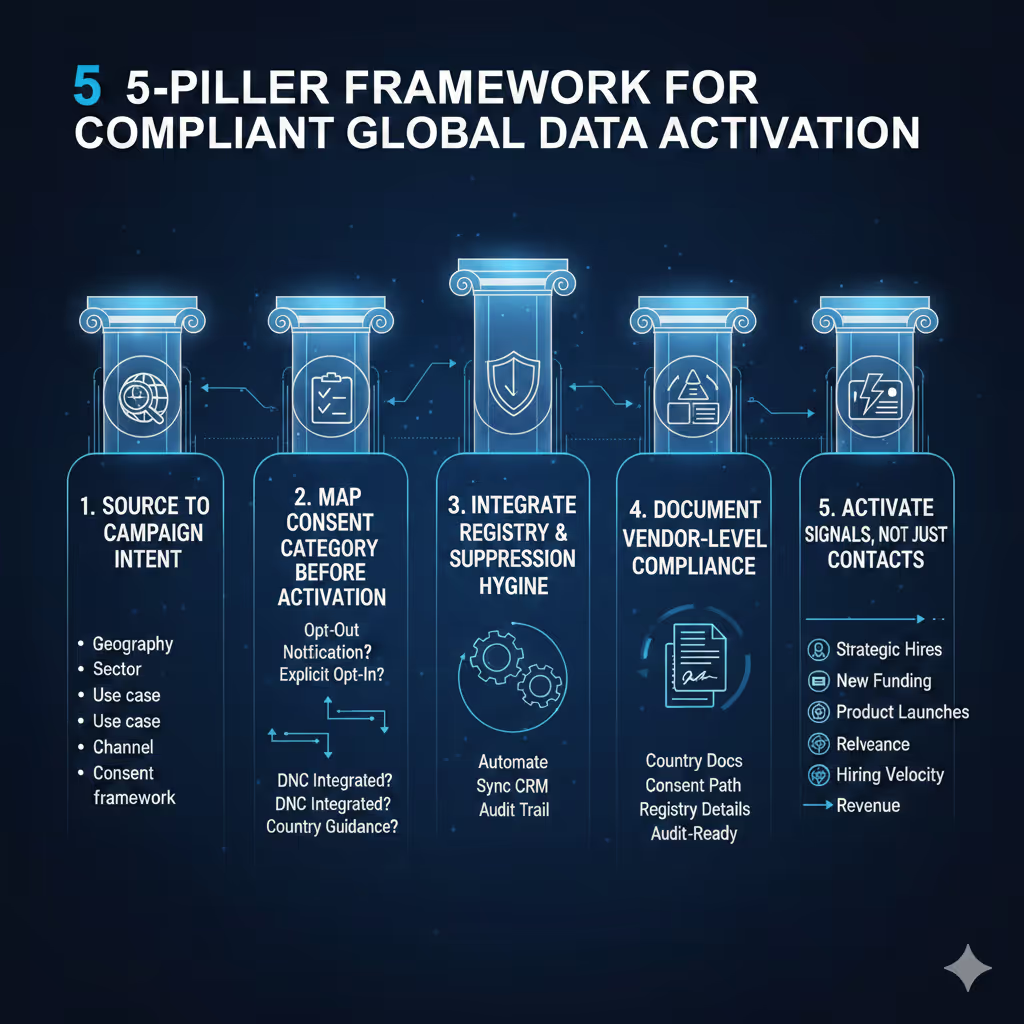
Part 3: The 5-Pillar Framework for Compliant Global Data Activation
Most revenue teams treat international data compliance like a fire drill — scrambling to check boxes right before launch, then praying nothing catches. That's not a strategy. It's a liability.
What follows is a framework built from the operational reality of activating B2B data across dozens of countries with different consent models, registry requirements, and enforcement regimes. These aren't theoretical pillars. They're the five things that separate teams who scale internationally from teams who get burned.
Pillar 1: Source Data to Campaign Intent — Not to Inventory
Here's where most data purchases go sideways.
A revenue leader says, "We need EMEA IT Directors," and the vendor pulls from whatever inventory they have sitting on the shelf. The data arrives. It technically matches the title filter. But it wasn't built for your campaign, your channel, or your compliance requirements — and you don't find that out until deliverability craters or legal starts asking questions.
The fix is deceptively simple: define what you actually need before you buy.
That means specifying five dimensions up front, not just one or two:
Geography — not just "EMEA" but specific countries, because consent requirements in Germany look nothing like consent requirements in the UAE.
Sector — vertical specificity matters. "Technology" is too broad. "Series B+ SaaS companies with 200–1,000 employees selling to enterprise" is a brief your data partner can actually build against.
Use case — are you running cold outbound email? Content syndication? Paid retargeting? LinkedIn InMail? The use case determines the consent pathway required, and getting this wrong is where compliance exposure lives.
Channel of activation — closely related to use case, but distinct. Multi-channel campaigns need data that's cleared for each channel, not just the primary one. If your data was sourced for email but you're also loading it into a paid audience, you may have a problem.
Consent framework required — this is the one most teams skip entirely. Before a single record is sourced, you should know: does this country require opt-in? Opt-out notification? Is there a legitimate interest basis available? Your data partner should be building to that specification.
The bottom line: data should be manufactured to order, not pulled from a warehouse. If your vendor is handing you the same list they gave three other companies this quarter, you're not getting compliant data — you're getting convenient data.
Pillar 2: Map the Consent Category Before You Activate
Every country your campaign touches has a consent model. Some require explicit opt-in before any outreach. Some allow opt-out notification. Some have hybrid models depending on the channel. Some have rules that apply only to specific industries.
If you don't know which model applies before you launch, you're gambling with your sender reputation, your brand, and potentially your legal standing.
Here's what a proper pre-launch consent mapping looks like in practice:
Is opt-out notification required? In many markets, B2B outreach is permissible as long as the recipient has a clear, functional way to opt out and is notified of that right. But "many markets" isn't "all markets" — and the details matter. Some countries require the opt-out mechanism to be in the recipient's native language. Some require it in the first communication, not buried in a footer.
Is explicit opt-in mandatory? In countries like Germany, Italy, and increasingly across the EU for certain channels, you can't send cold outreach without prior consent. Period. If your data wasn't sourced with documented opt-in, it's non-compliant on arrival.
Are DNC registries integrated? Multiple countries maintain national Do Not Contact registries. If you're not suppressing against them before every send, you're not compliant — and in some jurisdictions, the fines are per-contact, not per-campaign.
Are country-specific guidance requirements met? Beyond the broad regulatory frameworks, individual countries often publish specific guidance on B2B communications. These aren't suggestions. Data protection authorities reference them when they investigate complaints.
Content syndication eligibility adds another layer. Not all contacts in your database are eligible for content syndication campaigns. The consent basis for downloading a whitepaper through a third-party publisher is different from the consent basis for receiving a cold email, and your data should reflect that distinction.
Turn this into an actual pre-launch checklist. Not a PDF that lives in a shared drive somewhere — a gate in your campaign workflow that physically prevents activation until every box is confirmed. The five minutes this adds to your launch process could save you months of remediation.
Pillar 3: Integrate Registry and Suppression Hygiene Into Your Workflow
Do Not Contact registries exist across dozens of countries, and they're not static. They update continuously. A contact that was clean last month may not be clean today.
Most teams treat suppression as a one-time data cleaning step. They run a DNC check when the list is purchased, then never check again. That's a compliance gap that widens with every passing week.
Here's what operational suppression hygiene actually looks like:
Automate registry suppression into your activation workflow. This shouldn't be a manual step someone remembers to do. It should be baked into the infrastructure — every list, every send, every time. If a contact hits a DNC registry between your last check and your next campaign, your system should catch it automatically.
Sync CRM opt-outs back into your master suppression file. When someone opts out through your CRM, that opt-out needs to propagate everywhere — not just the email platform they opted out from, but your retargeting audiences, your outbound sequences, your content syndication lists, and any third-party tools in your stack. One opt-out means opted out everywhere.
Run pre-send validation checks. Before any campaign goes live, run a final validation pass. This catches records that were added to registries after your last suppression sync, contacts whose email addresses have become invalid, and any records that should have been suppressed but slipped through due to data formatting inconsistencies.
Log your suppression logic for audit trail. If a regulator or a prospect's legal team asks you to prove that a specific contact was checked against relevant registries before you contacted them, can you produce that documentation? If the answer is "probably not," your suppression process isn't complete. Every check, every suppression, every exception should be logged with timestamps.
Compliance isn't a legal checkbox you tick once a quarter. It's an operational workflow that runs continuously, automatically, and with full documentation. The teams that treat it this way don't just avoid fines — they maintain cleaner data, better deliverability, and stronger sender reputations as a direct result.
Pillar 4: Document Vendor-Level Compliance — And Demand Proof
Here's an uncomfortable truth: most revenue teams have no idea how their data vendors actually source contacts in specific countries.
They know the vendor has a privacy policy. They know there's a contract with data processing terms. They might even have a verbal assurance that "everything is GDPR compliant." But when you ask, "How specifically was this list of German IT Directors sourced, and what is the documented lawful basis for each record?" — the room goes quiet.
That silence is your exposure.
Every country in your campaign footprint has its own requirements for lawful data processing. Your vendor should be able to document, country by country:
The lawful basis for processing. Is it legitimate interest? Consent? Contractual necessity? The answer may vary by country even within a single campaign, and your vendor should be able to articulate which basis applies where.
The consent pathway. For countries requiring opt-in, how was consent obtained? Through what mechanism? When? Is there documentation? "We have consent" is not the same as "here is the timestamped consent record for this specific contact."
Registry incorporation details. Which DNC and suppression registries does the vendor check against? How frequently? Is it automated or manual? Can they provide evidence of registry checks for your specific data delivery?
Country-specific documentation and guidance compliance. Beyond broad regulations like GDPR, has the vendor reviewed and incorporated the specific guidance published by each country's data protection authority?
Audit-ready documentation. If a regulator came knocking tomorrow, could your vendor produce a clear, complete paper trail for every record they delivered to you? Not in theory — in practice, within a reasonable timeframe?
Revenue teams should be asking these questions before they sign contracts, not after they receive complaints. Make vendor compliance documentation a procurement requirement, not an afterthought. And if a vendor can't explain how data was sourced in a specific country with specificity and documentation — that's not a vendor limitation, it's a risk signal. You are exposed, and the liability sits with you as the data controller.
Pillar 5: Activate Signals, Not Just Contacts
Here's where compliance and competitive advantage converge.
Even if you nail the first four pillars — sourcing to specification, mapping consent, integrating suppression, and documenting vendor compliance — you're still only halfway there if all you're activating is contact data.
Compliant contact data is table stakes. It gets you permission to reach out. It doesn't get you relevance.
Signal-driven activation is what separates campaigns that convert from campaigns that get ignored (or worse, reported as spam).
What does signal-layered data look like in practice? It's the difference between "here are 5,000 VP Engineering contacts in DACH" and "here are 340 VP Engineering contacts at companies in DACH that have made a strategic engineering hire in the last 90 days, recently closed a funding round, and are showing hiring velocity in cloud infrastructure roles."
The signals that matter most for B2B activation include:
Strategic hires — a company bringing on a new CRO, VP of Engineering, or Head of Data signals a mandate to change something. That's a buying trigger.
New funding — fresh capital means new budgets, new initiatives, and urgency to show returns. Timing your outreach to funding events dramatically increases relevance.
Product launches — companies launching new products often need supporting infrastructure, tooling, and services. The launch itself is the intent signal.
New locations — geographic expansion means new compliance requirements, new market data needs, and operational growing pains your solution might address.
Hiring velocity — the rate and direction of hiring reveals strategic priorities better than any press release. A company tripling its sales team has different needs than one tripling its engineering team.
Ownership changes — mergers, acquisitions, and PE investments trigger technology evaluations, vendor consolidation, and budget reallocation.
Technology installs — knowing what a company is currently running (and what they've recently adopted or sunset) tells you exactly where your solution fits — or doesn't.
When you layer these signals onto compliant contact data, something powerful happens on both sides of the equation.
You reduce risk: Smaller, more targeted lists mean fewer unnecessary contacts, less spam exposure, lower complaint rates, and reduced brand risk. You're not blasting 10,000 people hoping 50 respond — you're reaching 500 people with a reason to care.
You increase performance: Relevance drives engagement. Engagement drives conversion. Conversion drives revenue velocity. Signal-enriched campaigns consistently outperform volume-based campaigns on every metric that matters — open rates, reply rates, meeting rates, pipeline creation, and closed-won revenue.
This is the real unlock of the framework: compliance done right doesn't slow you down. It forces the kind of precision and signal-driven targeting that makes campaigns perform better in the first place. The teams that figure this out aren't just safer — they're faster.
.avif)