
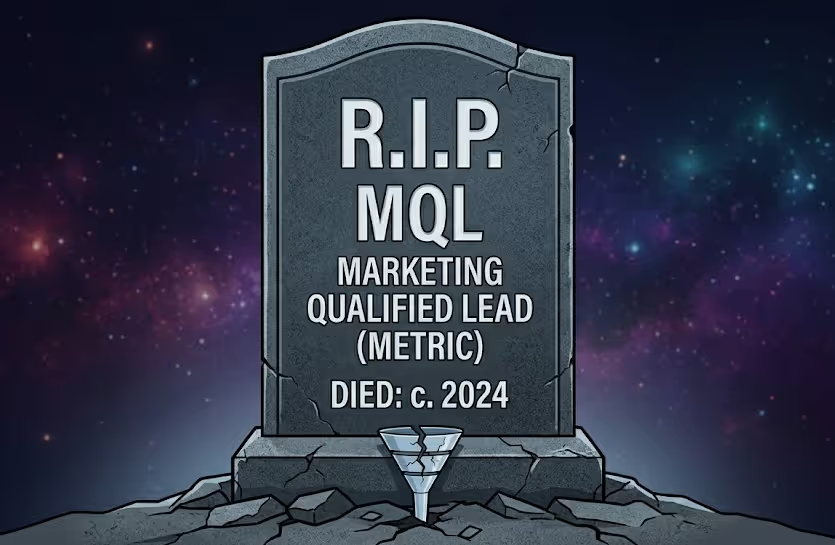
Someone downloaded a white paper. Someone attended a webinar. Someone clicked three emails. Someone visited a pricing page. Then marketing declared victory. The problem is not that those signals are worthless. The problem is that they are incomplete.
Worse, they often create a false sense of precision inside a buying journey that has become more anonymous, more fragmented, and more committee-driven.
Forrester has argued for years that the lead-centric revenue process is breaking down, noting that fewer than 1% of leads convert into closed deals in typical MQL-driven motions. That is not a small optimization problem. That is the scoreboard telling you the game has changed.
The old model assumed a neat progression:
Traffic
→ form fill
→ MQL
→ SQL
→ opportunity
→ revenue.
But modern B2B buying does not move in a straight line. It moves across Google, LinkedIn, Meta, review sites, dark social, Slack groups, podcasts, peer conversations, retargeting impressions, analyst content, sales touches, partner referrals, and anonymous website visits.
By the time a buyer raises their hand, the decision is often already halfway made.
Gartner reports that a majority of B2B buyers prefer a rep-free buying experience. That should terrify any marketing team still reporting success primarily in MQL volume. Because the buyer did not become interested when they filled out the form. The form fill was just the part you could see. LeadGenius research into the MQL vs. MQA gap maps exactly where that breakdown happens.
The New Metric Is Opportunity Created
The ultimate conversion metric for digital and ABM marketers should not be MQLs. It should be opportunity creation.
Not because every campaign can be reduced to last-touch pipeline math. Not because brand does not matter. And not because early-stage engagement is irrelevant. It is often where the deal is won.
But opportunity creation is the first moment where marketing activity becomes commercially legible. It is where anonymous interest, account engagement, buying group activity, and sales readiness turn into something the business can actually inspect.
A real opportunity tells you: Was this the right account? Did we reach the right people? Did the message create urgency? Did the audience strategy capture the buying committee? Did sales accept the context? Did the campaign create pipeline, not just activity?
That is the difference between a marketing metric and a revenue metric.
The Mistake Is Treating Opportunity Creation as a Single Event
Opportunity creation is not a button at the end of the funnel. It is the result of multiple checkpoints working together. The best ABM and digital teams will stop asking "How many leads did this campaign generate?" and start asking:
- Did this campaign reach the full buying group?
- Did we engage evaluators, decision-makers, technical validators, budget holders, and internal evangelists?
- Did we identify which accounts moved from passive awareness to active research?
- Did we know which stakeholders showed up before the form fill?
- Did we suppress existing pipeline and customers from wasted spend?
- Did we connect ad exposure, website behavior, CRM stage movement, and sales activity into one view?
That is where most teams break. They do not have a demand problem. They have a visibility problem.
Each platform optimizes for its own conversion event. None of them care whether the account becomes real pipeline. Google's own documentation explains that modern measurement increasingly relies on modeled conversions when direct observation is limited by consent and privacy restrictions. Useful, but it also reinforces the larger point: platform-reported conversions are not the same thing as revenue truth.
ABM Needs a Buying Group Model, Not a Lead Model
The MQL failed because it reduced a group decision to an individual action. But most meaningful B2B purchases are not made by one person. They are shaped by committees.
The person who fills out the form may not be the person who owns the budget. The person researching integrations may not be the person who signs. The person clicking ads may not be the person creating urgency internally.
A modern ABM strategy has to build audiences around the full opportunity path, not just the obvious lead source. That means creating audience coverage for:
- Marketing leaders who own pipeline
- RevOps leaders who own attribution and routing
- Sales leaders who care about qualified meetings
- Technical evaluators who validate fit
- Finance or procurement stakeholders who influence approval
- End users who feel the pain first
- Executives who need the strategic reason to act
The conversion is not the first hand raise. The conversion is when enough of the buying group has been reached, educated, retargeted, and activated that sales can create a real opportunity.
The Next Era of Digital Marketing Is Unified Attribution
Most B2B teams do not run one marketing program. They run three or four disconnected mini-economies. That structure made sense when digital marketing was channel-first. It does not work when the business needs to understand pipeline creation across the full buying journey.
Opportunity creation requires a unified view. A marketer should be able to answer:
- Which accounts saw ads across LinkedIn, Google, and Meta before opportunity creation?
- Which personas were reached inside those accounts?
- Which campaigns influenced the buying group, not just the form filler?
- Which landing pages created progression toward meetings?
- Which audiences created Stage 1, Stage 2, and Stage 3 pipeline?
- Which sources assisted revenue even when they did not get last-touch credit?
Without that view, budget allocation becomes theater. You are not optimizing toward pipeline. You are optimizing toward whichever platform tells the best story about itself.
The Future Scoreboard
The new digital marketing scoreboard should look more like this:
MQLs can still exist as an operational checkpoint. But they should not be the board-level proof of marketing performance.
The board does not care that 900 people downloaded a guide. The CRO does not care that LinkedIn produced cheaper leads than Google if none of them became pipeline. The CFO does not care that Meta drove engagement if the audience was wrong.
The question is simpler now: Did marketing create opportunities with the right accounts? Everything else is a diagnostic metric.
The Practical Takeaway
For digital and ABM marketers, the job is changing. The job is no longer just to generate leads. The job is to build the system that turns account insight into opportunity creation.
- Better audience data and stakeholder mapping
- Better signal capture and retargeting logic
- Better CRM alignment and cross-channel attribution
- Better reporting around pipeline, not activity
The MQL was built for a world where the form fill was the visible moment of intent. That world is gone.
The new moment of truth is opportunity creation. Not because it is perfect. Because it is the first metric that forces marketing to answer the question that actually matters:
Did we create real sales motion with the accounts we were supposed to win?
How leading B2B teams are moving beyond lead volume to measure what actually drives pipeline. Data, frameworks, and the case for account-qualified motion.
Read the report →Build the System That Creates Opportunities, Not Just Leads.
AdGenius unifies your paid media across LinkedIn, Google, and Meta with the account intelligence to drive real pipeline.
See AdGenius in Action.avif)