
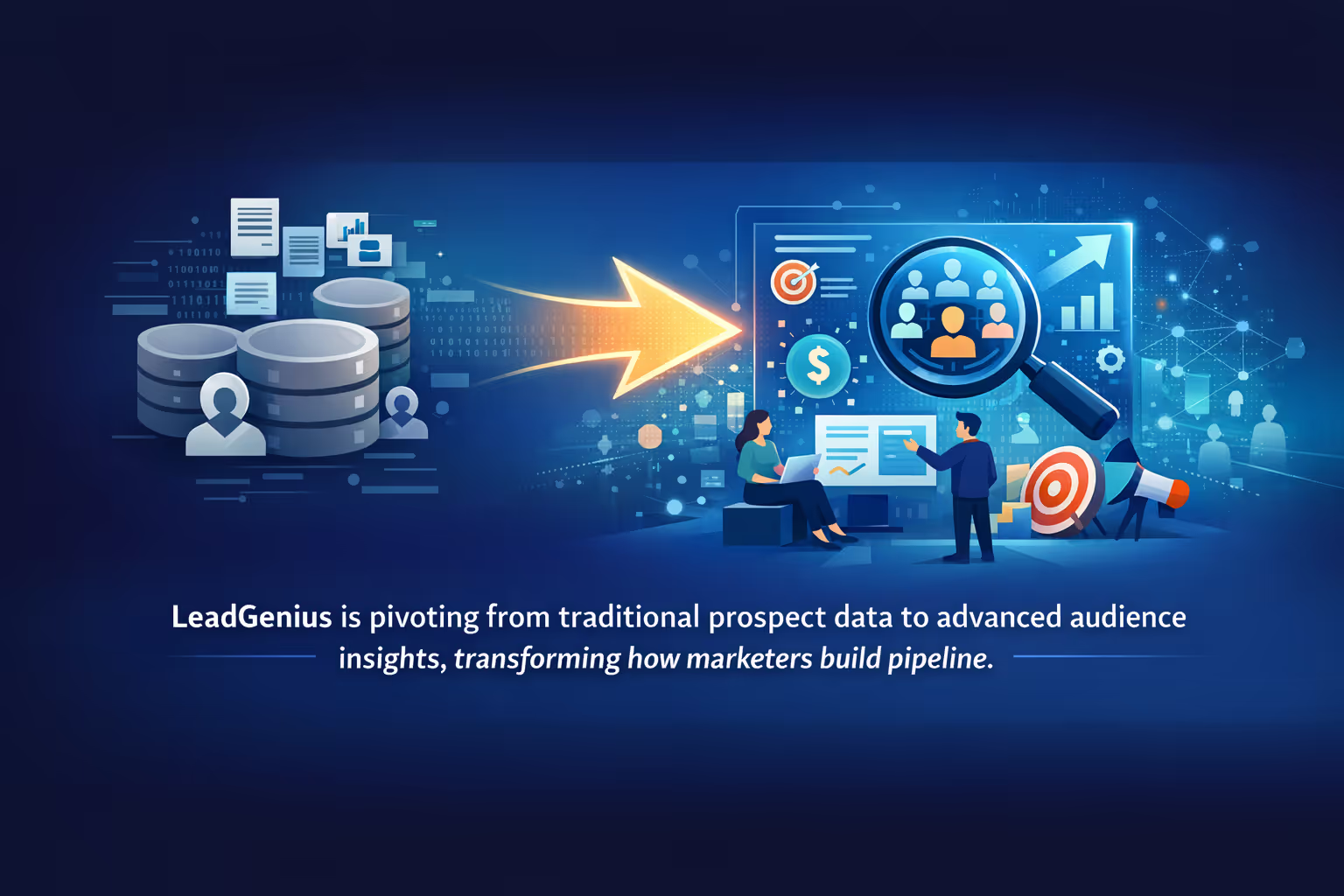
The Next Chapter for LeadGenius
Why our shift into audience data and AdGenius-powered activation is not a side project, not a packaging tweak, and not a polite little repositioning exercise — but a meaningful move closer to pipeline creation itself.
LeadGenius has always been strongest when the ask was harder: harder accounts, harder geographies, harder segmentation, harder signals. What changes now is not our ability to find precision data. What changes is where that precision gets deployed. We are moving from helping customers acquire records to helping them build audiences, activate smarter campaigns, and create more pipeline.
of B2B buyers actively avoid suppliers who send irrelevant outreach, according to Gartner research published by Gartner in 2025.
of B2B buyers prefer an overall rep-free buying experience, which makes better audience targeting and digital relevance more important, not less.
of marketers hit barriers to personalization, with data issues named as the most common culprit in Salesforce's 2026 State of Marketing research.
higher marketing ROI is one of the upside ranges McKinsey associates with effective personalization powered by better data and relevance.
There is a moment in every category when the old definition of value starts to crack.
Not all at once. Not with one flashy press release. Not with some grand declaration that everything is different now.
It starts when a thing that once felt differentiated begins to feel expected. Then familiar. Then interchangeable. The value migrates. The market gets noisy. New entrants show up with lower prices, AI wrappers, decent-enough outputs, and just enough confidence to make buyers wonder whether the old premium still makes sense.
That is exactly where the broader B2B data market is headed.
The future does not belong to whoever can warehouse the most data. It belongs to whoever can turn data into audience, audience into activation, and activation into pipeline.
That is why LeadGenius is making a real pivot.
Not away from precision datasets. Not away from bespoke research. Not away from the global, hard-to-source, hard-to-validate work that built this company.
But toward a more strategic layer of the revenue engine: audience data and AdGenius-powered activation designed to support deeper pipeline creation for marketing teams, performance marketers, agencies, and revenue leaders who need more than another static list.
And yes, it is a big move. Not quite as delightfully strange as a wool shoe company trying on an AI costume, but seismic nonetheless.
The old data category is splitting in two
One side of the market is racing toward commoditization: standard records, standard firmographics, standard enrichment, standard summaries, standard signals, all increasingly made easier to source, model, and package by AI.
The other side is becoming more valuable: dynamic audience construction, campaign-specific segmentation, timing-sensitive signals, channel-aware activation, and custom logic that helps marketers decide who to go after, why now, with what message, and in which motion.
That second category is where we want to live.
Why now? Because the economics of generic data are compressing while the value of relevance is rising. Gartner reported in 2025 that 73% of B2B buyers actively avoid irrelevant outreach and 61% prefer an overall rep-free buying experience. If buyers are spending more time researching independently and less time tolerating noise, the quality of the audience and the relevance of the message matter more than ever.
A list tells you who exists. An audience tells you who matters now.
A database helps you export names. An audience strategy helps you decide where spend should go, who should be suppressed, what creative should change, and which segments deserve more aggressive follow-up.
That is a much bigger lever on growth.
Why this matters to existing LeadGenius customers
For existing customers, this is not some awkward reinvention where we throw away the old playbook and pretend to be a different company. It is the natural extension of what has always made LeadGenius useful.
We have never been at our best when acting like a generic data vending machine. We have always been strongest when the requirement was specific, the market was fragmented, the targeting logic was nuanced, the geography was global, or the signal mattered more than the surface-level label.
Audience data is where that same muscle gets more valuable.
Because the conversation changes from:
- Can you find the right companies and contacts?
- Can you append this field or validate this record?
- Can you enrich this list a little more cheaply?
To:
- Can you help us define the market better?
- Can you isolate the best-fit audience for paid media, outbound, partner, or ABM motions?
- Can you connect data, timing, and activation so our campaigns waste less and convert better?
That is a more strategic question, and it leads to a better relationship than simple record fulfillment ever could.
Why this matters to CROs
If you are a CRO, this pivot should matter because the market keeps pretending pipeline problems are always sales execution problems. They are not.
Sometimes they are audience problems.
The wrong accounts. The wrong contacts. The wrong timing. The wrong geography. The wrong creative-to-segment fit. The wrong assumption about who the best buyers are. The wrong orchestration between digital channels and human follow-up.
No amount of heroic rep effort fixes bad audience strategy. It only makes bad assumptions more expensive.
Forrester wrote in 2026 that 73% of B2B purchases involve three or more departments, with an average of 13 internal people and 9 external participants influencing the decision. That is not a simple lead handoff problem. That is a buying-network problem — and it demands better audience design, better segmentation, and better relevance across the motion.
This is why the shift toward audience data is so important. It aligns LeadGenius much more directly with the actual questions CROs care about:
- Which accounts deserve concentrated effort?
- Which segments are more likely to convert efficiently?
- Where is paid media wasting money on poor-fit audiences?
- Which buying pockets need different messaging, not just more pressure?
- How do sales and marketing work from the same audience truth instead of two different spreadsheets and a prayer?
That is not just “better data.” That is better revenue design.
Why this matters to digital marketing leaders and agencies
Digital marketers are under brutal pressure right now. They are expected to drive efficient growth while channels get noisier, privacy gets tighter, attribution gets messier, and AI makes mediocre content cheaper by the hour.
That is exactly why this pivot matters.
Most traditional data vendors were built for a CRM-first world. They were designed to enrich records after the fact, not shape campaign performance before the money gets spent.
But marketing teams do not need more random data piled into the stack. They need audiences built around the variables that actually change performance:
- business model fit
- growth signals
- geography and expansion timing
- technology environments
- hiring patterns
- suppression logic
- creative relevance
- channel-specific buying conditions
That is why AdGenius matters in this next chapter. It is not just a product name. It is the connective tissue between data and demand creation.
Salesforce reported in 2026 that 75% of marketers have adopted AI, yet 84% still admit to running generic campaigns. The same research found that 78% need more personalized content than they can produce and 98% hit barriers to personalization, with data problems sitting at the center. The problem is not access to tools. The problem is usable context.
That is a gift to any smart marketing leader paying attention.
Because if the market is drowning in generic campaigns, then better audience logic becomes a competitive advantage. And if everyone has access to the same AI models, then the real edge shifts toward who has the best segmentation, the cleanest context, and the strongest activation strategy.
Why bespoke audience data wins in an AI-heavy market
AI is going to make standardization easier. That part is obvious.
It will make it easier to summarize companies, infer categories, enrich records, write copy, score accounts, and generate “insights” that look intelligent on first glance. Some of that will be genuinely useful. Some of it will be glorified wallpaper.
But that is exactly why bespoke audience data becomes more valuable, not less.
When everyone can generate a decent approximation, the premium shifts toward the teams that can generate a more relevant audience, a more defensible signal set, and a more usable go-to-market action plan.
McKinsey has argued that strong personalization can reduce customer acquisition costs by as much as 50%, lift revenue by 5% to 15%, and increase marketing ROI by 10% to 30%. Those gains do not come from “more data” in the abstract. They come from better relevance.
That is the bet.
Not that the old data market disappears. It will not. It will keep existing, and plenty of it will get cheaper.
But the highest-value part of the category will increasingly belong to partners who can turn data into targeting logic, targeting logic into activation, and activation into measurable pipeline outcomes.
This is not a retreat. It is a move closer to the money.
Some pivots are defensive. This one is not.
This is not a company running away from a harder market and slapping a new label on the homepage. It is a company recognizing that the center of gravity is moving and choosing to move there on purpose.
LeadGenius will still do what it has always done well: precision, customization, global coverage, hard-to-source intelligence, and differentiated account and contact datasets.
But increasingly, those capabilities will be used in service of a bigger outcome: helping customers build better audiences, activate smarter campaigns, and create more pipeline.
For existing customers, that means more strategic ways to use us. For agencies and digital teams, it means a stronger foundation for paid media and growth motions. For CROs, it means a partner closer to revenue creation and farther from generic data procurement.
What comes next
The companies that win the next era of go-to-market will not be the ones with the biggest pile of static data. They will be the ones that know how to identify the right audience, activate it with relevance, and convert that relevance into pipeline.
That is where this market is going. And that is where LeadGenius intends to lead.
Research notes
Public research cited in this article:
- Gartner, Gartner Sales Survey Finds 61% of B2B Buyers Prefer a Rep-Free Buying Experience, June 25, 2025. Used for the 61% rep-free buying preference and 73% irrelevant outreach avoidance statistics.
- Forrester, Three Realities About B2B Buying Networks, February 23, 2026. Used for the buying-network statistics on departments and stakeholders involved in B2B purchases.
- Salesforce, 75% of Marketers Have Adopted AI, Yet Still Use It to Send Generic Campaigns, February 19, 2026. Used for AI adoption, generic campaign, and personalization-barrier statistics.
- Salesforce, 5 Hard Truths From the Tenth State of Marketing Report, February 17, 2026. Used for the personalization-content gap and data quality / silo framing.
- McKinsey, What is personalization?, May 30, 2023. Used for customer acquisition, revenue, and ROI impact ranges associated with personalization.
.avif)