
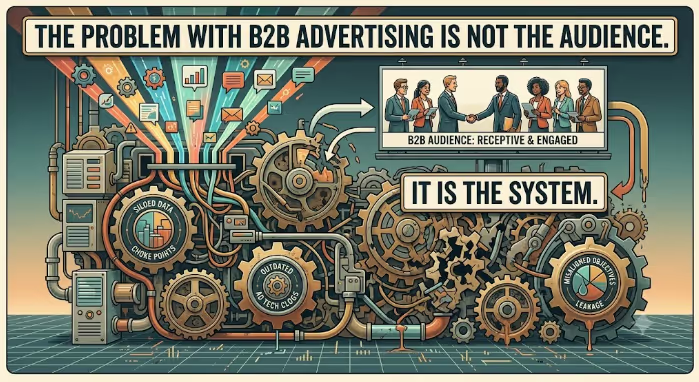
There is a thing that happens in B2B marketing that almost everyone knows is broken, but almost no one has a clean way to say it.
A team buys an audience. Maybe it comes from ZoomInfo. Maybe it is built in Clay. Maybe it is assembled from CRM data, website traffic, enrichment workflows, firmographics, technographics, intent signals, and a few heroic spreadsheets held together by somebody in marketing ops who deserves a raise.
Then the team pushes that audience into LinkedIn. Or Google. Or Meta. Or programmatic. Or all of them.
And then something strange happens. The audience, which began as one strategic idea, gets shattered into a dozen disconnected realities.
LinkedIn has its own version of performance. Google has another. Meta has another. Display has another. The CRM has another. The website has another. Sales has another. Finance, usually, has no idea which one to believe.
The campaign does not fail all at once. It fails more quietly than that. It fails in the space between systems.
It fails because the person who clicked the LinkedIn ad later searched on Google, returned through direct traffic, visited the pricing page, left without converting, saw a display ad three days later, opened an email, ignored the SDR, then finally came back and booked a demo. But by then, the buyer journey has been chopped into pieces. Each platform claims a fragment. No system understands the whole.
That is the actual crisis in B2B advertising right now. It is not that marketers cannot find audiences. It is that they cannot unify what happens after they find them.
This is the problem AdGenius is built to solve. And it is why AdGenius is not just another audience activation tool. It is a bet on a different future for paid media: one where performance is not managed channel by channel, dashboard by dashboard, vendor by vendor, but orchestrated as one connected system.
The audience is not enough
A lot of the current GTM data conversation is about audience construction. That makes sense. If you are trying to sell to HR leaders in mid-market manufacturing companies with a specific HRIS, or ecommerce sellers active on one marketplace but not another, or medspas using a specific software integration, audience quality matters. Bad audiences waste everything downstream.
But the market has overcorrected. It has started to treat audience building as the hard part and media execution as the easy part. Build the list, upload it to the walled garden, launch the campaign, optimize the creative, watch the dashboard.
That is the ClayAds and ZoomInfo-style model: build or source the audience, then push it into existing ad networks. There is value in that. But it is incomplete. Because the audience is only the beginning of the system. It is not the system itself.
The more important question is what happens after the audience is activated.
Who saw which message?
Which channel reached them first?
Which channel brought them back?
Which accounts showed buying behavior but never converted?
Which visitors should be suppressed?
Which ones should be routed to sales?
Which ones are worth retargeting across more than one channel?
Which campaigns are creating demand, and which are merely harvesting credit?
This is where most paid media programs begin to fall apart. Not because the marketers are bad. Because the infrastructure is bad.
B2B advertising has been built around channels. But B2B buying does not happen in channels. It happens across them.
Walled gardens create walled thinking
Every ad platform wants you to see the world through its dashboard.
LinkedIn wants to prove LinkedIn worked.
Google wants to prove Google worked.
Meta wants to prove Meta worked.
Programmatic wants to prove programmatic worked.
This is not a moral failure. It is an incentive structure. Each platform optimizes for itself. Each platform reports on itself. Each platform asks for more budget based on its own version of reality.
The problem is that buyers do not live inside those reporting lines. A CFO does not wake up and say, "Today I will be a LinkedIn-sourced lead." A VP of Sales does not think, "This white paper was clearly a view-through-assisted programmatic touch." A Head of Operations does not experience your brand as a sequence of UTM parameters.
They experience it as a series of impressions, signals, memories, searches, conversations, objections, reminders, and moments of relevance. The buying journey is cumulative. The reporting model is fragmented. That gap is where money gets wasted.
And in an environment where media costs are rising, sales teams are under pressure, buyers are harder to reach, and CFOs are asking harder questions about pipeline efficiency, that gap has become too expensive to ignore.
AdGenius is really an argument about unification
The simplest way to describe AdGenius is that it provides unified cross-channel retargeting across the channels B2B teams already use — social, search, CTV/OTT, video, audio, display, native, and more. But the deeper idea is more important.
AdGenius is an argument that paid media should not be managed as a set of disconnected campaigns. It should be managed as a coordinated performance system.
That means AdGenius can hook into the ad channels you already have, while also bringing additional channels online when the strategy calls for it. The point is not to force a company into a new media stack. The point is to connect the fragmented one it already has.
This sounds obvious. But it is not how most teams operate. Most companies still run retargeting like a series of isolated channel tactics — a LinkedIn retargeting campaign here, a Google remarketing campaign there, maybe a Meta audience, maybe some display, maybe some ABM ads, maybe some CRM suppression if marketing ops has time and the integrations do not break.
But there is rarely one unified view of the audience, the journey, the message, the spend, and the outcome. AdGenius changes that. It allows marketers to think less like channel managers and more like system designers. That is a very different kind of marketing.
Retargeting is usually where the waste is hiding
There is a strange irony in B2B advertising. Companies spend enormous amounts of money trying to create awareness among cold audiences, while often failing to properly convert the warm audiences they already have.
People visit the website. They view product pages. They read customer stories. They check out pricing. They land on demo pages. They compare competitors. They come back multiple times. They show all the signs of curiosity.
And then, in many cases, nothing intelligent happens. They are either ignored, retargeted generically, or thrown into a channel-specific nurture motion that does not understand who they are or what they did.
A homepage visitor gets treated like a demo-page visitor. A blog reader gets treated like a pricing-page visitor. A customer gets treated like a prospect. A closed-won account keeps seeing acquisition ads. A person who already booked a meeting keeps seeing "book a demo" creative. This is not just annoying. It is expensive.
Retargeting should be one of the highest-ROI motions in B2B marketing because the buyer has already raised a hand. Maybe not all the way. Maybe not enough to fill out a form. But enough to show intent.
The job of retargeting is to make that intent more durable.
To remind. To educate. To sequence.
To suppress. To escalate. To route. To convert.
But that only works if retargeting is unified across channels. If it is siloed, it becomes a chase. If it is unified, it becomes a strategy. That is the difference AdGenius is trying to make.
The Performance Blueprint is the missing layer
One of the most interesting parts of AdGenius is not the media execution itself. It is the Performance Blueprint. The Performance Blueprint matters because most paid media audits are either too shallow or too abstract.
They tell you what a platform is doing. They do not tell you what the system is doing. They recommend budget shifts. But they do not always explain where demand is leaking. They tell you to test more creative. But they do not show which audience segments deserve different treatment. They tell you to improve conversion rates. But they do not identify the precise pool of visitors, accounts, pages, and behaviors that should become the next campaign.
The Performance Blueprint is designed to answer a sharper question: where is demand already being created, and why is it not converting?
That is the question every revenue leader should care about. Because the highest-ROI opportunity is often not a new audience. It is the audience you already paid to attract but failed to move forward.
A proper Performance Blueprint looks across website behavior, ad account performance, CRM context, visitor-level signals, channel performance, funnel conversion points, landing page friction, audience quality, budget allocation, and 90-day KPI targets. It does not simply ask, "What campaign should we run?" It asks:
What is already working?
What is quietly failing?
Which visitors are most valuable?
Which channels are over-credited?
Which channels are under-used?
Which audiences should be sequenced?
Which should be suppressed?
Which should go to sales?
Which should get more media?
Which should get less?
That is why the Performance Blueprint is not just a report. It is a decision document. It gives marketing leaders something far more useful than a dashboard. It gives them a diagnosis.
Why the 90-day test matters
The 90-day test is important because marketing teams have been trained to accept ambiguity for too long. They are told brand takes time. Attribution is complicated. Sales cycles are long. The market is noisy. The data is imperfect. The funnel is nonlinear. All of that is true. But it can also become an excuse for not knowing whether the system is working.
AdGenius does not need a year to make the core argument visible. It needs a structured 90-day test.
Connect the ad channels. Install the pixel. Understand current performance. Identify retargeting pools. Analyze website behavior. Review CRM context. Find where demand is already being created.
Bring unified retargeting online. Build segments around actual behavior. Coordinate messaging across channels. Suppress the wrong audiences. Prioritize the right ones. Pair high-intent signals with sales action.
Shift spend toward what is working. Reduce waste. Improve the handoff between media and sales. Identify which audiences and channels are actually moving buyers forward.
At the end of 90 days, the business should be able to answer a very practical question: did unified cross-channel retargeting outperform the old siloed approach?
That is the right question. Not "Did LinkedIn work?" Not "Did Google work?" Not "Did the display campaign get clicks?" The question is whether the connected system produced better outcomes than the disconnected one.
The platform fee is not a small detail
AdGenius also makes a very different economic argument. It runs on a pure platform fee, not a percentage of ad spend. This may sound like a pricing detail. It is not. It is an incentive detail.
In a percentage-of-spend model, the vendor makes more when the client spends more. That does not automatically mean the vendor is acting badly. But it does create a structural tension. The client wants efficiency. The vendor benefits from scale. Those two things are not always the same.
A platform-fee model is cleaner. It says: pay for the system, then put your media dollars to work. Every dollar that is not extracted as a percentage-of-spend toll can stay in the market — buying impressions, clicks, reach, retargeting, tests, and learning.
The question becomes less, "Why does our partner make more every time we increase budget?" And more, "Is this platform helping our media dollars perform better?" That is the conversation revenue leaders actually want to have.
The shift from audience delivery to performance orchestration
The core difference between AdGenius and tools like ClayAds or ZoomInfo is not that one has audiences and the other does not. The difference is where the value is created.
Audience delivery says: here is who to target. Performance orchestration says: here is how to move the right audience through the right channels with the right message at the right time, while measuring the system as a whole.
That is a much higher-leverage idea. Because in modern B2B, the challenge is not simply finding accounts. It is converting attention into action.
It is knowing when a visitor should see a proof point instead of a product ad. It is knowing when a demo-page visitor should get an aggressive conversion message. It is knowing when a current customer should be suppressed from acquisition spend. It is knowing when an engaged account should trigger SDR follow-up. It is knowing when LinkedIn is creating awareness that Google later captures. It is knowing when programmatic is assisting conversion even if it does not get the last click. It is knowing when the budget mix is wrong because the system is optimizing for platform-reported success instead of revenue movement.
That is performance orchestration. And it is where the category is going.
The future of GTM data is not static lists
There is a broader point here about the future of go-to-market. The old data market was built around access. Who has the most contacts? Who has the biggest database? Who has the most direct dials? Who has the most company records?
That market is not going away. But it is becoming less interesting. The future is not just access to data. The future is custom intelligence, bespoke signals, and activation systems that adapt to the actual GTM motion.
In advertising, that means the audience is not a static file. It is a living system. It changes as people visit pages, consume content, move through the funnel, engage with ads, enter the CRM, become opportunities, become customers, or fall out of the buying cycle.
The companies that win will not be the ones with the largest audience file. They will be the ones with the best ability to turn audience behavior into coordinated action. That is what AdGenius is really pointing toward.
What revenue leaders should take away
For revenue leaders, the AdGenius argument is simple. You are probably already creating more demand than you are converting.
Some of that demand is hiding in website traffic. Some of it is hiding in demo-page visits. Some of it is hiding in returning visitors from target accounts. Some of it is hiding in abandoned journeys that your current retargeting motion does not understand.
The answer is not always more spend. Sometimes it is better unification. Better sequencing. Better suppression. Better channel coordination. Better audience segmentation. Better measurement. Better routing to sales. Better diagnosis before scale. That is what AdGenius brings together.
It hooks into the channels you already use. It can bring more channels online. It unifies audience data. It coordinates cross-channel retargeting. It provides reporting and attribution across the journey. It produces a Performance Blueprint that shows where demand is leaking and how to act. It gives you a 90-day test to prove the model. And it does it with a pure platform fee, so media dollars stay focused on media.
- Build an audience.
- Upload it into a channel.
- Hope the dashboard looks good.
- Unify the audience.
- Connect the channels.
- Diagnose the funnel.
- Retarget intelligently.
- Suppress waste.
- Coordinate the journey.
- Measure the system.
- Prove the outcome.
That is the real shift. AdGenius is not just changing how B2B companies retarget. It is changing the unit of analysis.
Not the click.
Not the channel.
Not the uploaded audience.
Not the dashboard.
The system.
Connect with a strategist →
.avif)