The SMB Data Renaissance: Why the World's Smartest GTM Teams Are Finally Cracking the Long Tail
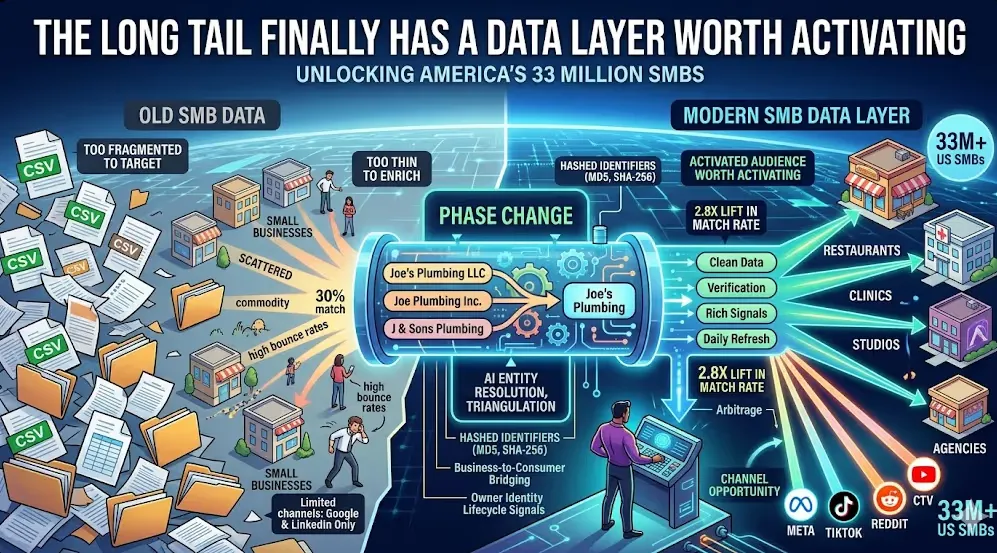
For twenty years, targeting small businesses at scale was a data problem no one could solve. Entity chaos, phantom records, and stale addresses made SMB the swamp every enterprise GTM team had to wade through. That era is over. Here's what changed — and how modern data infrastructure is finally turning the long tail into an activatable audience.
If you run demand generation or RevOps at a B2B SaaS company selling into small business — whether that's HR tech, accounting, payroll, POS, back-office ops, or any platform where "the SMB" is your core ICP — you already know the dirty secret of this market: the data has always been terrible.
Not bad in the way enterprise data is bad (outdated titles, duplicate records, wrong phone numbers). Bad in a fundamentally different way. SMB data is bad because the category itself is a moving target. Businesses form and dissolve in a matter of months. Registered agents mask true operators. Legal names bear no resemblance to the DBA above the storefront. The person running the business on Tuesday may have sold it by Friday. A single franchise brand can have 4,000 independently-owned locations, each a legal entity unto itself.
So the industry did what the industry does: it gave up on activating the long tail and pretended the only SMBs worth selling to were the ones that happened to have a strong LinkedIn presence. The rest — millions of sole proprietors, emerging LLCs, independent operators, newly-registered agents — were written off as unreachable.
That assumption was always wrong. And in 2026, it's finally being dismantled.
How Big Is the Opportunity Everyone Has Been Ignoring?
Start with the raw numbers. There are roughly 33 million small businesses in the United States. Sole proprietorships alone account for about 13 million of them. LLC formation has been accelerating for a decade; nonemployer firms have grown by more than 80% since the late 1990s. Weekly business application filings tracked by the Federal Reserve Bank of St. Louis routinely exceed 130,000 new entities.
If you sell an HRIS, accounting platform, point-of-sale, scheduling tool, inventory system, restaurant back-office product, or any SaaS whose buyer is a 5-to-500 person operation, this is your TAM. Not the 400,000 mid-market and enterprise accounts everyone else is chasing on LinkedIn. The other 32.6 million.
The problem was never demand. The problem was data.
What SMB Data Used to Be
To appreciate where we are now, you have to remember where the industry was even three or four years ago. The typical "SMB data" vendor offered one of three things:
SMB Data: 2015–2022
- D&B/Experian files scraped from credit bureau exhaust — accurate for legal-entity status, useless for buyer identification
- Web scrapes of business directories (Yelp, Yellow Pages) with 40–60% stale-rate within a year
- LinkedIn-derived firmographics that systematically excluded any owner who wasn't actively posting
- Industry-specific lists ($2–4/record) built manually and obsolete on arrival
- No consistent entity resolution between legal name, DBA, registered agent, and owner
- Match rates to ad platforms (Meta, Google Customer Match) in the 15–25% range — unusable for activation
- Audience building meant LinkedIn. That was the whole strategy.
SMB Data: 2024–Now
- Primary-source ingestion directly from all 50 Secretaries of State, plus international registries across 130+ jurisdictions
- AI-driven entity resolution unifying legal name, DBA, officers, registered agents, and filing history into a single persistent ID
- Weekly refresh cadences tracking new formations, dissolutions, address changes, and officer turnover in near real time
- Hashed email (HEM) and NANP phone coverage that pushes match rates to ad platforms into the 55–75%+ range
- Consumer-graph overlay connecting business owners to household, demographic, financial, and behavioral attributes
- Audience layer data engineered for direct activation in Meta, TikTok, YouTube, Reddit, CTV, and programmatic DSPs
- Triangulation logic: SoS filing + consumer identity + digital ad behavior + firmographic enrichment, reconciled in one graph
The thing that changed isn't just more data. It's the entity resolution underneath. For years, the industry could see that Jane Doe owned "Doe Enterprises LLC" in Delaware and also appeared to be the registered agent for "Jane's Cafe" in Arizona. But tying those two records to the same operator — and then connecting her to a verified business email, a consumer identity, and a devicegraph — required a reconciliation layer that simply did not exist at commercial scale.
AI-driven entity resolution changed that. Large language models are exceptionally good at the messy, fuzzy string-matching and contextual reasoning that entity resolution requires. The combination of deterministic rules (exact matches on EIN, address, agent) and probabilistic inference (name similarity, filing co-occurrence, address geocoding) now achieves match confidence scores north of 0.9 on use cases that were complete non-starters five years ago.
From Filings to Activatable Audiences: The Modern SMB Data Stack
Here's what a modern SMB data pipeline actually looks like — the one GTM teams are quietly standing up behind the scenes to feed their paid media, outbound, and lifecycle programs.
Data Enrichment Flow: Filing to Audience
Ingest from Primary Sources
Direct scrape of all 50 U.S. Secretaries of State plus 130+ international corporate registries. Captures company number, jurisdiction, legal entity type, incorporation date, dissolution date, registered agent, and filing history for every registered business.
Normalize and Deduplicate
LeadGenius-normalized legal names strip entity suffixes (LLC, Inc., Corp.), reconcile branch and parent entities, track previous names and DBAs, and merge duplicate registrations across jurisdictions using a composite key on company_number + jurisdiction_code.
Resolve People and Relationships
Officers, agents, beneficial owners, and directors are linked via persistent person UIDs across their multiple filings. Corporate relationships — subsidiaries, branches, control statements, share parcels — are mapped into a unified graph.
Triangulate with Business Contact Data
Business phone (NANP 10-digit), business email (MD5/SHA-256 hashed), and officer contact details are attached where available. LeadGenius layers in firmographics: employee counts, industry codes, non-registered addresses, financial filings, and compliance signals.
Overlay the Consumer Graph
For owner-operators and sole proprietors, business records are linked to consumer identity with 500M+ persistent IDs spanning 16 attribute categories: Automotive, Behavioral, Consumer Interest, Demographic, Donor Behavior, Financial, Geographic, Household Composition, Interests, EAGLES, Lifestyle Segments, Occupations, Political, Reading, Real Estate, and Transactional.
Activate as Audience Segments
Hashed identifiers push directly into Meta, TikTok, YouTube, Reddit, Google Customer Match, LinkedIn Matched Audiences, and programmatic DSPs. Same segments feed outbound sequences, enrich CRM records, and drive personalized landing pages — all from the same underlying graph.
What That Unlocks for Marketing and RevOps
The practical implication for a marketing leader at, say, a payroll platform selling to 10-to-200 employee businesses: you can now build a targeted audience of U.S. restaurant LLCs incorporated in the last 24 months whose registered agents are the owner-operators, layered with household income and likelihood-to-own-a-franchise signals, and push that as a Meta Custom Audience with match rates in the 60%+ range. Five years ago, that campaign could not have been run at all.
For an HR tech company: build a segment of professional services firms with 25–100 employees, recent officer changes, and a registered business email, activate it across LinkedIn, YouTube, and CTV simultaneously, and suppress any account already in your CRM. The audience refreshes weekly as new filings come in and stale records drop out.
For a vertical SaaS targeting brick-and-mortar retail: identify newly-registered specialty retail LLCs in high-growth ZIPs, correlate with commercial real estate filings and owner demographic data, and run creative that speaks directly to first-year-of-business pain points. The data supports the targeting; the targeting supports the creative; the creative finally has a place to land.
Coverage: What a Complete SMB Dataset Actually Contains
Most buyers of SMB data underestimate the field depth of a modern corporate graph. Here's what comes through in a fully-built dataset — the kind used by enterprises running SMB-focused GTM programs at scale.
Company Core
Legal name, normalized name, previous names, jurisdiction, entity type, incorporation and dissolution dates, current status, inactivity flags, business phone, hashed business email, registered address, industry codes, latest financials.
Officers & Agents
Full name, position, start/end dates, nationality, country of residence, partial date of birth, occupation, contact address, persistent person UID, officer email (hashed), officer mobile phone.
Filings & Compliance
Every statutory filing with date, title, description, type, and source URL. Annual return status, account due dates, insolvency history, liquidation flags, charges — the signals that reveal business health.
Relationships
Control statements, subsidiaries, branches, and share parcels. Min/max ownership percentages, voting rights, number of shares, start and end dates — the corporate-structure graph needed for account-based targeting at parent-child level.
Consumer Identity
Persistent individual and household IDs across all U.S. consumer records. Full PII, geographic data to ZIP+4 and Census Block Group, CBSA, FIPS codes, latitude/longitude — activation-grade geo at scale.
Consumer Attributes
Sixteen categories: Automotive, Behavioral, Consumer Interest, Demographic, Donor Behavior, Financial, Geographic, Household Composition, Interests, EAGLES, Lifestyle Segments, Occupations, Political, Reading, Real Estate, Transactional.
The Channel Opportunity Matrix: Where SMB-Focused Advertisers Are Leaving Money on the Table
Here's where things get interesting for marketing leaders. Once you have activatable SMB audience data, the question becomes: where do you deploy it? And the answer is almost never "where everyone else already is."
Industry data shows B2B advertisers concentrating the overwhelming share of paid spend on LinkedIn and Google Search — roughly 76% of B2B paid budgets between those two channels alone, per late-2024 benchmarks. Meta, TikTok, Reddit, YouTube, and CTV collectively get the leftovers. For SMB-focused platforms this is strategically upside-down. Small business owners spend time on the platforms their customers are on — which means Meta, TikTok, YouTube, and Reddit over-index, not LinkedIn.
Approximate B2B paid media allocation based on 2024 LinkedIn Ads benchmarks and industry reports. Percentages sum above 100 due to overlapping channel inclusion in source surveys.
The arbitrage is structural. Most B2B SaaS targeting SMBs never built the audience data to activate outside LinkedIn, so they just didn't. When you finally can — because you have 500M consumer IDs tied back to business entities — you discover that CPMs on Meta, TikTok, and Reddit are a fraction of LinkedIn's, and the audiences you can build there are far less saturated.
Use Cases: What GTM Teams Are Actually Doing with This Data
| Use Case | Data Layer Applied | Activation Channel | Why It Works Now |
|---|---|---|---|
| New-formation outreach | SoS filings, officer contact, hashed email | Outbound Direct Mail | Businesses incorporated in the last 90 days are prime for first-time HR, accounting, and banking tools |
| Owner-operator lookalikes | Officer identity + consumer graph | Meta TikTok YouTube | Build seed audience from customers; LAL against 500M consumer IDs with business linkage |
| Vertical account lists | Industry codes + non-registered addresses | ABM Programmatic | Restaurant chains, specialty retailers, fitness studios — full location graph with DBAs resolved |
| Competitor-churn targeting | Officer turnover + filing recency signals | Outbound Meta | Recent CFO/controller changes at SMBs correlate with software replacement cycles |
| Franchise expansion | Relationships graph (subsidiaries, branches) | ABM | Parent-child resolution lets you pitch the corporate entity while targeting individual units |
| International SMB expansion | 130+ jurisdictions outside the U.S. | Outbound Meta Local | Same entity-resolution logic applied to UK Companies House, Canadian provincial registries, EU equivalents |
Quality Signals: What to Look For in an SMB Data Partner
Not all SMB data is created equal. Any provider can hand you a spreadsheet of 20 million LLCs; very few can hand you a spreadsheet of 20 million LLCs that are active, reachable, and resolvable back to a human buyer. A few diligence questions that separate the real from the repackaged:
- Where does the data originate? Primary-source scraping from Secretary of State registries is the gold standard. Reselling credit bureau files or Yelp exhaust is not.
- What's the refresh cadence? Monthly is table stakes. Weekly delivery is the current bar for audience activation. Daily feeds are emerging for time-sensitive plays like new-formation outbound.
- How is entity resolution handled? Ask about the match rate methodology, confidence scoring, and how previous names, branches, and foreign registrations are reconciled. Vendors who can't answer this are working from flat files.
- Can the data actually activate? Match rates to Meta, Google Customer Match, and LinkedIn Matched Audiences should be in the 55%+ range for SMB owners. Anything below 40% means the underlying identity graph isn't there.
- What's the international coverage? If you plan to expand, check jurisdiction counts. A provider with only U.S. coverage will become a constraint the moment you enter Canada, the UK, or Europe.
Why LeadGenius Has Been Doing This for Fifteen Years
LeadGenius has been building bespoke data for the world's most sophisticated GTM teams since long before "SMB audience activation" was a category. Enterprise platforms that target small businesses — including some of the most recognizable names in HR tech, fintech, payments, and vertical SaaS — have relied on LeadGenius to assemble the datasets their competitors couldn't find, maintain them at scale, and reconcile them into something activatable.
The core capability is unchanged: assemble data from primary sources, triangulate it with proprietary enrichment, resolve it at the entity and person level, and deliver it in a format that plugs into the customer's GTM stack. What has changed is what that stack looks like.
Five years ago, "delivery" meant a CSV going into a CRM. Today, it means a bulk dataset feeding a CDP, a reverse-ETL pipeline pushing segments into ad platforms, a weekly delta file of newly-registered entities triggering outbound, and a consumer-graph overlay enabling lookalike modeling across Meta, TikTok, and CTV simultaneously. Same underlying data discipline. Entirely different activation surface.
Whether the use case is U.S. sole proprietorships, newly-registered LLCs in emerging markets, international corporate entities across 130+ jurisdictions, or the full consumer graph layered on top — the platform is engineered to handle it. Delivery cadences scale from quarterly bulk to monthly to weekly. Delivery formats scale from flat files to APIs to direct audience sync into Meta, TikTok, Google, and LinkedIn.
A Few Things GTM Teams Ask About Most
The hardest part of SMB targeting has always been that by the time you've bought the list, half of it is already wrong. Weekly refresh from primary sources is the only way to stay current.
We used to think SMB audiences just couldn't match on Meta. Turns out they match fine — we just didn't have the underlying consumer graph tying the business owner back to a household. Once that's in place, CPAs drop 40–60%.
International SMB is a graveyard for most data vendors. The jurisdictions are fragmented, the formats are inconsistent, and the entity types don't map cleanly. You need a platform that has actually ingested UK Companies House, Canadian provincial registries, and EU equivalents — not one that says it can.
The Takeaway
The SMB market has always been the biggest, most underserved segment in B2B. What changed is that the data infrastructure finally caught up. Secretary of State filings, AI-driven entity resolution, consumer-graph overlays, and activation-ready audience layers have collectively turned an unreachable TAM into something you can actually run a campaign against.
For marketing and RevOps leaders at B2B SaaS companies targeting SMBs — HR tech, accounting, ops, back-office, restaurant tech, retail platforms, fintech — the implication is direct. The teams who build their data and audience foundation on primary-source, triangulated, activation-ready infrastructure are the ones who escape the LinkedIn-and-Google duopoly, activate across the channels their competitors have abandoned, and compound an advantage in a market where 32 million businesses are still waiting to be reached.
That's the renaissance. And it's happening now.
Ready to see what your SMB audience graph actually looks like?
LeadGenius works with the world's most sophisticated B2B GTM teams to build, enrich, and activate proprietary SMB datasets — domestic and international, from Secretary of State filings to fully activation-ready audience segments. Talk to a strategist about your ICP, your current data gaps, and what a modern SMB data stack could unlock for your pipeline.
Connect with a Strategist →