
There Are No Silver Bullets in Demand Generation. There Are Only Basis Points.
Modern demand gen isn't transformed by one tactic. It's transformed when the system stops leaking. A look at the hidden waste in B2B marketing — and what compounds when you stop fixing the wrong things.
There is a fantasy at the center of modern demand generation. It is the fantasy that somewhere out there, usually behind the next software purchase or channel experiment, there is a single move that will fix the pipeline problem.
A new AI outbound tool. A new paid channel. A new attribution model. A new intent vendor. A new campaign framework. A new landing page. A new webinar series. A new "growth motion."
The fantasy is appealing because it suggests the problem is tactical. It suggests the gap between where pipeline is and where it needs to be is a matter of finding the missing play. And that is comforting, because missing plays can be bought, copied, or assigned to someone by Friday.
But most demand generation problems are not solved that way. They are not solved by one big breakthrough. They are solved by a hundred smaller corrections. A little less wasted spend. A little more audience precision. A little clearer positioning. A little better buyer timing. A little more proof. A little more discipline around the channels already being funded.
This is a frustrating truth because it does not sell very well. "We found seven places where we are wasting money and fixed them" is not as exciting as "We launched a new AI-powered revenue engine." But in practice, the former often matters more.
Every marketing organization has a ceiling. That ceiling is set by forces marketing cannot fully control: product-market fit, category urgency, budget, brand awareness, competitive intensity, sales execution, macroeconomic conditions, and whether the buyer actually believes the problem is worth solving now.
But inside that ceiling is a question every demand gen leader can control: how much of the available opportunity are we wasting?
That is the real work. Not just creating more demand, but losing less of the demand that already exists. Not just increasing spend, but making every dollar less stupid. Not just producing more leads, but finding the accounts, people, moments, and messages that have a plausible chance of becoming revenue.
The best demand gen teams are not always the teams with the biggest budgets. They are the teams with the least leakage. They understand where targeting breaks. They know where ad platforms overcharge. They know where job title filters lie. They know where websites confuse buyers. They know which keywords create pipeline and which create decorative form fills. They know the difference between content that fills a calendar and content that changes a buying conversation.
This is the quieter discipline of demand generation. It is not glamorous. It is incredibly powerful.
The First Leak Is Usually the ICP
Every company says it knows its ICP. Almost none of them operationalize it well.
This is one of the great hidden failures of B2B marketing. The ICP exists in the strategy deck. It sounds sharp in the kickoff meeting. It is usually described with real conviction: company size, industry, geography, revenue band, buying committee, pain points, technology environment, maybe a few named customer examples.
Then it gets handed to an ad platform. And suddenly the ICP becomes "software companies with 200 to 1,000 employees."
That is not an ICP. That is a category approximation.
The problem is not that marketers do not know better. The problem is that most of the systems they use are built around blunt translation. Native ad platforms, CRM filters, and prebuilt data providers flatten the complexity of a real market into a few crude fields: industry, employee count, revenue, location, seniority, department.
These things matter. But they are not enough.
Two companies can look identical inside a database and behave completely differently in the market. They can share an industry code and have totally different buyers, budgets, growth rates, sales motions, technology stacks, and strategic priorities.
A company selling developer infrastructure is not the same as a company selling consumer productivity software. A venture-backed firm hiring aggressively into enterprise sales is not the same as a bootstrapped firm serving SMBs with no expansion motion. A company opening new locations is not the same as one quietly shrinking. A company hiring implementation specialists, RevOps leaders, and compliance staff is telling you something very different from a company hiring only support reps.
The database says they are similar. The market says they are not.
When the ICP is translated poorly, everything downstream gets worse. Paid media wastes impressions. Outbound wastes rep time. Content reaches the wrong audience. Sales loses trust in marketing. Pipeline looks busy but weak. Everyone starts arguing about lead quality when the real problem happened much earlier: the system never knew who it was supposed to reach.
The fix is not simply "better targeting." It is a richer definition of fit. Demand gen teams need to move beyond basic firmographics and begin incorporating account signals that reveal actual commercial relevance: hiring trends, funding, product launches, new locations, ecommerce activity, marketplace presence, technographics, ownership changes, regulatory exposure, category-specific behaviors, and signs of growth or operational change.
This is where the old data model starts to break. Prebuilt databases are good at telling you who exists. They are much weaker at telling you who matters right now.
The future belongs to custom insight layers: bespoke data models that translate the real ICP into observable signals. Not "find me software companies." Find me companies that look like our best customers, behave like they are entering a buying window, and show evidence of the specific pain we solve.
That is the difference between a larger audience and a sharper one. And in most mature demand gen programs, sharper beats larger.
The Second Leak Is the Person
Even if you get the account right, you can still get the person wrong.
This sounds obvious, but it is astonishing how much B2B media spend depends on the assumption that title targeting works better than it does.
LinkedIn title filters are inconsistent. People describe the same job in wildly different ways. Seniority is messy. Functional responsibility does not always map neatly to title. Meta has almost no meaningful B2B title layer. Google captures intent, but often has no idea whether the searcher is a buyer, a student, a consultant, a junior employee, or a competitor.
So a campaign can technically reach target accounts while still missing the people inside those accounts who matter.
That matters because buying committees are not interchangeable. The CFO does not care about the same thing as the operator. The RevOps leader does not care about the same thing as the CRO. The HR manager does not care about the same thing as the CEO. The practitioner may feel the pain most sharply, but the executive may own the budget. The economic buyer may approve the purchase, but the internal champion may create the urgency.
If your campaign reaches the wrong person, your message may be true and still fail.
This is one of the reasons paid media performance often disappoints. Teams think they have an offer problem or a creative problem when they actually have a contact-resolution problem.
The right best practice here is simple: audit who is actually seeing and converting from your campaigns. Not who you intended to reach. Who you actually reached.
Pull demographic reports. Look at job titles. Look at seniority. Look at function. Look at the contacts sales accepted and rejected. Look at whether form fills map to the buying committee you actually need.
Then ask the uncomfortable questions:
- Are we paying premium CPMs to reach low-authority audiences?
- Are we reaching individual contributors when we need budget owners?
- Are we only reaching executives and missing the operators who feel the pain?
- Are we targeting titles that sound right but do not actually map to responsibility?
- Are we building campaigns for personas the platform can identify, rather than the personas that drive the deal?
This is where ABM needs to grow up. The future of ABM is not account targeting. It is buying-committee targeting. Not just "this company is in our ICP," but "these are the specific people, in the specific roles, with the specific likely influence, across the specific channels where we can reach them."
That requires better data than most platforms provide natively. It requires enrichment. It requires CRM intelligence. It requires custom research. It requires seeing the buyer not as a title filter, but as a human being embedded in a decision system.
Paid Media Cannot Fix a Confusing Story
There is another leak that often hides in plain sight: the website.
A company spends months optimizing targeting, bids, creative, and channel mix. It gets the right person from the right account to the site. The buyer arrives. And then the site fails to explain what the company does.
This happens constantly. The homepage is elegant but vague. The headline is aspirational but unclear. The product description is full of category language no buyer would use. The differentiation is implied rather than stated. The proof is buried. The CTA appears before the buyer understands why they should care.
The visitor leaves. Marketing calls it a traffic quality problem. It was a positioning problem.
This is why website positioning is not a brand exercise. It is a demand gen efficiency lever. A confusing site taxes every channel. It raises bounce rates. It lowers conversion rates. It weakens retargeting pools. It forces ads to explain too much. It makes sales calls start from zero. It causes qualified buyers to self-disqualify because they cannot figure out whether the product is for them.
The first ten seconds matter. A buyer should quickly understand what you do, who it is for, what painful problem it solves, why your approach is different, what outcome they can expect, and why they should believe you.
That sounds basic because it is basic. And because it is basic, many companies skip it. They want the clever line. The elevated narrative. The category language. The homepage that sounds like everyone else in the Gartner Magic Quadrant.
But clarity is not the enemy of sophistication. Clarity is what makes sophistication useful. Before scaling traffic, fix the story.
Content Has to Do a Job
A lot of B2B content is good in the way a well-organized conference panel is good. It is reasonable. It is polished. It contains ideas. Nobody is embarrassed by it.
But it does not change anything. It does not create urgency. It does not explain the cost of inaction. It does not introduce a problem the buyer had not fully named. It does not connect to the product in a way that feels natural. It does not help sales. It does not create a next step.
It exists. And in modern demand gen, content that merely exists is expensive.
The better test is not whether content is "good." The better test is whether it performs a role in the buying system:
- Does it attract the right person?
- Does it teach the market something useful?
- Does it reveal a problem your product is uniquely suited to solve?
- Does it arm a champion?
- Does it create internal urgency?
- Can it be distributed through paid, organic, sales, email, partners, retargeting, and outbound?
- Does it create a more valuable conversation than the buyer was having before they read it?
The strongest demand gen content is product-relevant without being product-obsessed. It teaches the market something true and, in doing so, makes the company's solution feel necessary.
A generic article about data quality might get traffic. An article explaining why prebuilt databases fail in LATAM expansion creates a buying frame. A generic post about sales productivity might get clicks. A piece showing how bad account selection wastes SDR capacity creates urgency. A generic guide to ABM might perform fine. A report showing how specific account signals predict readiness to buy gives sales and marketing a new operating model.
The best content does not simply answer a search query. It changes the buyer's understanding of the problem. That is when content becomes pipeline infrastructure.
Sometimes the Platform Is Just Taking Your Money
Demand gen teams also need to be more honest about platform incentives.
LinkedIn is a valuable channel. It is also an expensive one. And like every ad platform, it is designed to spend your budget. That does not make it bad. It makes it a marketplace.
The problem comes when marketers confuse platform automation with business optimization. Automated bidding, maximum delivery, and recommended bid ranges are convenient. But they are not neutral. They optimize for delivery inside the platform's system, not necessarily for your pipeline economics.
Pausing campaigns during weekends and after-hours periods — when B2B decision-makers aren't browsing — typically recovers 20–30% of LinkedIn budget. Most teams never enable dayparting.
Sometimes the most valuable thing a demand gen team can do is refuse to overpay. Manual bidding is not exciting. It will not be the subject of a keynote. But it can materially change campaign efficiency.
Start lower than the recommended range. Increase slowly. Find the point where delivery becomes acceptable without surrendering margin to the auction. You are not trying to win every impression. You are trying to win enough of the right impressions at a price that makes sense.
This is particularly important in narrow audiences: executives, technical buyers, enterprise accounts, or ABM lists where every impression is expensive.
There is a larger lesson here. Modern demand generation requires financial discipline at the tactical level. Not just "what channel should we fund?" but "what is the platform charging us to reach this buyer, and is that price justified by what happens down-funnel?" That is the difference between running campaigns and managing a portfolio.
Outbound Is Becoming a Timing Discipline
For years, outbound advice has obsessed over messaging. Better subject lines. Better personalization. Better openers. Better CTAs. Better sequences.
That all matters. But timing matters more.
At any given time, only 3–6% of your total addressable market is actively buying. The other 94–97% are either not in market, already locked into another solution, or unaware they have the problem. The teams winning outbound aren't writing better cold emails. They are finding the small slice of the market where timing, pain, and fit overlap — and reaching it before competitors do.
This is the logic behind micro-campaigns. Instead of large, generic outbound motions, micro-campaigns focus on small groups of accounts that have a specific reason to care now:
- A company just raised funding.
- A new executive joined.
- A hiring spike suggests expansion.
- A new market opened.
- A company launched a product.
- A competitor was displaced.
- A regulation changed.
- A location opened.
- A negative news event created operational pressure.
The play is not complicated. Find the signal. Build the list. Write the message around the moment. Make a relevant offer. Repeat every week.
The hard part is not the copy. It is the data. This is where AI and custom data become powerful, but not in the way people often describe. The real value is not having AI write fake personalization at scale. The value is using AI and custom research to find the pockets of the market where timing, pain, and fit overlap.
Outbound performance is increasingly a data problem before it is a copywriting problem. The teams that understand that will build smaller lists and get better results. The teams that do not will keep asking SDRs to personalize bad accounts.
Incentives Work, Except When They Don't
Incentivized demos are one of those tactics everyone has a strong opinion about.
The critics are right: incentives can create junk. They can attract people who want the gift card, not the conversation. They can inflate demo volume while lowering quality. They can annoy sales. They can make marketing look better in the dashboard while making the business worse.
But the defenders are also right: incentives can work. The question is not whether incentivized demos are good or bad. The question is where they are being used.
Used against broad, cold audiences, they are usually dangerous. Used against high-fit, bottom-of-funnel audiences, they can accelerate action.
That distinction matters. A gift card should not be used to manufacture demand where none exists. It can be used to reduce friction for someone who already matches the ICP, has shown intent, visited high-value pages, engaged with comparison content, or entered a buying-relevant segment.
The right test is not "should we run incentivized demos?" The right test is "does an incentive improve qualified demo conversion among buyers who are already worth talking to?"
Measure show rates. Sales acceptance. Opportunity creation. Pipeline quality. Close rates. Cost per opportunity. Cost per dollar of pipeline. Treat it like an experiment, not a religion.
That is the posture demand gen needs more broadly: less moralizing about tactics, more precision about context.
Customer Proof Should Not Be Buried
Most companies underuse their customers. They write a case study. Put it on the website. Maybe announce it once on LinkedIn. Then it sits there, waiting for a buyer to discover it.
This is strange, because customer proof is one of the most powerful assets in B2B marketing. Buyers trust other buyers. They trust evidence. They trust specificity. They trust stories where someone like them had a problem like theirs and solved it.
The best teams do not treat customer proof as a static asset. They turn it into an operating system. Customer stories become LinkedIn posts, short videos, sales snippets, webinar segments, ad creative, retargeting assets, landing page proof, founder interviews, before-and-after breakdowns, and internal champion enablement.
This is especially important for companies selling something abstract or custom. Custom data is a good example. It can sound theoretical until a buyer sees the use case. "We can build bespoke audiences" is a claim. "We helped identify SAP BW customers, ecommerce sellers, medical spas using specific integrations, or global SMB segments that standard databases missed" is a story a buyer can understand.
And in a market full of generic claims, proof is one of the few forms of differentiation buyers still believe.
Google Search Is High Intent, But Not All Intent Is Equal
Google Search is often treated as the cleanest channel because the buyer is actively looking. But active looking is not the same as active buying.
Some keywords create pipeline. Some create research. Some create students. Some create competitors. Some create job seekers. Some create tiny companies that will never buy. Some create people with a real problem and no budget. Some create people with budget and no urgency.
If you only optimize Google Ads around form fills, you are flying half-blind. You need to know which keywords create sales-accepted leads, opportunities, pipeline, and closed-won revenue.
This sounds obvious. Many teams still cannot do it. They know the cost per conversion. They do not know the cost per qualified opportunity. They know which campaigns generated leads. They do not know which keywords produced revenue. They know where the platform says success happened. They do not know where the business says success happened.
Industry-average ABM programs deliver 2.45x ROI. Top-tier programs deliver 7.5–9.0x. The gap isn't budget. It's the connection between campaign activity and revenue outcomes — which most teams never close.
That gap creates waste. The cure is keyword-level ROI tracking. Connect search activity to CRM outcomes. Look at which keywords progress and which stall. Cut the terms that produce activity but not revenue. Fund the terms that produce real pipeline, even if they look expensive at the lead level.
Cheap leads are not efficient if they waste sales time. Expensive leads are not expensive if they turn into customers. The job is not to lower CPL. The job is to increase the efficiency of revenue creation.
Search Is No Longer Just Search
There is another shift demand gen leaders need to internalize: buyers no longer research in one place.
They search Google. They ask AI tools. They read Reddit. They compare vendors on G2 and Capterra. They scan LinkedIn. They watch YouTube. They ask peers. They look for category pages, listicles, teardown posts, comparison content, and unfiltered community opinions.
This means discoverability is no longer just an SEO problem. It is a presence problem. The question is not "do we rank?" The question is "when a buyer starts researching the problem we solve, do they see us repeatedly, credibly, and in the right context?"
A company should know the phrase it wants to own. Then it should appear wherever a buyer might investigate that phrase. Google. Bing. Reddit. Quora. LinkedIn. G2. Capterra. AI search results. Partner ecosystems. Analyst-style content. Category listicles. Community threads.
The goal is not simply traffic. It is repeated recognition inside a compressed research window. If a buyer sees you in five credible places within five minutes, trust compounds.
This is especially important for companies challenging an established category. Buyers may begin with the old language. "Best B2B contact database." "Top data enrichment tools." "ZoomInfo alternatives." But the opportunity is to move them into a new frame. The category phrase gets you found. The point of view gets you remembered.
The Real Best Practice Is System Thinking
Taken individually, none of these ideas feel revolutionary.
Tighten the ICP. Audit the persona. Clarify the website. Improve content. Control bids. Run micro-campaigns. Test demo incentives carefully. Promote customer proof. Track keyword-level ROI. Show up wherever buyers research.
But that is the point.
Every part touches every other part. A sharper ICP improves paid media. Better person-level targeting improves conversion quality. Clearer positioning improves landing page performance. Stronger content improves paid, organic, outbound, and sales. Better bidding improves efficiency. Better signals improve timing. Better proof reduces risk. Better keyword reporting improves budget allocation. Better discoverability improves trust before the buyer ever enters the funnel.
The companies that win are not just better at campaigns. They are better at connection. They connect data to targeting. Targeting to messaging. Messaging to proof. Proof to conversion. Conversion to pipeline. Pipeline back to budget decisions.
This is why efficiency is not a finance exercise. It is a strategy.
In a market where every channel is more expensive, every buyer is harder to reach, every executive is scrutinizing spend, and every team is being asked to do more with less, waste becomes a competitive liability. The old model was to buy growth one campaign at a time. The better model is to build a demand system that learns.
Not perfectly. Not magically. Not with one silver bullet. But with enough small improvements, compounded over time, to get closer and closer to the ceiling the market will allow.
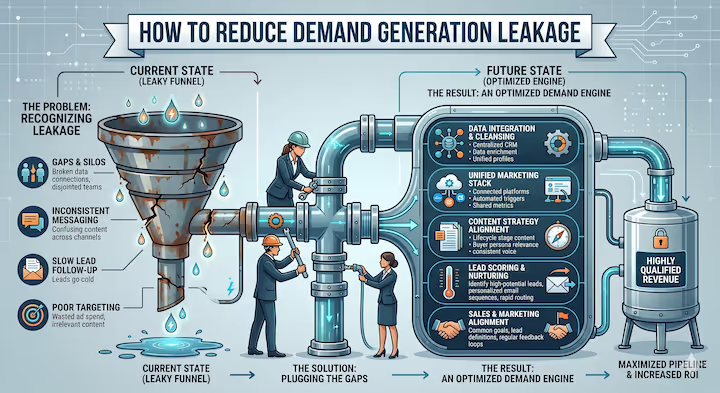
That is the work. Not finding the miracle. Finding the leaks.
Build the demand system, not the next campaign
LeadGenius helps revenue teams find the accounts, people, and moments that drive pipeline — with custom-sourced data, in-region researchers, and signal-led targeting that doesn't waste impressions on the wrong buyers.
Talk to a Strategist.avif)