
Let me start where I always start: with the data layer.
Because if you strip away the press releases, that's what Salesforce's buying spree over the last two and a half years has actually been about. Not "AI." Not "agents." Data. The whole strategy rests on a single sentence Marc Benioff keeps repeating, and it's a sentence I'd tattoo on the wall of every RevOps team I've ever worked with: you have to get your data right to get your AI right.
I've spent my career arguing that data is the bedrock of revenue, not a cog in the machine. So watching the biggest company in our category bet ~$10B+ to prove that thesis is, frankly, validating. But it's also a cautionary tale. Let's walk through what they bought, what the market thinks of it, and the part nobody's talking about — the overlap they've quietly created and what it means for the way you build your own stack.
The shopping list: a roll-up disguised as a roadmap
Here's the run, compressed. Watch the pattern, not the logos.
See it? Nearly every deal feeds the same machine: Data 360 at the bottom, Agentforce on top. Get the data right, layer autonomous agents over it, sell the outcome. On a whiteboard, this is a beautiful strategy. It might even be the right one.
So why has the market run the other way?
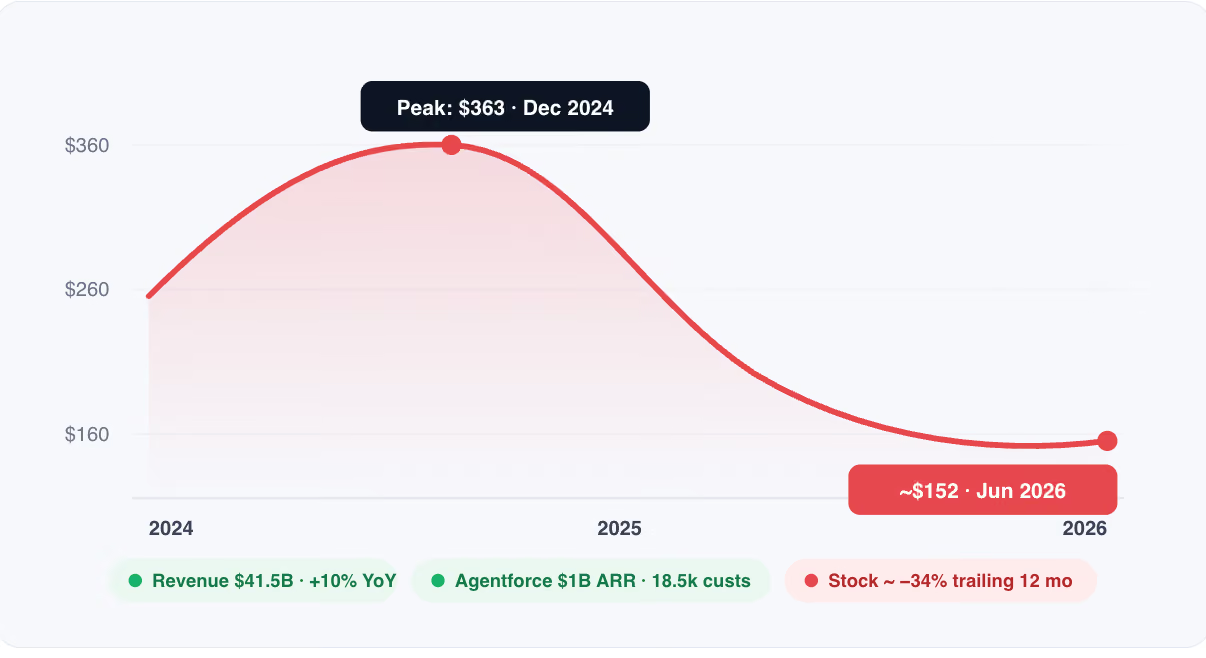
Here's the number that should stop you. While Salesforce was buying the future, its stock was busy giving back the present.
Revenue's growing double digits. Agentforce blew past $1B in ARR across 18,500 customers. The AI traction is real. And the stock still got cut roughly in half from its December 2024 peak of $363 to around $152 today.
The lazy take is "the market's afraid of AI eating seat-based software." Maybe. But I think the market is asking a sharper question — the same one I ask every vendor who pitches me a "platform":
There's a difference between acquiring capabilities and acquiring coherence. Cash buys the first. Only integration buys the second.
Salesforce has, without question, won the capabilities race. Nobody has assembled more of the agentic enterprise under one roof. But coherence is the part that has to be built after the deal closes — two engineering orgs, two roadmaps, two go-to-market motions, all designed by people who assumed they'd run their own company forever. That bill comes due later. And you can see the first invoice already.
The overlap nobody at Salesforce wants to map
Watch two deals six months apart. End of 2025: Salesforce buys Qualified — agentic marketing, an "always-on" AI worker that sits on your website, engages visitors, qualifies leads, books meetings. June 2026: it buys Fin (the company formerly known as Intercom) — an AI agent that sits on your website (and chat, email, WhatsApp, SMS, phone) and resolves ~76% of support tickets without a human.
On the org chart these are tidy: Qualified is pre-sale marketing, Fin is post-sale service. Different clouds, different buyers. Clean.
Now step off the org chart and stand where the buyer stands.
Here's the thing real conversations don't respect: the line between "qualify this visitor" and "help this visitor." Somebody lands with a question that's half support ticket, half buying signal — that's not the edge case, that's most of them. The boundary that looks crisp on the org chart dissolves the instant a human shows up.
And it gets messier, because Salesforce already sells an agent platform — Agentforce, the thing the whole strategy is named after. Its native help agent reportedly resolves ~62% of cases. Fin resolves ~76%. So Salesforce just paid $3.6B for a better version of something it already markets as the crown jewel. Even the engines disagree: Fin runs its own model (Apex); Agentforce was built on a different stack. Which agent wins internally? Which brain?
The tell
The moment a vendor has to publish a decision tree explaining which of its own AI agents you should buy, the integration story has outrun the product story. That's not a knock — it's a stage. But it's a stage you should be able to recognize, because you'll go through a smaller version of it yourself.
What this means for the rest of us
You're not running $40B in revenue. But you're running the same playbook in miniature — a CRM, an enrichment vendor, an intent tool, a sequencer, three "AI" features your team turned on last quarter. The Salesforce story is a high-resolution preview of the trap, and the way out is the same at every scale.
- 1 Buy capabilities, but budget for coherence. The sticker price of any tool is a fraction of the cost. The real spend is integration — making the new thing speak to your data and your other tools. If you can't name who owns that work, you're buying a catalog, not a platform.
- 2 The data layer is the only durable moat. Agents are commoditizing fast — Salesforce just admitted as much by buying one that beat its own. What doesn't commoditize is clean, connected, trusted data underneath. Get that right and you can swap agents like batteries. Get it wrong and no model saves you. "No clean data, no intelligence — only hallucination" applies to your stack too.
- 3 Audit for overlap before you add, not after. Every new tool should answer one question: what does this do that something I already own can't? If the honest answer is "it's a little better," you may be buying redundancy and the confusion tax that comes with it.
- 4 One source of truth beats five smart point solutions. The buyer doesn't experience your org chart; they experience the seams. Same goes for your reps. Coherence is a feature you ship to your own team first.
None of this is a prediction that Salesforce fails. They metabolized Slack, Tableau, and MuleSoft into something that mostly hangs together — the agentic bet may go the same way. But "eventually" is doing heavy lifting in that sentence, and "eventually" is exactly the credit the market just stopped extending.
The acquisitions bought the pieces. What no check can buy is the slow, unglamorous work of making the pieces feel like one thing. That work is the whole game now — for Salesforce, and for your revenue engine. It just won't show up in a press release.
Get the data layer right first.
No agent outruns bad data. LeadGenius delivers enterprise-grade, compliant B2B contact intelligence — AI plus human-in-the-loop — so the foundation under your GTM stack is actually trustworthy.
Talk to a Strategist.avif)