
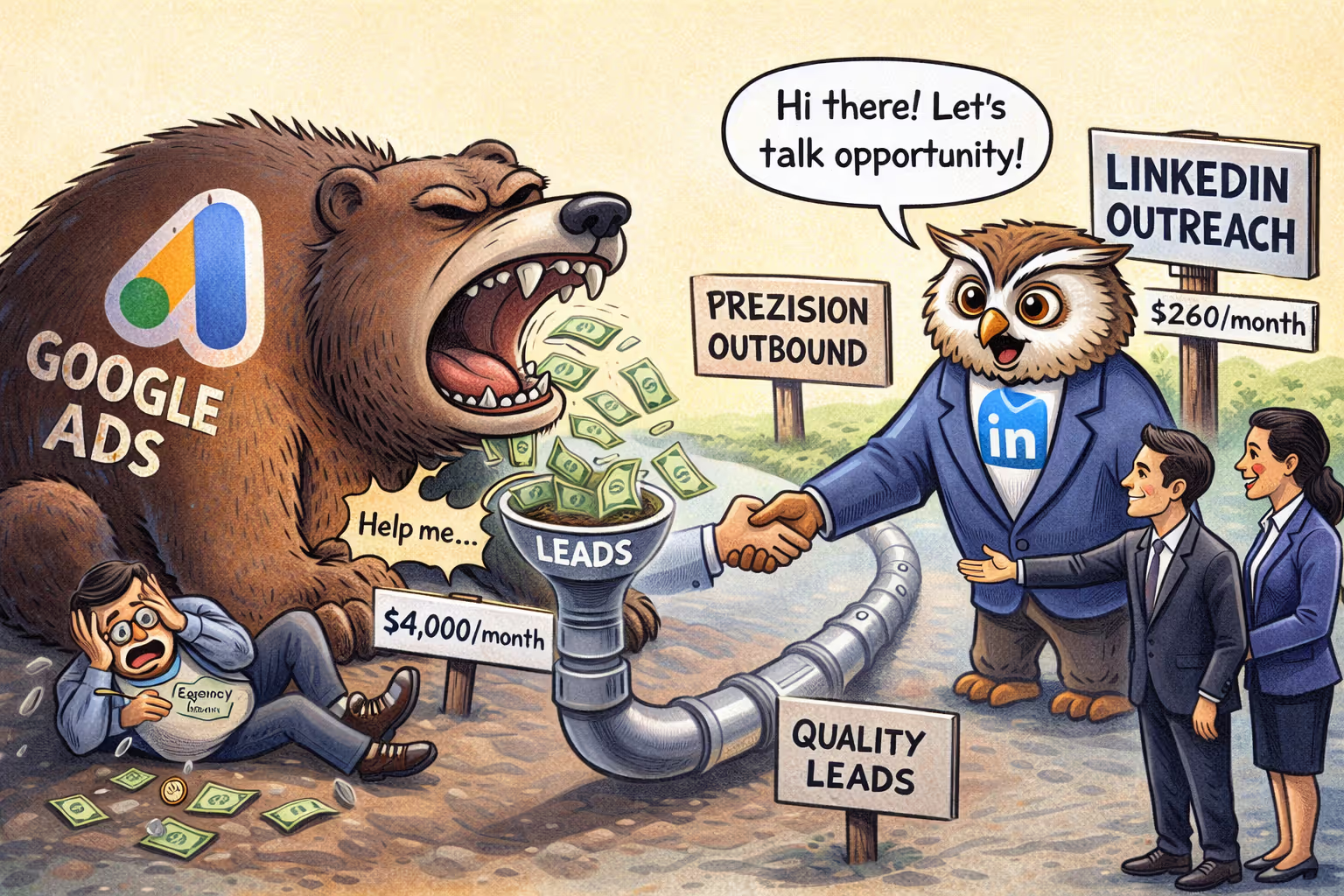
There is a moment most B2B teams eventually hit in paid acquisition. It is not when spend goes up. It is when spend goes up, lead quality goes down, and the calendar somehow still looks worse.
That is the real breaking point.
One of the more interesting posts I have seen lately came from a small agency owner who described spending roughly $4,000 per month on Google Ads, watching cost per lead climb from about $80 to $160 over time, and then realizing that a more deliberate LinkedIn-led outbound motion was producing more meetings, better-fit buyers, and higher-value clients for a fraction of the monthly cost. The shift was not from "marketing" to "sales." It was from rented intent to targeted relationship-building.
And that is the part many demand generation teams still miss.
The Problem Is Not Just Rising CPL
A lot of teams can tolerate higher costs if performance holds. What they cannot tolerate is paying more for traffic that looks active but behaves passive.
That is exactly what makes this kind of story resonate. The issue was not simply that paid search became more expensive. The issue was that the leads were increasingly lower quality, more price-sensitive, and less aligned to the kind of client the business actually wanted. That is a very different problem than "our ads need optimization." That is a signal that the channel may be attracting the wrong kind of demand altogether.
Search intent feels efficient because it looks close to the point of conversion. But in crowded categories, intent is often overpriced, over-shared, and stripped of context.
You may be buying clicks from people searching a category term without knowing whether they are the right company, the right persona, the right budget, or the right use case. That is not a pipeline engine. That is a toll road.
Precision Outbound Flips the Economics
The most important insight here is not about software. It is about control. The author described getting better results because they were selecting who to reach out to instead of waiting for an ad platform to send whoever happened to click.
Meeting quality improved because audience selection improved. Retainer value improved because targeting improved. The process got more efficient because they were speaking directly to decision-makers rather than filtering through a batch of loosely qualified form fills.
That is the hidden advantage of outbound when it is done well. Not volume. Not spam. Not sequences for the sake of sequences. Precision. You decide:
- Which companies fit your ICP
- Which titles matter
- Which signals suggest timing
- Which message is relevant to that segment
- Which channel should be used first
- Which follow-up path makes sense based on actual engagement
That is a very different acquisition model than paying for generalized demand and hoping the platform does not drift.
Relationship-Driven Channels Compound
The real lesson is not "LinkedIn is free." It is that relationship-driven channels build on themselves over time.
Someone sees your profile.
They accept a connection request.
They notice your name in the feed.
They engage with a post.
They remember the message.
They reply later, not immediately.
The meeting comes weeks after the touch that actually mattered.
Paid search often behaves like a faucet. You turn it on, leads appear. You turn it off, they disappear. Relationship-led outbound behaves more like an asset. It compounds. That is why so many teams underestimate it. It does not always feel efficient at the start because the return is delayed. But delayed does not mean weak. In many B2B markets, it means durable.
Content Alone Is Not the Engine
The source material is especially instructive here. The author did not claim that simply posting content solved pipeline. In fact, they said content by itself produced zero leads over two months. What worked was a more human motion: personalized outreach based on prospect activity, light engagement before the ask, and a system that automated logistics without removing relevance.
Content warms.
Signals prioritize.
Outbound activates.
When teams confuse those three jobs, they either over-invest in content and wonder where pipeline is, or they over-automate outbound and wonder why nobody replies.
Relevance Is the Strategy, Not Automation
A lot of outbound discourse gets reduced to tooling. Which sequencer. Which inbox tool. Which enrichment platform. That misses the point. The biggest lever is not the workflow. It is the input quality behind the workflow.
If your target list is stale, generic, and built from broad filters, then better sequencing just helps you fail in a more organized way. If your target list is built from real business context, then every downstream channel gets better.
This Is Why Bespoke Data Matters More Than Bigger Databases
The future of pipeline generation is not "more records." It is better reasons to contact the right accounts. That means moving beyond static firmographics and rented keyword intent into actual go-to-market context:
That is the difference between contacting a list and contacting a company for a reason.
For a digital marketing leader, this matters because media performance is no longer just a creative-and-bidding problem. It is increasingly an audience design problem. For a sales leader, it matters because reps do not need more names — they need higher-propensity conversations. For a revenue leader, it matters because the cheapest lead is not the goal. Efficient pipeline is.
Paid Media Still Has a Place. It Just Should Not Do Every Job.
Ads are not useless. They still have a place. But they stop being magical when teams expect them to carry awareness, targeting, qualification, timing, and conversion all at once. That is where smarter channel architecture wins.
The modern question is not "Should we do Google Ads or LinkedIn?" It is "Where are we overpaying for weak intent, and where can precision create better economics?"
The Bigger Strategic Takeaway
The most valuable thing in the original post was not the platform comparison. It was the mindset shift. The author stopped outsourcing audience selection to an ad platform and started building a more intentional pipeline motion. That move improved meeting quality, increased control, and created an engine that got stronger over time instead of more expensive.
When paid channels become crowded, the answer is not always to spend harder. Sometimes the answer is to get closer to the buyer, closer to the signal, and much more deliberate about who deserves outreach in the first place.
Because once acquisition costs start rising, the winners are rarely the teams with the biggest budget. They are the teams with the best inputs.
.avif)