
Every revenue organization reaches a point where the CRM stops being a strategic asset and starts feeling like a junk drawer. Duplicate records. Subsidiaries listed as standalone accounts. A Fortune 500 parent company buried somewhere on page 47 of a report, disconnected from the twelve child accounts your reps are already working. Sound familiar?
The problem isn't your team's discipline. It's structural. Most CRMs are built to store flat records—one row per account, no relationships, no hierarchy. And when your data is flat, your strategy is flat too. You can't run effective ABM if you don't know that three "different" accounts in your pipeline all roll up to the same corporate parent. You can't forecast accurately if subsidiary revenue is scattered across disconnected records. You can't even de-duplicate properly without understanding which entities are branches, which are subsidiaries, and which are the global headquarters.
Parent-child account mapping solves this. It's the process of identifying every account in your CRM, determining its corporate hierarchy—parent company, ultimate parent, location type—and structuring those relationships so they're queryable, reportable, and actionable. It sounds simple. In practice, it's one of the most operationally complex data projects a revenue organization can undertake. And it's one of the most valuable.
The Real Cost of Flat Account Data
Consider what happens without hierarchical structure. Your SDR team is running outbound into Oath Inc., AOL, and Verizon Communications—three separate account records in Salesforce, three separate sequences, potentially three different reps. But Quigo is owned by AOL, which was acquired by Oath, which rolls up to Verizon. That's not three accounts. That's one corporate family. Without parent-child mapping, you're not just wasting effort. You're actively confusing the prospect with inconsistent messaging from multiple reps who don't know they're selling into the same entity.
Multiply this across thousands of accounts and the impact compounds across every revenue function.
What Parent-Child Mapping Actually Looks Like
At LeadGenius, we've refined this process across hundreds of enterprise engagements. The hierarchy isn't just "Company A owns Company B." It's a structured, multi-level classification that determines how every account should be treated in your go-to-market motion.
Corporate hierarchy structure
Each account in your CRM gets mapped to its position in the hierarchy—with three fields populated: LG Parent, LG Ultimate Parent, and Location Type.
Every input record—starting with just a company name, website, and address—gets classified by location type. This isn't a binary "parent or child" designation. The real world is more nuanced than that.
A Global HQ with no parent above it becomes a standalone—its own parent and ultimate parent. A subsidiary gets mapped to its parent, and then we trace upward to find the ultimate parent (the parent of the parent). A branch location inherits the same parent as its HQ. The logic is strict and deliberate, because getting this wrong means your ABM targeting, territory assignments, and revenue rollups are all built on a broken foundation.
The Three-Step Company Identification Engine
Before you can map hierarchies, you need to be certain that each account record actually represents a real, operational business. This is where most internal teams stumble. They jump straight to ownership research without first validating the data underneath.
LeadGenius runs every record through a three-stage identification process before hierarchy mapping begins.
Company identification workflow
Step 1: Firmographic enrichment. We validate that the input data—company name, website, address—leads to an actual operational business. This catches dead companies, misspelled names ("Hersey Company" instead of Hershey), and ambiguous records ("University of California"—which one?).
Step 2: Legal entity and DBA identification. We determine whether the company goes by a DBA name, what its legal entity structure is, and how it maps to its operating identity. This matters because "DKNY" and "Donna Karan New York" are the same entity, and treating them as separate accounts creates downstream chaos.
Step 3: Location type and parent matching. This is where the hierarchy gets built. We classify the location type, search upward for the parent company, and then search again for the ultimate parent—the top of the corporate tree. If a parent is found, the starting company is automatically classified as a subsidiary or branch. If no parent exists, the company becomes its own parent and ultimate parent (a standalone).
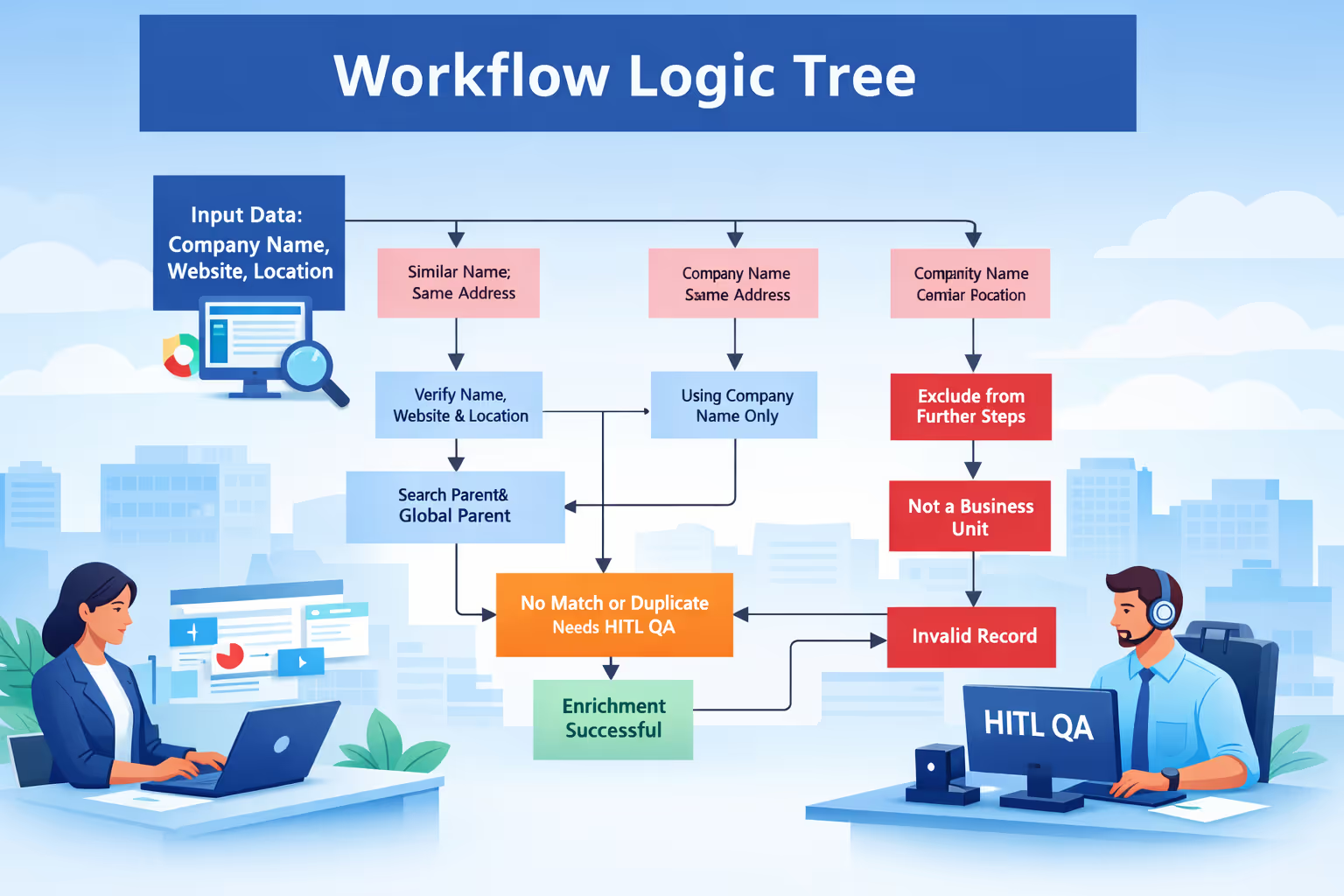
When enrichment fails—because of name-website mismatches, missing location data, or undetermined location types—the record enters a second-run workflow. We systematically retry: prioritize the company name, then the website, then extract location from the name field, and finally escalate to human intelligence for manual resolution. Nothing gets left behind.
Why This Matters for Every Revenue Stakeholder
For sales leadership
Hierarchical mapping transforms territory planning. When you can see that twelve accounts in your CRM all belong to the same corporate family, you can assign one strategic account team instead of letting four reps trip over each other. You can roll up pipeline by parent account to see the true size of an opportunity. And you can identify whitespace—divisions and subsidiaries where you don't have any penetration yet—because the hierarchy itself becomes a prospecting map.
For ABM and demand generation
Account-based marketing only works when the "account" is correctly defined. If your ABM platform is targeting a subsidiary as if it's a standalone company, your messaging, personalization, and budget allocation are all miscalibrated. With proper hierarchy, you can build campaigns at the parent level (reaching the economic buyer) while executing tactics at the subsidiary level (reaching the end users). You can also de-duplicate your paid media spend—no more running separate ad campaigns against three entities that are really one buying committee.
For RevOps and Salesforce admins
Clean hierarchy unlocks the full power of Salesforce's native Parent Account field. Once that lookup relationship is populated with accurate CRM IDs, you get rollup reporting, hierarchy views, and the ability to build automation rules based on corporate structure. RevOps teams can finally answer questions like: "What is our total ACV across the entire Verizon family?" or "How many open opportunities exist across all Johnson & Johnson subsidiaries?" Those questions are unanswerable with flat data.
For customer success and expansion
Knowing the corporate hierarchy tells you where expansion opportunities actually live. If you've closed one subsidiary of a global conglomerate, the hierarchy map shows you the other thirty subsidiaries that might have the same need. It also prevents awkward situations where your CS team is nurturing a relationship at a branch while sales is cold-calling the headquarters with no context.
The Operational Reality: A 10-Step Handshake
Effective parent-child mapping isn't a one-shot data append. It's a structured, multi-step collaboration between the data provider and the client. At LeadGenius, the process follows a deliberate sequence designed to minimize rework and maximize data integrity.
Ingest & alignment
Client exports all CRM accounts. LeadGenius clarifies mapping preferences: ultimate vs. immediate parent, treatment of foreign parents, holding companies, and PE-owned entities.
Cleaning & deduplication
Every record is validated, flagged for duplicates, name changes, and defunct companies. Two lists are returned: one for batch CRM update, one requiring manual client review.
Hierarchy research
With clean data in hand, researchers identify parent companies, trace ultimate parents, and cross-reference against the full account list to link existing CRM records.
Enrichment & delivery
New parent accounts are enriched and uploaded. Final mapping is delivered as a structured file with Account ID, Parent Account ID, and Parent Account Name—ready for CRM import.
The reason this works as a sequence—rather than trying to do everything simultaneously—is hard-earned operational wisdom. Attempting to map hierarchies while simultaneously cleaning dirty data leads to cascading errors. A misspelled account name creates a false "new parent" that then has to be unwound. A missed duplicate means two records in the hierarchy that should be one. The sequential approach costs time upfront but eliminates the exponentially more expensive rework that comes from cutting corners.
Common Pitfalls That Derail Hierarchy Projects
Having executed this process at scale, we've cataloged the failure patterns that trip up internal teams and less experienced providers.
Confusing investors with parents. A startup that took Series B funding from Sequoia Capital is not a subsidiary of Sequoia. Venture capital investment does not create a parent-child relationship. Only majority ownership (50%+ voting power) qualifies an entity as a parent.
Reversing the hierarchy. Researchers sometimes list subsidiaries as parent companies—the exact opposite of what's intended. This usually happens when the subsidiary is more well-known than the actual parent (think Instagram being listed as the parent of Meta, rather than the reverse).
Same company, different name. Médecins Sans Frontières is not the parent of Doctors Without Borders. KFC is not a child of Kentucky Fried Chicken. These are the same entity with variant names, and listing them as parent-child creates phantom records that corrupt your hierarchy.
Skipping the cross-reference. Before creating a "new" parent account, you must check whether that parent already exists in the client's CRM under a different name. Missing this step creates duplicates at the parent level—which is even harder to clean up than duplicates at the child level, because multiple children now point to the wrong parent record.
The Strategic Multiplier
Hierarchical account data is a force multiplier for almost everything a modern revenue organization does. It makes ABM targeting more precise. It makes pipeline forecasting more accurate. It makes territory planning rational instead of arbitrary. It makes expansion selling systematic instead of opportunistic. And it makes your CRM a genuine source of competitive intelligence rather than a compliance exercise.
But it requires investment—both in the initial mapping and in ongoing maintenance as companies get acquired, divested, renamed, and restructured. This is not a "set it and forget it" initiative. The corporate landscape shifts constantly, and your hierarchy needs to shift with it.
The organizations that treat account hierarchy as infrastructure—as foundational as their CRM itself—are the ones that consistently outperform in account-based go-to-market. They know who they're selling to. They know how those entities are connected. And they can act on that knowledge at every level of the organization.
Ready to structure your account data?
LeadGenius has mapped millions of parent-child account relationships for revenue teams at scale. Let's talk about your CRM.
Connect With a Strategist.avif)