In March 2005, Paul Graham and a handful of partners gathered eight scrappy founding teams in Cambridge, Massachusetts and handed each a small check. They called the program Y Combinator, named after a recursive function from theoretical computer science. Nobody — not Graham, not the founders, certainly not the broader venture industry — could have predicted that this experiment would spawn one of the most prolific engines of company creation in modern economic history.
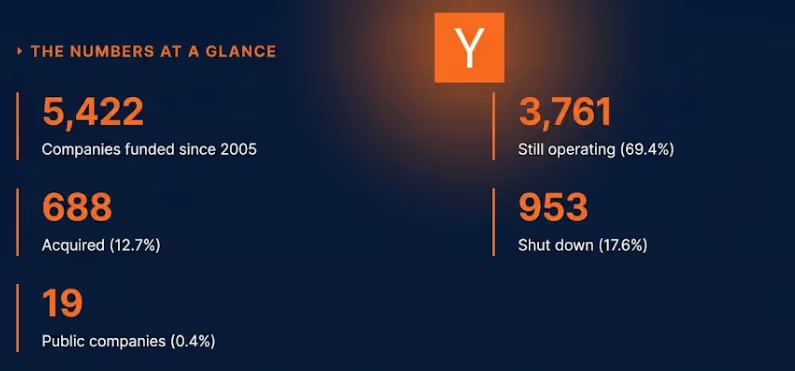
Two decades later, the numbers are staggering. Y Combinator has now funded more than 5,400 companies. A complete look at the dataset reveals something more nuanced than the legend suggests: roughly 69% of all YC alumni are still operating, about 13% have been acquired, 18% are inactive, and just 0.4% have gone public. Behind those percentages sit some of the most consequential technology companies of the 21st century — and a graveyard of well-funded failures that history has largely forgotten.
This is the story of both.
Every YC-funded company in the alumni network by current status. Only 1 in 285 has gone public.
Companies funded per year. YC's batch sizes grew faster than almost any institution in venture history.
01 The public winners: nineteen out of five thousand
Of the 5,422 companies in the YC alumni network, only 19 have made it to public markets. That number sounds small until you realize it includes some of the most defining consumer and enterprise platforms of the cloud era.
The crown jewels are well known. Airbnb, founded in 2008 by Nathan Blecharczyk, Brian Chesky, and Joe Gebbia, redefined the global travel industry and now employs over 6,100 people. Dropbox, also a 2008 alum, brought cloud storage to the mainstream. Stripe, while still private, sits in a category of its own — founded by John and Patrick Collison in 2009, it now employs 7,000 people and is the economic infrastructure underpinning a significant portion of internet commerce.
Then there is the 2012 vintage, which may be remembered as YC's single greatest cohort year. That year alone produced Coinbase, Instacart, GitLab, and Amplitude. DoorDash, founded a year later in 2013, has become the largest food delivery company in the United States with an 8,600-person workforce.
Beyond software, YC's public alumni stretch into surprising domains. Ginkgo Bioworks (synthetic biology), Oklo (advanced fission), Rigetti Computing (quantum), Momentus (space), and Embark Trucks (autonomous freight) represent moonshot bets — many of which have struggled on public markets, but all of which made it through the IPO door.
Book accommodations around the world. Redefined global travel.
Economic infrastructure for the internet. YC's most valuable alumnus.
Brought crypto from fringe to NASDAQ.
The largest food delivery company in the United States.
The defining product of the early cloud era.
Essential infrastructure during the pandemic.
Complete DevOps platform. Pioneer of fully-remote operations.
Digital analytics for thousands of digital products worldwide.
What unites these names is timing as much as talent. The overwhelming majority were founded between 2008 and 2013 — a period of cheap capital, smartphone proliferation, and cloud infrastructure maturation. They caught the wave at the right moment, and they were patient enough to ride it for a decade or more before tapping public markets.
The 2012 vintage produced four public companies
Coinbase, Instacart, GitLab, and Amplitude all came out of the 2012 batch. No other YC cohort year has matched that output, before or since. The closest comparison is 2008 — Airbnb and Dropbox in a single class.
02 The acquisition path
If IPOs are vanishingly rare, acquisitions are the path most successful YC companies actually take. The dataset contains 688 acquired companies — roughly 13% of all alumni — and the list reads like a tour of the last fifteen years of tech M&A.
The largest acquisition by employee count is Cruise (3,000 people), acquired by General Motors in 2016 for over $1 billion. Reddit and Twitch, both around 2,000 employees, are also classified as acquired — Twitch's purchase by Amazon in 2014 for nearly $1 billion remains one of YC's defining exits.
Then there's Heroku, acquired by Salesforce in 2010 for $212 million. Segment, built from a failed 2011 YC project that pivoted, was acquired by Twilio in 2020 for $3.2 billion. Weebly was bought by Square in 2018 for $365 million. PlanGrid was acquired by Autodesk for $875 million.
Sized by employee count at or near time of acquisition. The breadth of acquirers shows how thoroughly YC alumni have been absorbed.
Acquisitions tell a different story than IPOs. They're often the polite term for a company that built something valuable but couldn't quite achieve escape velocity on its own. They are still wins. Founders, early employees, and investors get paid. But they are wins of a different magnitude than DoorDash's $40 billion+ public-market debut.
03 The quiet giants: still private, still winning
The most interesting category in the dataset is the third one: the still-private, still-operating, demonstrably large companies. These are the future IPOs, the next acquisitions, or — for the lucky few — the next generation of category-defining incumbents.
Stripe (7,000 employees) sits at the top. Below it, the picture diversifies meaningfully across HR/payroll, fintech, logistics, compliance, and increasingly — emerging-market consumer platforms.
These are not pilots or experiments. They are large, operating, increasingly profitable businesses serving billions of people across emerging markets. YC's most underappreciated bet may be the realization, around 2015–2018, that an accelerator in Mountain View could plausibly fund the dominant companies of Lagos, Mumbai, and São Paulo.
Top 10 countries by company headquarters. The U.S. still dominates, but emerging markets now collectively account for hundreds of operating companies.
04 The losers: 953 cautionary tales
Every honest accelerator story has to grapple with its failures, and YC has 953 of them on the books — companies marked Inactive. Many are silent shutdowns: a two-person team that ran out of runway, returned what capital remained, and moved on. But some are spectacular implosions, the kind that defined entire startup mythologies for a generation.
The biggest shutdowns by peak employee count.
The smaller failures often resonate more, because they capture the absurd ambition of a specific era. FlightCar ("the Airbnb of car rentals"), Move Loot (used furniture marketplace), VetPronto (on-demand veterinary house calls), Tutorspree (online tutoring before that was a real category), Bus.com (charter bus booking) — these were companies built on the assumption that any service could be uberized. Many were right; most were not.
The steady-state failure rate is closer to 1-in-4
Of YC companies founded in the 2000s, 23% are inactive — a survival rate of just 43% as independent operating companies. The 2020s cohort shows only 9% inactive, but only because failure takes time. The companies founded in 2023 simply haven't had enough years to fail yet.
Keyword frequency across all 5,422 company descriptions. AI appears in nearly 2,000 — more than every other category combined.
05 The quietly dormant middle
The dataset reveals a less-discussed but arguably more revealing pattern. Of the 3,761 "active" YC companies, more than 2,100 — about 57% — show no detectable advertising activity across LinkedIn, Meta, or Google. They are not marketing. They are not paid-acquiring. They may still exist legally, the founders may still be drawing modest salaries, but they have effectively stopped trying to grow.
Of the entire 5,422-company alumni network, only 44 companies qualify as Heavyweight or Super Heavyweight advertisers — meaningful, sustained, multi-channel marketing operations. That is less than 1%.
A proxy for whether a company is meaningfully trying to grow. The Dormant tier is the modal outcome.
Just 44 companies — 0.8% — qualify as heavyweight
If you sell into startups, those 44 heavyweight advertisers are most of your real addressable market.
This is the unspoken middle of the YC distribution: companies that didn't die loudly and didn't succeed visibly. They built something, raised a seed round, perhaps a Series A, and then plateaued. The honest framing is that this group — not the winners and not the losers — is the modal YC company outcome.
06 What the numbers mean
Step back from the individual stories and the YC data tells a consistent narrative about technology entrepreneurship in the 21st century.
07 Conclusion: the manufacturing process
Y Combinator's twenty-year run has reshaped how startups are funded, built, and scaled. It has produced legitimate generational companies. It has also produced an enormous tail of failures, near-misses, and quiet zombies. Both are essential parts of the same story.
The winners — Stripe, Airbnb, Coinbase, DoorDash, Dropbox, Instacart, Cruise, Twitch, Reddit, Deel, Rippling, Brex, Faire, Flexport, Razorpay, Rappi, and the rest — exist because thousands of other founders were willing to try and fail. The losers — Atrium, LendUp, Le Tote, Brave Care, Moxion, and the long roster of companies that quietly closed up shop — are not embarrassments. They are the raw material of the venture model. Every batch is a portfolio bet, and every portfolio is mostly wrong.
What YC actually built, beyond any individual company, is a manufacturing process for that portfolio. The data show that the process works — not because it eliminates failure, but because, often enough, it produces a Stripe.
Run this kind of analysis on any market.
LeadGenius combines AI with human-in-the-loop research to deliver custom B2B intelligence — verified contacts, account signals, and behavioral data across global markets. Find the 44 heavyweights. Skip the 3,662 dormants.
.avif)