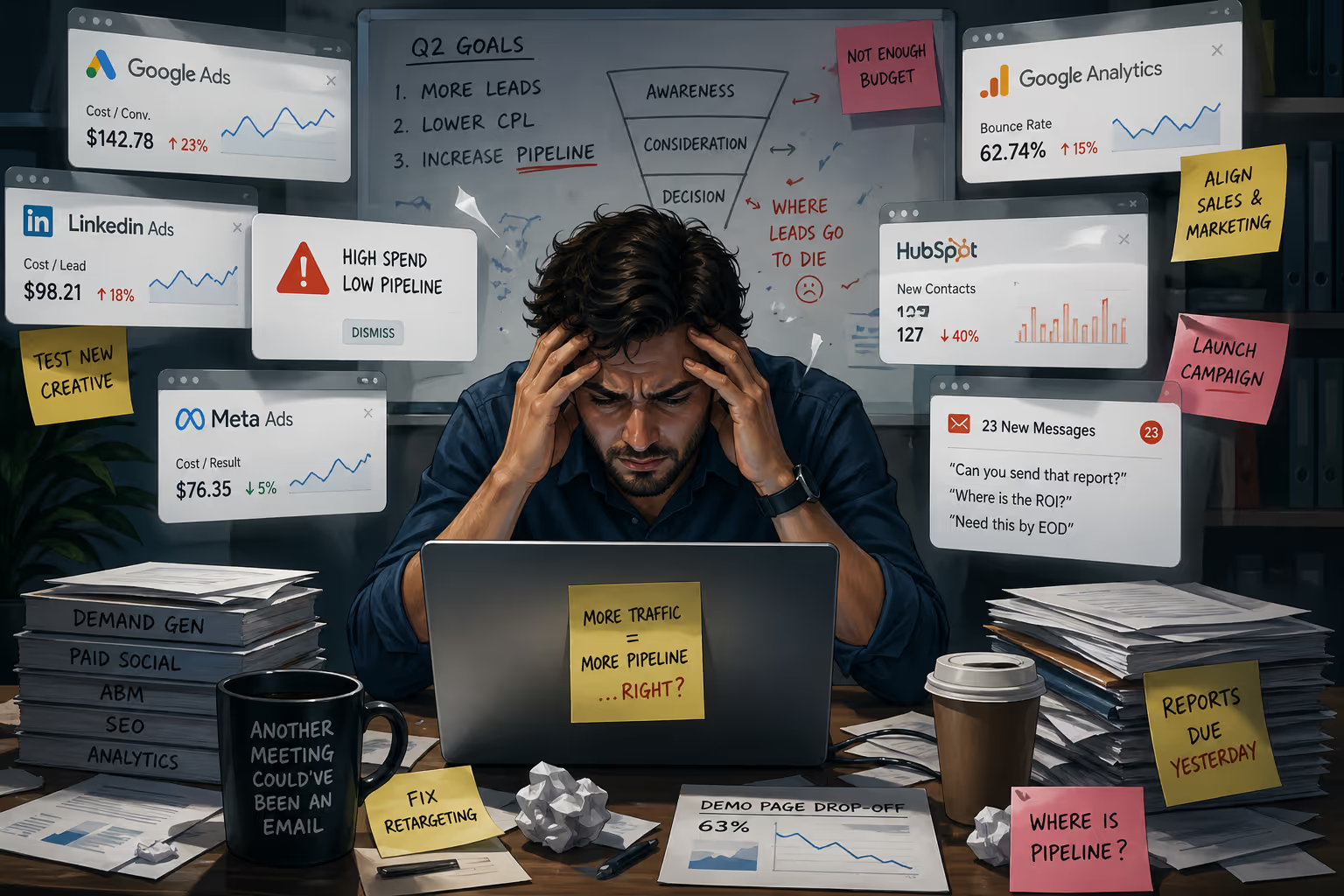

There's a quiet line item that doesn't show up in any media plan: the cost of competing with yourself.
If you run paid media for a B2B company in 2026, here's what your week probably looks like. You build a LinkedIn audience of 80,000 IT directors. Your closest competitor builds the same audience. So do three vendors who don't even compete with you directly but happen to share an ICP. LinkedIn auctions impressions to the highest bidder among you. CPMs go up. Your CAC creeps. You add budget to "stay competitive." Repeat on Google. Repeat on Meta. Pay rent on someone else's traffic and call it a strategy.
That's the walled garden tax. It's not a conspiracy. It's just how the platforms are designed to work. The economics favor concentration: more advertisers chasing the same finite audience inside a closed system, with the platform setting the rules and clipping the toll. The advertiser's job became picking a walled garden and hoping the auction math works out.
It doesn't.
01How we got here
For about a decade, the pitch was simple. Targeting got better. Attribution got tighter. Platforms had your buyers in one place, so concentrating spend made sense. Anyone who's actually run a multi-million-dollar paid program over the last three years knows what happened next:
- iOS 14.5 nuked Meta's signal in 2021. Conversion data degraded; learning phases got longer; CPAs went up across the board.
- LinkedIn raised the floor on B2B inventory as every SaaS company in the world decided LinkedIn was "the" channel. Sponsored content CPMs in tech are routinely $80–$120 now. Message ads are worse.
- Google deprecated cookies, then didn't, then partially did, and handed everyone Privacy Sandbox. Retargeting pools shrank. Attribution windows got fuzzier. Smart Bidding ate the budget.
- Apple Mail Privacy Protection broke open rates as a signal. Every B2B nurture sequence using opens to score intent was suddenly grading on noise.
The platforms didn't get worse at their jobs. They got better at extracting margin. The walled garden didn't crack. It raised rent.
02The four complaints I hear over and over
I've spent the last 18 months talking to demand gen leaders in HRIS, fintech, hospitality SaaS, and security. Different categories, same four complaints. Worth naming them plainly because most "thought leadership" on this topic stops at the symptom.
"I'm bidding against myself across platforms and I can't see it."
A prospect sees your LinkedIn ad on Monday, your Google search ad on Tuesday, your Meta retargeting ad on Wednesday. Three platforms, three auction systems, three reports, none of which know about the others. Each platform claims credit for the conversion. Your blended CAC is real; the platform-reported CAC is fiction. You can't optimize what you can't see, so you keep funding the channels that report best, not the ones that work best.
"Frequency is broken in the ways that matter, and fine in the ways that don't."
Inside a single platform, frequency caps work. Across platforms, there is no cap. So your highest-intent prospect (the one who visited your demo page, came back twice, and downloaded a report) gets hammered with the same retargeting creative on every channel they touch. Meanwhile, the warm prospect who only spends time on Reddit and YouTube sees nothing because you don't have a budget allocated there.
"I'm paying premium CPMs on the platforms my ICP is most expensive on, and getting nothing on the platforms where they're cheap."
This one's mathematically obvious and operationally invisible. LinkedIn CPMs for HR decision-makers run 4–10x higher than Meta or Reddit CPMs for the same individuals. The audience is on every channel; the price is not. But because your team only has reps for LinkedIn and Google, that's where the budget goes. You're paying the toll on the most expensive bridge while three cheaper bridges sit empty.
"My data is fragmented, and the platforms benefit from keeping it that way."
Your CRM has buyer signal. Your website has behavior. Your ad accounts have engagement. Your sales tools have intent. None of them talk to each other in a way the bidding algorithms can use. Each platform wants you to upload a list and trust their black box. The result: you're feeding the same audience into five algorithms that don't know about each other, paying each one to "find" people you already know.
03The non-solutions that get sold as solutions
Before we talk about what actually moves the needle, let's name the things that don't.
"Just go all-in on one channel." Tempting. Concentrates the problem instead of solving it. The auction gets worse, not better, when you raise your bids.
"Audience enrichment will fix it." Some vendors are positioning audience enrichment (matching your CRM to ad platform IDs) as the answer to walled garden math. It isn't. Enrichment makes you better at targeting inside the same auction. You still pay the premium. You just have a cleaner list.
"Just trust Performance Max." Handing more decisions to the platform's black box does not, in any universe, reduce your dependence on the platform's black box.
"Diversify with TikTok / Reddit / CTV." Closer to right, but only if you can orchestrate across them. Spinning up four more disconnected ad accounts gives you four more disconnected reports.
04What actually moves the math
Three things have to be true at once for a B2B paid program to escape the walled garden tax.
One: cross-platform orchestration, not cross-platform reporting.
Reporting tells you what happened. Orchestration changes what happens (bids, frequencies, sequencing, budget allocation) based on a unified view of the buyer, not a per-platform view of the impression. If your ad platforms don't know about each other, the platforms win.
Two: a unified audience, not five fragmented ones.
Your CRM data, web behavior, ad engagement, and intent signals need to live in one customer profile that every channel reads from and writes to. Without that, you're targeting the same person five times and paying for the privilege.
Three: a paid plan that treats top-of-funnel and bottom-of-funnel as different problems.
Most underperforming programs over-spend on prospecting and under-spend on conversion of warm intent. The fix is not "more budget." It's "look at where demand is actually leaking and stop funding the leaks."
This is the AdGenius thesis, and it's the thesis behind the Performance Blueprint we build for prospects before they ever sign anything.
How much demand are you already paying for and failing to convert?
The AdGenius Performance Blueprint is a custom, data-driven breakdown of how your paid media engine is actually performing: where demand is leaking, which channels are over-funded, and what a 90-day plan looks like that converts the warm pool already in front of you.
Request your Performance Blueprint →05How AdGenius and a Performance Blueprint counter the headwinds
A Performance Blueprint is not a paid media audit. Audits are templates. A Blueprint is a custom diagnostic built from real ad account data, website behavior, CRM context, and visitor-level signals that tells a digital marketing leader three specific things:
- Where the demand is actually leaking (almost always middle-of-funnel, almost never top-of-funnel)
- Which channels are over-funded relative to what they're returning, and which under-funded channels are quietly outperforming
- What a 90-day plan looks like that converts the warm pool already in front of you, before adding more spend on top
A recent example: a company with quadrupled organic traffic, 232 demo-intent visitors sitting in their CRM, a 67% bounce rate, and zero retargeting infrastructure. The instinct was "we need more budget." The Blueprint diagnosis was "you have a goldmine you haven't mined." Reallocating spend toward retargeting the 232 warm visitors (including a 130-person segment that had spent nearly 10 minutes on a single high-intent page) was projected to drive 15+ incremental bookings before any new top-of-funnel dollar was spent.
That's the Blueprint half of the equation. AdGenius is the platform that makes the plan executable.
Cross-platform orchestration in one place.
AdGenius runs paid social, search, CTV/OTT, video, audio, display, native, and DOOH from a single workflow. The bidding algorithms see the buyer, not just the channel. Frequency caps work across platforms instead of inside each one. Budget reallocates to the channels actually driving conversion, not the ones with the prettiest dashboards.
A unified Customer Data Platform.
AdGenius pulls CRM data, web behavior, ad engagement, transactional data, and device data into one enriched customer profile that every channel targets from. The fragmentation tax goes away because the data isn't fragmented anymore.
AI-driven optimization that's accountable to the blended number.
Automatic Budget Optimization moves spend across channels in real time based on what's actually working. Generative AI builds the creative variants. Strategy Optimization adjusts underperforming ad groups dynamically. None of which matters in isolation. But stacked on cross-platform orchestration and unified data, it compounds.
Unified attribution.
Conversions get tracked across devices and channels, with credit assigned to the actual touchpoints that drove the outcome. The "every platform claims the conversion" problem stops being a problem because attribution lives outside the walled gardens, looking in.
06The sobering truth
None of this is a magic bullet. Cross-platform orchestration takes setup. Unified audience data takes integration work. A Performance Blueprint takes 2–3 weeks of analysis. If a vendor tells you they can fix walled garden economics in a week with a pixel and a prayer, they're either lying or they don't understand the problem.
But here's the math that matters: the walled garden tax is compounding. Every quarter you don't address it, your CAC goes up, your platform dependency deepens, and your attribution gets murkier. The companies that escape this trap in 2026 will not do it by being smarter inside Meta or LinkedIn. They'll do it by refusing to play the auction game on the platform's terms.
The Performance Blueprint is how that conversation starts. AdGenius is how the plan actually runs.
The auction isn't going to get cheaper. The question is whether you keep paying the rent or start owning the orchestration.
Stop competing with yourself for your own audience.
A custom, data-driven diagnostic of where your paid media is leaking, built from your ad accounts, your website behavior, and your CRM. No template. No checklist. Real plan.
Request your Performance Blueprint →.avif)