
Did Artisan violate section 8.2.13 of the LinkedIn user agreement?
Or did they simply run Into the Wall.
There’s a temptation, when a company disappears from LinkedIn overnight, to turn it into a morality play.
They scraped too hard.
They automated too aggressively.
They flew too close to the sun.
That story is comforting because it implies control. Follow the rules, tweak the tactics, stay just inside the lines — and you’ll be fine.
But that’s not actually what’s happening here.
What happened to Artisan looks less like enforcement and more like something structural: a platform reasserting sovereignty over its ecosystem, and doing it with increasing precision.
Artisan didn’t just lose a feature.
They lost their presence.
Company page gone.
Founders gone.
Social graph erased.
Not because the company failed — they raised ~$46M, built real traction, hired aggressively — but because they were operating inside a system whose tolerance for automation has quietly collapsed.
And that’s the part most people are still underestimating.
This Isn’t About Scraping. It’s About Control.
LinkedIn’s Section 8.2.13 — the clause that bans “bots or other unauthorized automated methods” — is intentionally broad. It doesn’t just prohibit scraping profiles. It prohibits driving inauthentic engagement.
That phrase is doing a lot of work.
It’s not saying:
“Don’t steal our data.”
It’s saying:
“Don’t simulate human behavior at scale without our permission.”
That’s a very different line in the sand.
Artisan, like many of the most interesting outbound startups of the last few years, wasn’t just extracting data. They were orchestrating behavior — sequences, actions, touches — designed to feel human, but executed by software.
And that’s precisely what the platforms are now optimizing against.
The Pattern Is the Story
If this were isolated, it would be easier to dismiss.
But it isn’t.
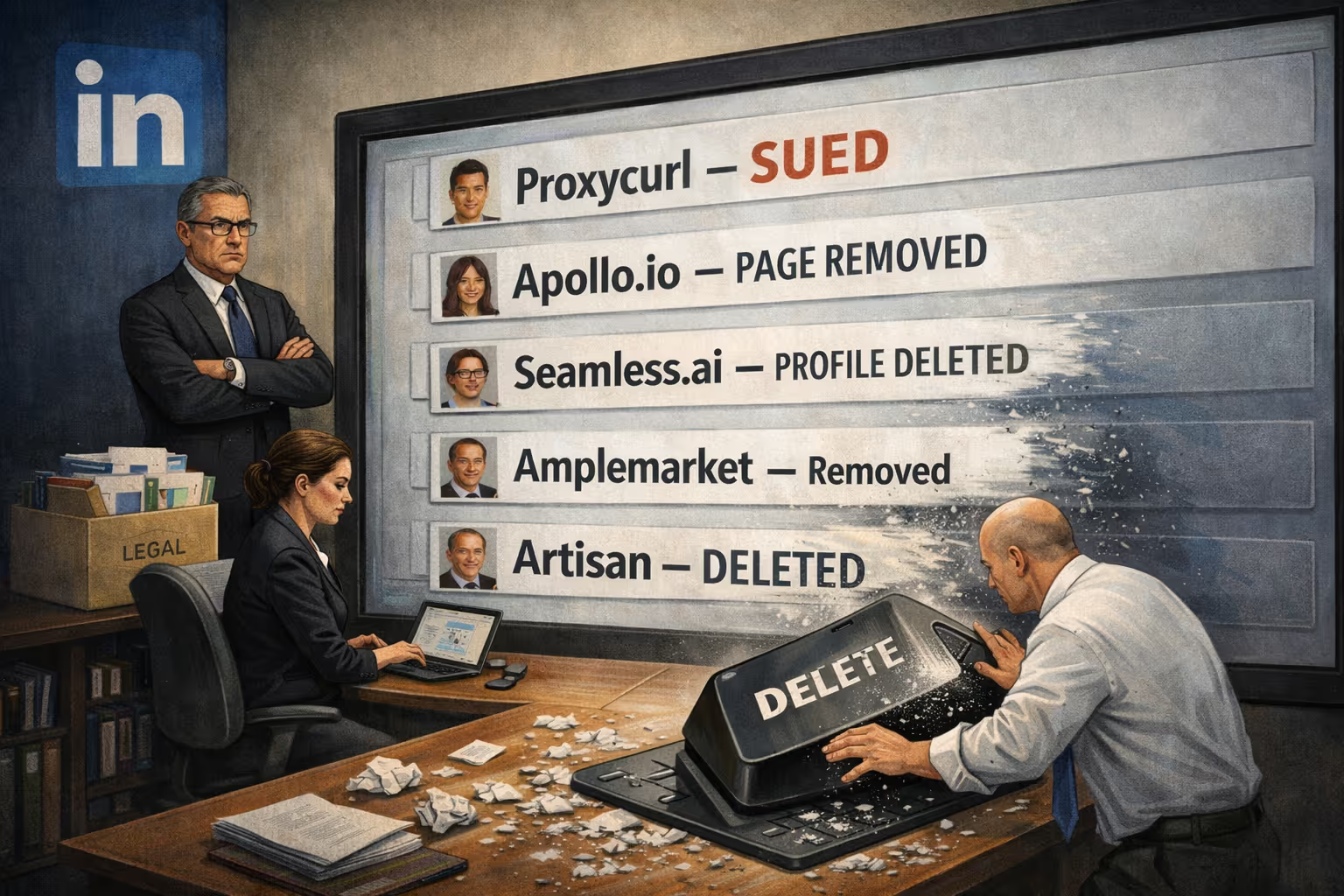
Over the last 12–18 months, LinkedIn (backed by Microsoft) has methodically applied pressure across the stack:
- Proxycurl — sued into shutdown
- Apollo.io — company page removed
- Seamless.ai — same
- Amplemarket — hit earlier
- Now Artisan — despite size, funding, or profile
This isn’t random enforcement. It’s a targeted campaign against a category of behavior: outbound automation that treats LinkedIn as a programmable surface.
And LinkedIn is no longer pretending it’s okay with that.
The Real Shift: Platforms vs. Automation
Zoom out far enough and the same pattern appears everywhere:
- LinkedIn tightening bot detection
- Gmail & Outlook escalating spam and reputation controls
- Carriers flagging and throttling outbound dialing
- App stores & APIs restricting non-sanctioned access
These companies aren’t anti-sales.
They’re anti-uncontrolled scale.
Automation breaks their business models when it operates outside their monetization paths. It degrades trust, floods networks, and — crucially — removes their ability to price access.
From their perspective, this isn’t philosophical. It’s economic.
Why This Is Worse for Customers Than Founders
Founders can pivot.
Customers are locked in.
This is the quiet risk most GTM teams never model:
You sign an annual contract.
You train reps.
You wire automation into your motion.
And then one dependency disappears.
LinkedIn doesn’t refund your contract.
Your vendor can’t “negotiate” platform access back.
Your reps just lose a tool — overnight.
The cost isn’t the subscription.
It’s the broken workflow.
The Hard Truth About 2026 GTM
For the last decade, the industry optimized for one thing: more automation.
More sequences.
More scraping.
More synthetic scale.
2026 is shaping up to reward the opposite.
- Fewer platforms, deeper signals
- Fewer actions, higher intent
- Less simulation, more verification
This is why bespoke data, human-in-the-loop research, and real-world signals are quietly gaining leverage again — not because they’re nostalgic, but because they’re resilient.
Signals from earnings calls don’t get banned.
Job postings don’t revoke access.
Press releases don’t break APIs.
They also don’t pretend to be people.
Artisan Isn’t a Warning. It’s a Preview.
What happened to Artisan isn’t a punishment for being reckless.
It’s what happens when an entire category matures past the tolerance of the platforms it depends on.
The lesson isn’t “don’t automate.”
It’s this:
If your GTM strategy only works when platforms look the other way, it isn’t a strategy — it’s a timing bet.
And those bets are getting harder to win.
Humans won’t replace automation.
But automation without humans — without verification, permission, and signal — is becoming unviable.
That’s not ideology.
That’s the direction of the system.
.avif)