
Why this report exists
I didn't set out to write a report on MQLs vs MQAs.
I'm a CRO (turned internal ‘founder’??) building a paid media optimization platform. Over the past few months, I've been having 3-4 conversations a week with demand gen leaders trying to understand who our platform is best suited for and what they actually care about.
A pattern kept showing up. Almost every enterprise marketer said some version of the same thing: "We're trying to move from MQLs to MQAs." They said it like MQLs were the disease and MQAs were the cure.
But the companies furthest along in their MQA journey didn't seem to have better answers about what was actually working. They had fancier dashboards and bigger platform contracts. When I asked which campaigns were creating pipeline, they didn’t know.
So I spent last week doing deep research: Forrester, Reddit threads, LinkedIn debates, practitioner blogs, vendor whitepapers, podcast transcripts, industry surveys to understand what's actually happening.
What I found surprised me. The MQL isn't dead. The MQA isn't the cure. The whole debate is more complicated and more vendor-influenced than the industry discourse would have you believe. And the right answer depends entirely on who you sell to, how they buy, and what your go-to-market motion demands.
This report is the result of that research. I'm sharing it because I think it'll be useful to anyone navigating the same question.
A note on independence: I don't sell an ABM platform. I don't sell marketing automation. I have no commercial interest in whether you run MQLs, MQAs, or both. That's exactly why I could write this honestly. This report just follows the evidence.
Key findings at a glance
MQLs convert to customers less than 1% of the time, but MQAs have zero published conversion benchmarks to prove they're better
87% of B2B teams report struggling with unreliable intent data, the foundation MQA scoring is built on
Only 7% of demand gen teams track MQAs as their primary success metric, despite the industry narrative
Demandbase, the company most associated with MQA, now recommends running both models simultaneously
Forrester says both MQL and MQA are insufficient and recommends a third model entirely (MQO)
The right model depends on four variables: deal size, buyer count, sales cycle length, and GTM motion
The "MQL is dead" narrative has been substantially amplified by vendors whose revenue depends on selling the replacement
Part 1: The case against MQL is devastating, and comes from its own creators
The most damning indictment of the MQL comes from the people who built the system.
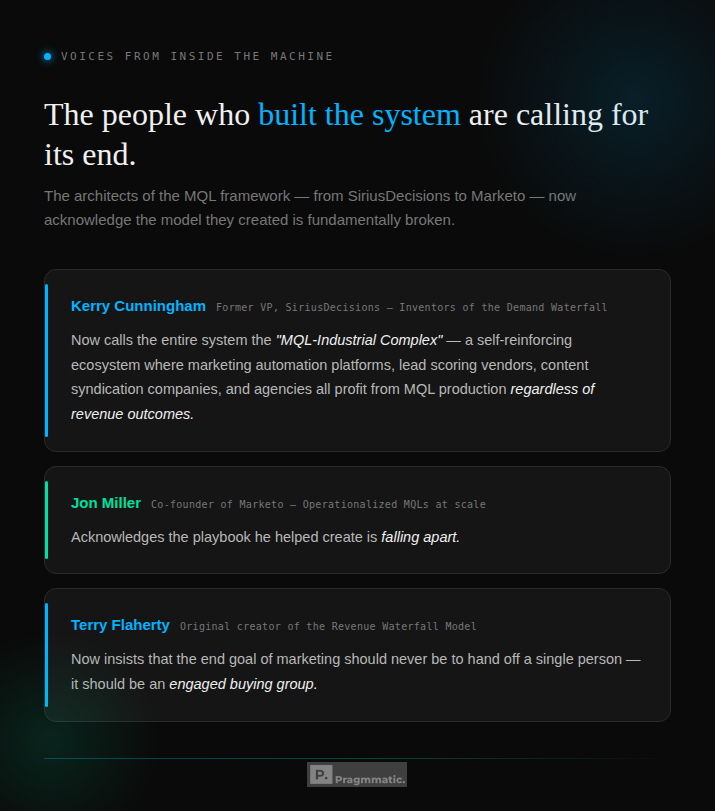
Kerry Cunningham, former VP at SiriusDecisions (the firm that invented the Demand Waterfall framework), now calls the entire system the "MQL-Industrial Complex"*: a self-reinforcing ecosystem where marketing automation platforms, lead scoring vendors, content syndication companies, and agencies all profit from MQL production regardless of revenue outcomes.
Jon Miller, co-founder of Marketo, the platform that operationalized MQLs at scale, acknowledges the playbook he helped create is falling apart.
Terry Flaherty, the original creator of the Revenue Waterfall model, now insists that the end goal of marketing should never be to hand off a single person; it should be an engaged buying group.
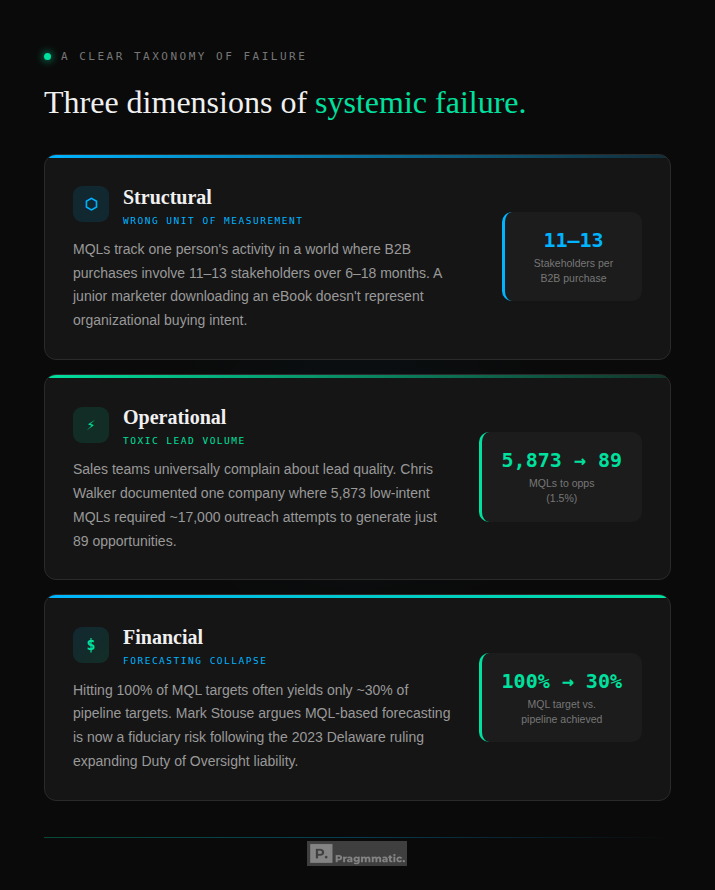
The specific criticisms form a clear taxonomy:
Structural failure: MQLs track one person's activity in a world where B2B purchases involve 11-13 stakeholders over 6-18 months. A junior marketer downloading an eBook doesn't represent organizational buying intent.
Operational failure: Sales teams universally complain about lead quality. Chris Walker documented one company where 5,873 low-intent MQLs required approximately 17,000 outreach attempts to generate just 89 opportunities.
Financial failure: Hitting 100% of MQL targets often yields only ~30% of pipeline targets, according to MadKudu analysis. Mark Stouse, CEO of Proof Analytics, argues that MQL-based forecasting is now a fiduciary risk following the 2023 Delaware ruling expanding Duty of Oversight liability.
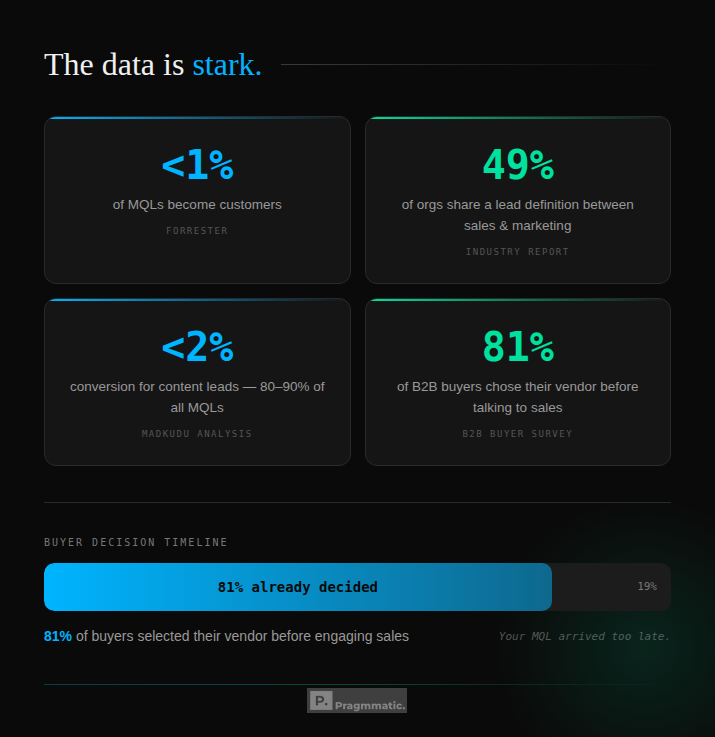
The data is stark:
Less than 1% of MQLs become customers (Forrester). Only 49% of organizations have a shared lead definition between sales and marketing. Content leads, which make up 80-90% of MQLs, convert at less than 2%. And 81% of B2B buyers have already selected their preferred vendor before engaging with sales.
Part 2: MQA has the same fundamental flaw, and no one has the data to prove otherwise
Here's where the debate gets dishonest.
The core criticism of MQL, that having a "qualified" lead doesn't mean the account will close, applies with equal force to MQA. Just because multiple people at an account are engaging with your content doesn't mean a purchase is imminent.
Forrester's Terry Flaherty is explicit in a four-part series that should be required reading for every demand gen leader:
"Both the MQL and MQA fail in providing optimal and actionable insight as the focal point in the revenue process."
His critique is precise: with MQLs, the focus on individuals is too narrow. With MQAs, the focus is too broad. Accounts are legal entities; they do not make buying decisions and therefore cannot be "qualified" to signify progression and propensity to buy.
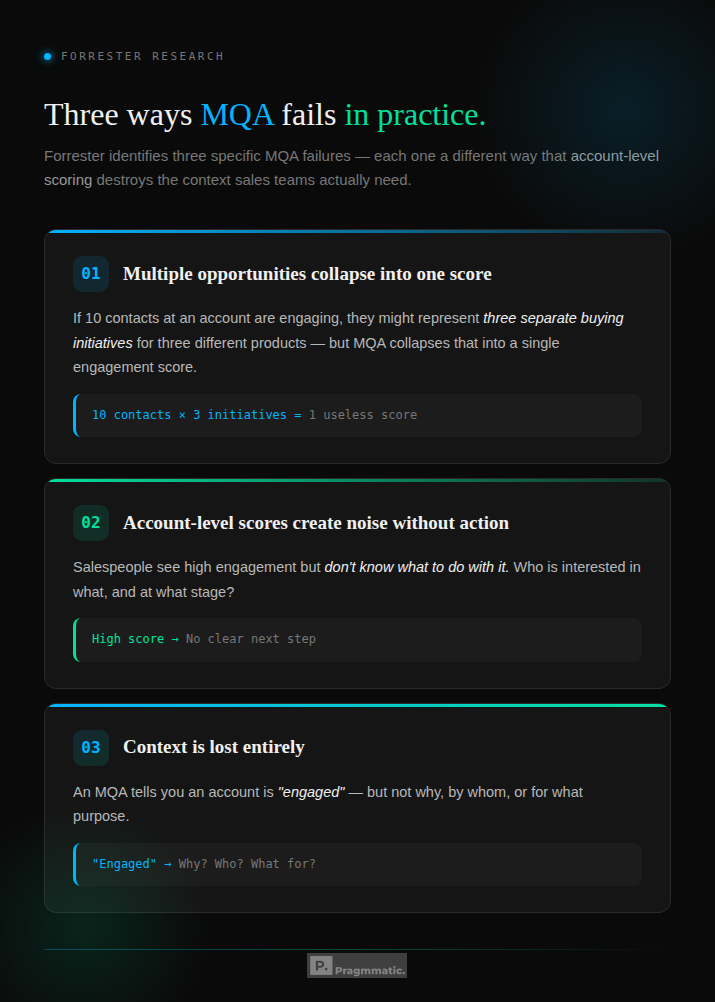
Forrester identifies three specific MQA failures:
- Multiple opportunities collapse into one score. If 10 contacts at an account are engaging, they might represent three separate buying initiatives for three different products, but MQA collapses that into a single engagement score.
- Account-level scores create noise without action. Salespeople see high engagement but don't know what to do with it. Who is interested in what, and at what stage?
- Context is lost entirely. An MQA tells you an account is "engaged" but not why, by whom, or for what purpose.
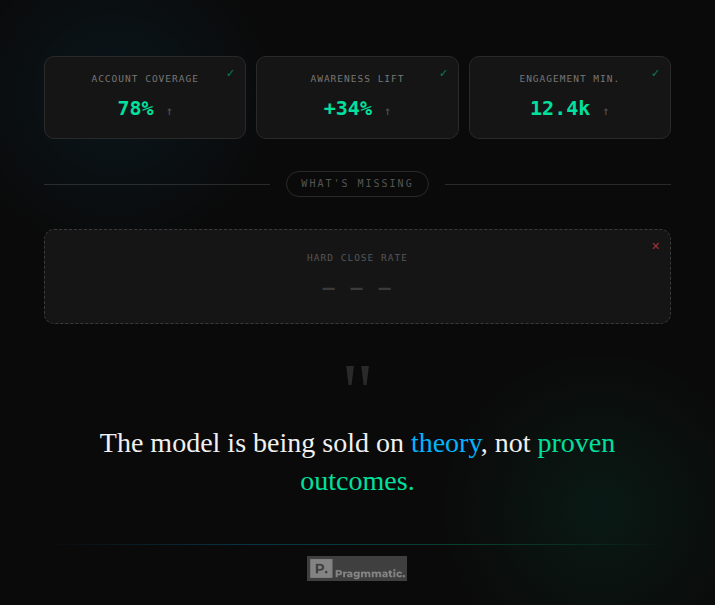
The most revealing finding in this research is what's missing: no publicly available, independently verified benchmark data exists for MQA-to-closed-won conversion rates.
The MQL model, for all its flaws, has extensively documented conversion benchmarks: 13% MQL-to-SQL, 5-7% MQL-to-opportunity across thousands of companies. The MQA model has nothing comparable. ABM platforms report on engagement metrics (account coverage, awareness lift, engagement minutes) but not hard close rates.
The model is being sold on theory, not proven outcomes.
Part 3: The intent data problem
The foundation MQA rests on, third-party intent data, is itself deeply unreliable.
A 2026 Salesmotion report found 87% of B2B teams struggle with unreliable intent signals and only 26% of intent signals ever turn into real opportunities.
Gartner's CMO Spend Survey found 30% of marketing leaders report data quality issues with intent data.
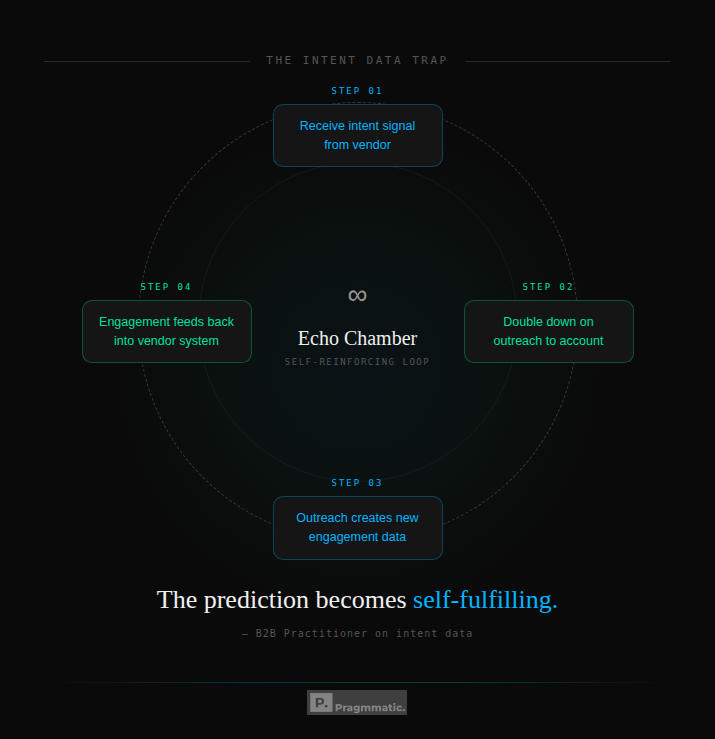
One practitioner described intent data as an echo chamber: your team receives intent data, doubles down on outreach, creates new engagement, that engagement feeds back into the intent vendor's system, and the original score appears validated. The prediction becomes self-fulfilling.
This doesn't mean intent data is useless. It means that a $200K+ ABM platform built on top of intent scoring is only as good as the signal quality underneath it, and that signal quality is not great for most teams.
Part 4: The MQA trend is substantially vendor-driven, but addresses a real gap
Two forces are driving MQA adoption. Genuine need and vendor influence
.
The genuine market need is real
B2B buying committees have grown to an average of 13 stakeholders crossing multiple departments. 86% of purchases stall during the buying process. 70-80% of buyers never fill out a form. The MQL model structurally cannot capture this complexity.
When a $200K enterprise deal involves a dozen stakeholders researching over 11 months, tracking individual form fills is inadequate. MQA exists because the buying motion changed.
The vendor influence is equally real
Dave Kellogg, former billion-dollar-company CMO, reviewed a Terminus-authored ABM book and concluded it deliberately “complexifies” marketing because when the authors are cofounders of an ABM company, every marketing problem looks like an ABM problem.
Gartner has placed ABM past the "Peak of Inflated Expectations" in its Digital Marketing Hype Cycle.
Reddit sentiment is particularly revealing. Practitioners describe 6sense and Demandbase as offering a lot of show but not a lot of substance, with 6sense reportedly costing $120K/year with two-year commitments and users reporting buggy functionality and inaccurate contact data.
Kaylee Edmondson, a former B2B SaaS CMO writing on the Demand Loops Substack, captures the disillusionment: she describes having three calls in a single week with CMOs asking whether they should renew their ABM platform, how to get sales to actually use it, and why they're spending $200K annually on tools they barely touch.
The telling admission
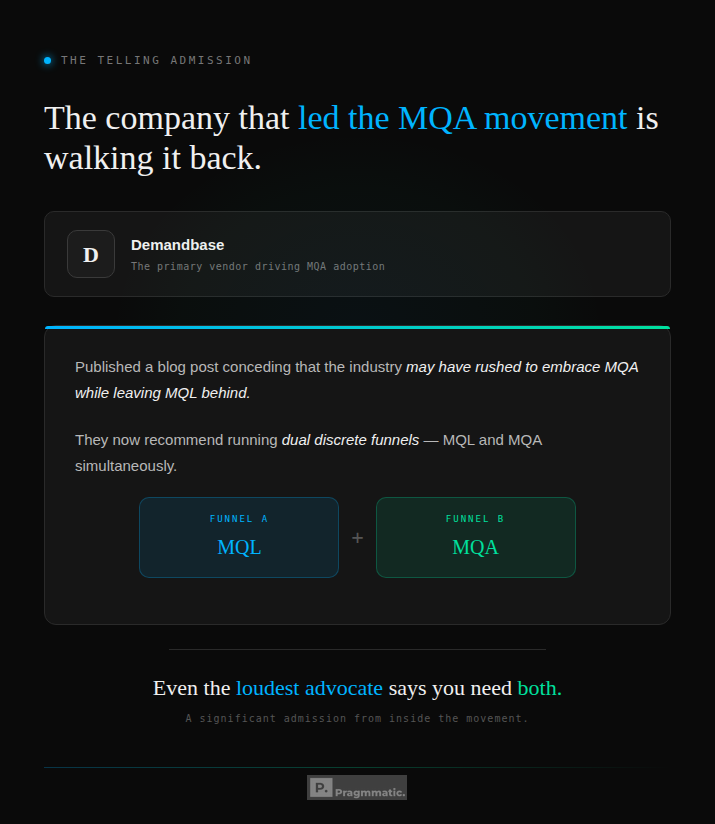
Demandbase itself, the company most associated with the MQA movement, published a blog post conceding that the industry may have rushed to embrace MQA while leaving MQL behind.
They now recommend running dual discrete funnels, MQL and MQA simultaneously. This is a significant admission from the primary vendor driving MQA adoption.
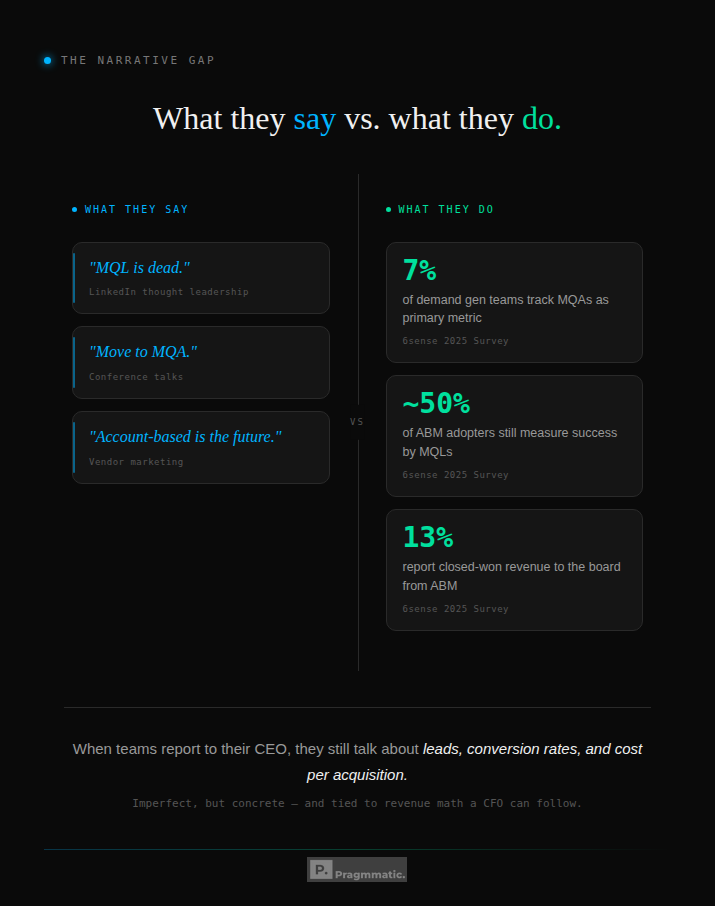
Part 5: The gap between the LinkedIn narrative and operational reality (the difference between what people say and what they do).
6sense's own 2025 State of B2B Marketing Metrics survey reveals the disconnect:
- Only 7% of demand gen teams track MQAs as their primary success metric
- Nearly half of ABM adopters still measure success by MQLs, even from non-target accounts
- Only 13% report closed-won revenue to the board from their ABM programs
The thought leadership says "MQL is dead." The conference talks say "move to MQA." But when teams sit down to report performance to their CEO or board, they're still talking about leads, conversion rates, and cost per acquisition.
Those are the metrics the business runs on. They're imperfect, but they're concrete and tied to revenue math that a CFO can follow.
Part 6: The contrarian defense of MQLs is stronger than you think.
The case for MQLs is underrepresented in industry chatter but analytically sound.
The quality problem is a sourcing problem, not a metric problem. HockeyStack's analysis of $100M+ in ad spend across 87 B2B SaaS companies found that demand gen MQLs convert to SQLs at 21.6% versus lead gen MQLs at 4.9%, a 4x difference. The problem isn't MQLs as a concept. It's that most companies generate MQLs through low-intent channels (content syndication, list purchases) rather than high-intent channels (demo requests, pricing page visits).
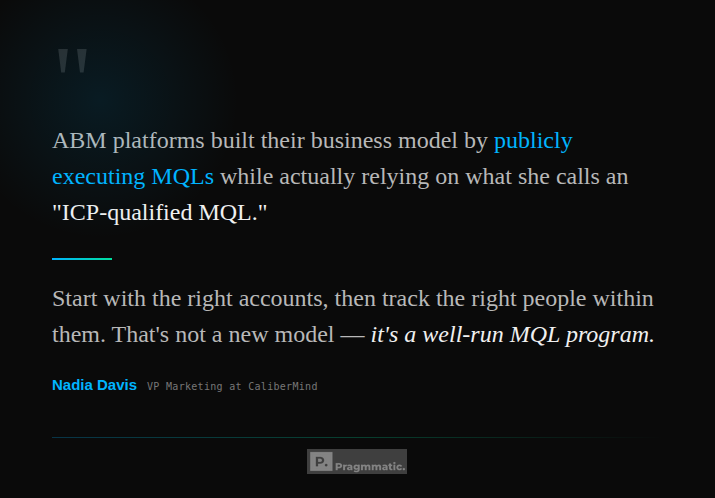
The "flipped MQL" insight. Nadia Davis, VP Marketing at CaliberMind, argues that too many organizations gave up on MQLs because they never defined them well to begin with. They blamed the metric instead of the instrumentation. Her "flipped MQL" concept starts at the account level with a target account list, reaches an MQA threshold, then drills into individual engagement. Her observation: aren't those just well-defined MQLs?
ABM platforms stand on MQL's shoulders. Davis makes perhaps the sharpest critique of the anti-MQL movement: ABM platforms built their business model by publicly executing MQLs while actually relying on what she calls an "ICP-qualified MQL." Start with the right accounts, then track the right people within them. That's not a new model; it's a well-run MQL program.
As RevenueTools puts it: every year, someone publishes a hot take declaring the MQL dead. And every year, B2B companies keep using MQLs because they have nothing better to replace them with.
Part 7: The right model depends on four variables
The "MQL vs MQA" framing is misleading because it implies a universal answer. The research is clear that four variables determine which model fits.
1. Deal size (ACV)
This is the strongest predictor. Below roughly $25K ACV, MQL makes sense. The individual contact often IS the buying decision. Above $25K, multi-stakeholder dynamics make account-level qualification more appropriate.
Example: Harlow, a freelancer project management tool at $20-30/month, has a single buyer who is simultaneously the end user, economic buyer, and champion, so MQL is the right model. Adobe Workfront, selling enterprise work management to buying committees, needs account-level qualification.
2. Buyer count
SMB purchasing decisions involve 1-2 people. SMB CEOs make 98% of tech buying decisions. Enterprise purchases now average 13 stakeholders across multiple departments.
When one person makes the decision, tracking that person as a lead works. When 13 people are involved, tracking the account is necessary.
3. Sales cycle length
SMB sales cycles run 3-90 days, fast enough that an MQL can be acted on while still relevant. Enterprise cycles of 6-18 months render individual lead scores meaningless long before they convert.
4. GTM motion
PLG companies are not moving from MQL to MQA. they're moving from MQL to PQL (Product Qualified Lead), which converts at 6x the rate of traditional MQLs. High-volume inbound and self-serve motions remain structurally MQL-compatible. ABM motions, particularly 1:few and 1:1, require MQA or buying-group approaches.
The decision framework
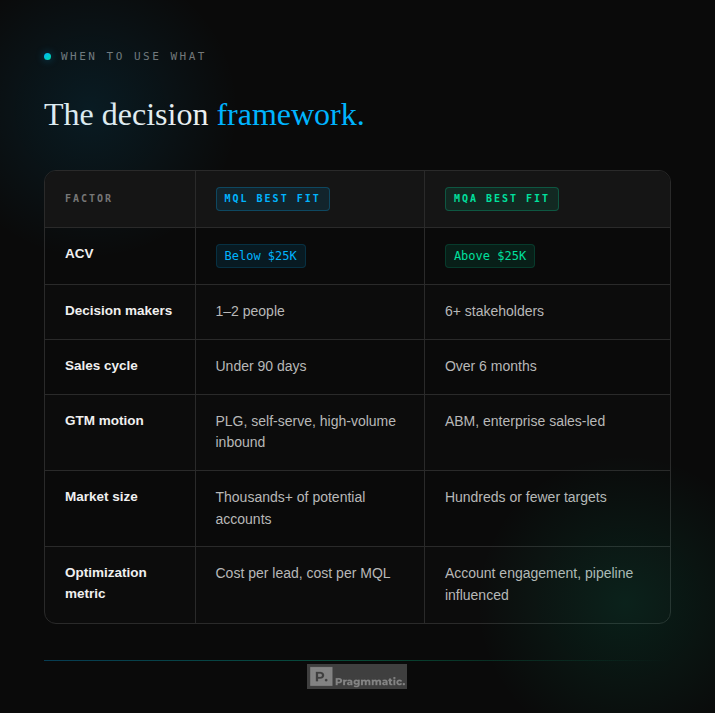
The emerging best practice for companies serving multiple segments is a dual-funnel model where MQL and MQA run as discrete, parallel paths.
Part 8: What Forrester actually recommends
Forrester's most forward-looking recommendation supersedes both MQL and MQA.
Terry Flaherty proposes replacing both with MQO (Marketing Qualified Opportunity), which ties marketing measurement to specific buying groups pursuing specific solutions within accounts.
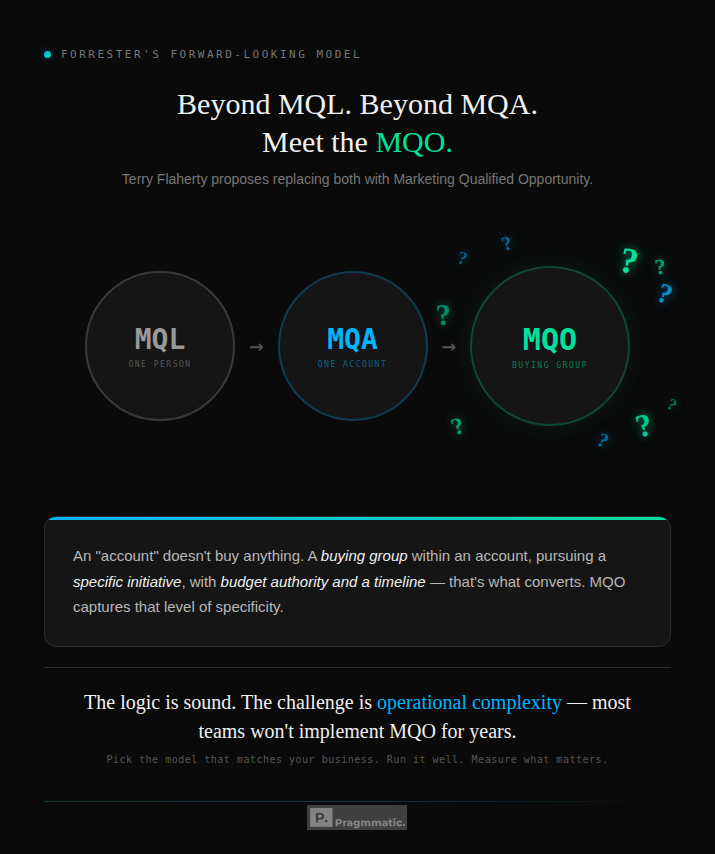
The logic is sound: an "account" doesn't buy anything. A buying group within an account, pursuing a specific initiative, with budget authority and a timeline. That's what converts. MQO captures that level of specificity.
Companies adopting this model report:
- 5-15% increases in previously hidden opportunities
- 10-20% increases in new opportunities
- Palo Alto Networks shared results at the 2024 Forrester Summit
The challenge is operational complexity. Most companies won't implement MQO for years. Which means the practical reality for most teams is: pick the model that matches your business, run it well, and measure what matters.
Conclusion: The metric isn't the strategy
The MQL vs MQA debate is ultimately a proxy war for a deeper question: does your go-to-market motion match how your buyers actually buy?
Neither metric is inherently superior. MQLs fail when applied to enterprise buying committees with 13 stakeholders. MQAs fail when applied to SMB self-serve purchases by individual decision-makers. Both fail when treated as the strategy itself rather than a measurement of strategy execution.
Three things the market hasn't fully internalized:
The "MQL is dead" narrative has been substantially amplified by vendors whose revenue depends on selling the replacement. 6sense, Demandbase, and Terminus all have commercial incentives to drive MQA adoption. Their thought leadership should be weighted accordingly.
The absence of MQA conversion benchmarks is a glaring gap. Until MQA can demonstrate measurably better conversion to closed-won revenue, the claim of superiority remains unproven.
**Forrester's buying-group/opportunity model (MQO) is the most rigorous framework**, but operationally complex enough that most companies will run hybrid MQL+MQA models for years.
The right answer isn't which metric is "better." It's which metric matches how your buyers actually buy, and whether your systems are optimized to make that metric work.
About this report
This report was researched and written by me, Zeb Couch, with help from Claude.
If you're a CMO or demand gen leader navigating the MQL vs MQA question and want to talk about how it connects to your paid media strategy, let’s chat!
Sources include: Forrester Revenue Process Alignment Series (Parts 1-4), 6sense Anti-MQL Manifesto, 6sense 2025 State of B2B Marketing Metrics, Demandbase MQA vs MQL blog, HockeyStack analysis of $100M+ B2B ad spend, Gartner CMO Spend Survey, MarketingProfs (Jon Miller predictions), Demand Loops Substack (Kaylee Edmondson), MarketingOps.com, RevenueTools, The B2B Stack, CaliberMind, LeanData buying group statistics, Corporate Visions B2B buying behavior data, and 50+ additional practitioner sources