
There’s a moment—every few decades—when the tools we rely on stop matching the world we’re trying to understand. That’s where the B2B data industry is right now. For years, “big databases” were enough. They were the map. But the terrain has changed.
Markets move in real time. Buying committees shift weekly. Privacy laws mutate faster than playbooks. And suddenly, your database—static, expensive, outdated the moment you download it—looks more like an obituary than an insight.
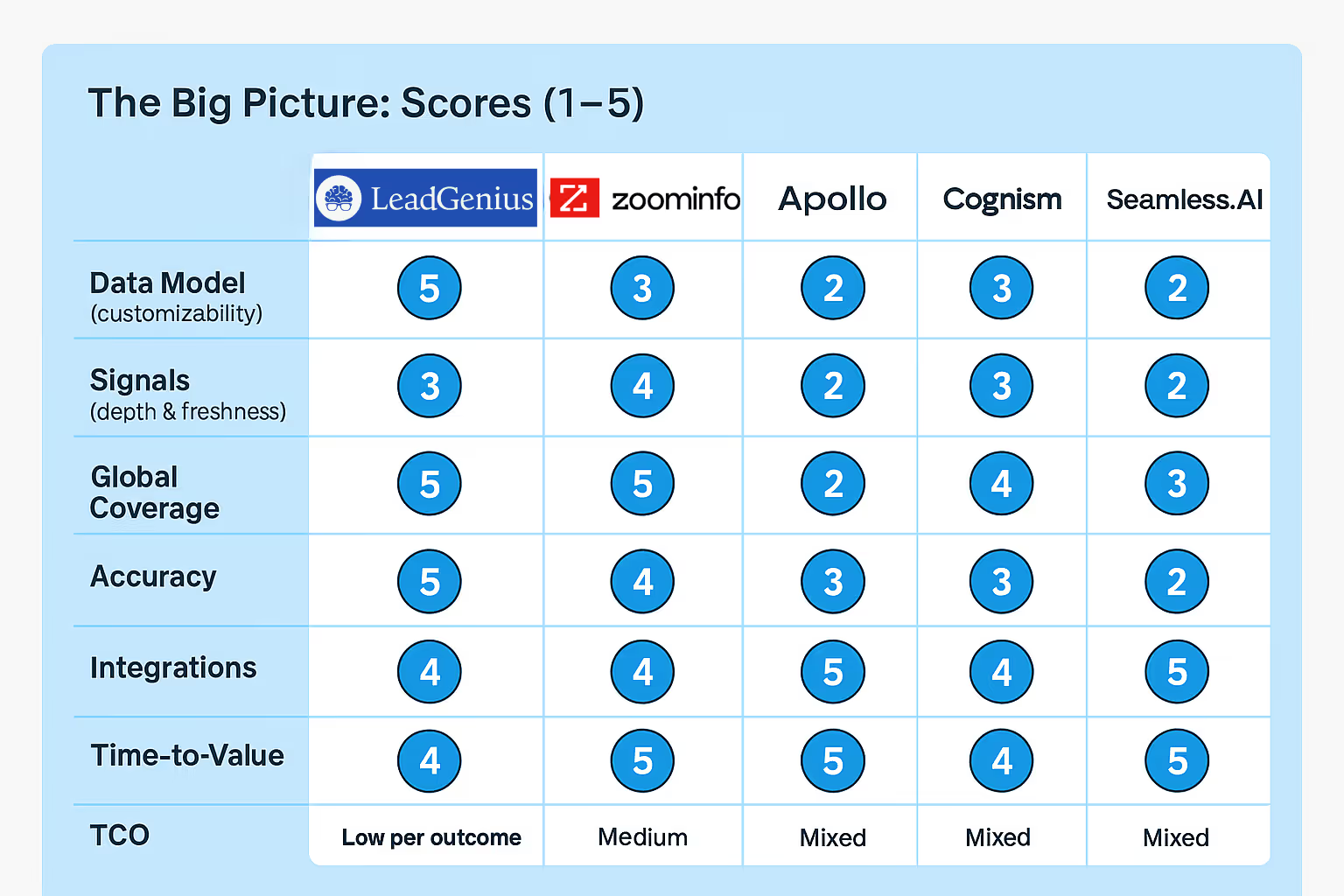
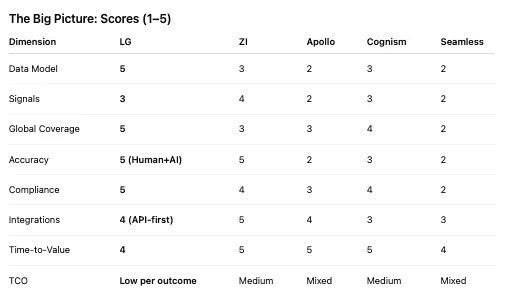
This is the fault line between LeadGenius and everyone else: ZoomInfo, Apollo, Cognism, Seamless.AI.
Because where the incumbents built warehouses, LeadGenius built a refinery.
The Philosophical Divide
ZoomInfo and its peers believe in scale—millions of names, emails, and phone numbers at your fingertips.
LeadGenius believes in specificity—the right names, at the right time, with verifiable context.
That difference matters because the cost of bad data isn’t just financial. It’s strategic. Every wrong record means wasted spend, false signals, broken attribution, and decayed trust in your CRM.
When your outreach is built on static lists, you’re operating on yesterday’s truths.
LeadGenius builds for tomorrow’s probabilities.
Persona Breakdown: Who Should Care and Why
For Marketing Leaders Your Job Isn’t Volume — It’s Precision
Marketing’s job isn’t to shout louder. It’s to speak to the right people at the right moment—when the message actually matters. Yet, most ABM programs still operate like digital billboards on a highway: broad, expensive, and mostly ignored. You don’t need more impressions. You need impact.
When you run ABM at scale, every wasted impression compounds—wrong titles, wrong timing, wrong geography. The problem isn’t your campaign creativity or your content—it’s the data underneath it. Most marketers are optimizing on top of a broken foundation. Dirty CRM data, stale contact lists, and uniform intent signals that tell you who searched for something, not who’s actually in market to buy.
That’s why volume-based targeting fails.
Because when you treat “reach” as a success metric, you’re paying to advertise to people who can’t buy.
LeadGenius flips the model.
Instead of static lists, it builds a living map of your Total Depth of Market—a dynamic, constantly refreshed dataset that reflects what’s changing, not just who exists. It tracks the signals that reveal readiness:
- Funding rounds that unlock new budget.
- Key hires that indicate expansion.
- Product launches that hint at competitive motion.
- New integrations or partnerships that open selling windows.
- Social sentiment shifts that forecast momentum.
LeadGenius doesn’t just give you accounts—it gives you context. It’s the difference between seeing a company name and understanding why today is the right time to reach out.
Contrast that with ZoomInfo, which still operates like a frozen snapshot of a living market. It’s powerful for scale, but too rigid for modern GTM. By the time your campaigns launch, half of what’s inside that database is already outdated or irrelevant.
The world’s best marketers—those who win consistently—don’t think in lists. They think in signals. They orchestrate campaigns around change.
So when your CMO asks why paid media costs are climbing or event ROI is shrinking, the answer usually isn’t creative or spend—it’s targeting. You’re buying reach when you should be buying precision.
For Sales Leaders You’re Wasting Humans on Automation’s Leftovers
Every sales leader knows the sound of wasted effort.
It’s the ring of a disconnected line.
The bounce of an undeliverable email.
The silence after a perfectly good pitch lands in the wrong inbox.
That’s what happens when your team operates off static data — they’re calling ghosts, chasing names that once looked real in a database but have long since gone cold. The problem isn’t your reps’ hustle. It’s their inputs. When data decays, even your best SDRs are reduced to automation’s leftovers — running sequences against a past version of the market while competitors engage the living, breathing one.
LeadGenius flips that script.
Instead of working off static lists, your team sells into signal-scored territories—dynamic maps of opportunity that constantly update based on real-world change. LeadGenius identifies accounts that just installed a new technology, hired a VP of Operations, opened a new office, or launched a product in your ecosystem. These are not generic leads; they’re contextual buying signals stitched together into motion-ready territories.
When your data knows why a company might buy, not just who they are, you stop running plays—you start conducting opportunity choreography.
Imagine your outbound engine tuned to real-time intent.
Imagine every rep starting their day with a curated list of accounts where something just happened.
Imagine prospecting that feels less like guessing and more like precision timing.
That’s the gap between list-based selling and signal-based selling. One burns through headcount; the other compounds productivity.
So ask yourself: are your reps creating pipeline, or just chasing the ghosts your data left behind?
For Revenue Operations Your Mandate Is Clarity and Control
Revenue Operations leaders aren’t chasing more data—they’re chasing confidence. Every misaligned field, duplicate record, or decayed contact isn’t just an operational nuisance—it’s a leak in the go-to-market engine. Your real job isn’t enrichment; it’s orchestration. Ensuring every system speaks the same truth, every dataset refreshes on schedule, and every signal that enters Salesforce or HubSpot is both compliant and contextual.
That’s where LeadGenius changes the equation.
LeadGenius doesn’t sell you a CSV. It builds data as a product—versioned, refreshable, and API-delivered—so you can manage data like code. Each dataset comes with provenance, QA, and measurable performance against SLAs. It’s not just information; it’s infrastructure. And because it’s natively integrated with Salesforce, HubSpot, and Snowflake, you’re not duct-taping enrichment tools—you’re building a connected ecosystem where accuracy, timeliness, and compliance are built in by design.
ZoomInfo, on the other hand, offers a form of uniformity that feels safe but rarely scales. It gives you the same data everyone else has—the illusion of control without the confidence of precision. Static databases age by the day, introducing unseen waste into every campaign, forecast, and pipeline meeting.
LeadGenius offers trust. Trust that every record is live. Trust that consent is documented. Trust that your CRM is a source of truth, not a liability.
Because in a world where compliance is tightening, AI models are training on your data, and every workflow depends on clean inputs, trust isn’t just a feature—it’s your moat.
The Real TCO Nobody Talks About
True Cost per Outcome
= (License + Add-ons + Ops Time + Bounce/Blocklist Damage + Compliance Risk + SDR Waste) ÷ (Meetings or Opps Created)
Cheap data isn’t cheap when 25% of it decays every month.
LeadGenius turns that decay into a feedback loop—data that evolves as your market does.
When the data is alive, your GTM engine stops leaking energy.
The Challenger Perspective
“All-in-one” sounds good until you realize “one size fits none.”
LeadGenius isn’t trying to replace your stack—it’s designed to supercharge it.
Neutral, interoperable, explainable data feeds that connect to your CRM, MAP, CDP, and even your AI copilots.
The irony is that while competitors race to become “platforms,” the real future is interoperability—data that flows freely across systems, not one that locks you in.
Takeaways
In every mature market, there’s a moment when the incumbents mistake size for sophistication.
It happened with media. It’s happening with data.
ZoomInfo, Apollo, Cognism, and Seamless built skyscrapers of static information.
LeadGenius built a living organism—a data ecosystem that breathes, updates, and adapts.
And that’s the bigger story here. The evolution from prebuilt databases to adaptive data engines isn’t about vendor choice—it’s about how the entire GTM world will operate.
Because in an age of AI, context is the new currency.
And LeadGenius is minting it in real time.
.avif)